01Facts
The Petitioner imported high-grade tin ingots manufactured in Malaysia by Malaysia Smelting Corporation (“MSC”) and claimed nil Basic Customs Duty under Notification No. 46/2011-Cus. dated 1 June 2011, relying on Certificates of Origin issued by Malaysia’s designated authority, the Ministry of International Trade and Industry (“MITI”).
¶ 1, 3, 9 · pp. 1–4The preferential claim was governed by the Customs Tariff (Determination of Origin of Goods under the Preferential Trade Agreement between the Governments of Member States of ASEAN and the Republic of India) Rules, 2009, which required, inter alia, a minimum Regional Value Content (“RVC”) of 35%.
¶ 5–8 · pp. 2–4The Directorate of Revenue Intelligence initiated an investigation and sought retroactive verification of the Certificates of Origin under Article 16 of Annexure III to the 2009 Rules.
¶ 10 · p. 4Upon receiving no response from the Malaysian authorities, Indian officials conducted a verification visit under Article 17.
¶ 11 · pp. 4–5The investigation found that MSC had repeatedly relied on a cost sheet prepared for July–September 2013 and had manufactured the tin ingots on a job-work basis using tin ore supplied free of cost by traders from non-ASEAN countries.
¶ 12 · p. 5The authorities treated the job charges as the relevant Malaysian value addition and concluded that the prescribed 35% RVC requirement was not satisfied.
¶ 13–16 · pp. 5–6Show-cause notices dated 7 December 2018 and 11 December 2018 were issued, demanding differential customs duty and proposing confiscation and penalties.
¶ 18 · p. 7During the pendency of the writ petition, adjudication orders dated 27 September 2019 and 5 July 2019 were passed.
¶ 19 · p. 7The orders confirmed differential duty of ₹39,69,936 and ₹99,84,190 respectively, with interest; the latter order also ordered confiscation and imposed a penalty under Section 114AA of the Customs Act, 1962.
¶ 20 · pp. 7–8The Petitioner challenged the proceedings principally on jurisdictional grounds and acknowledged the availability of a statutory appeal under Section 128.
¶ 27 · p. 1002Issues
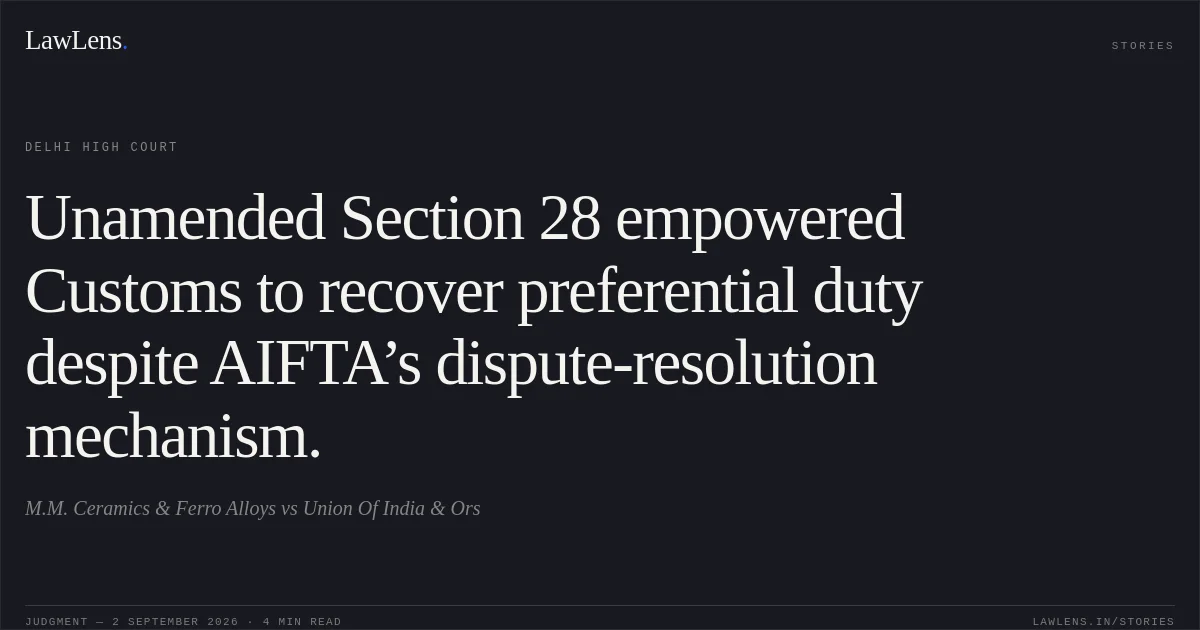
i.Whether Article 24 of the ASEAN–India Free Trade Area (“AIFTA”) required the Union of India to invoke the treaty’s consultation or dispute-resolution mechanism before initiating proceedings under Section 28 of the Customs Act, 1962 against the importer.
¶ 27, 31–34 · pp. 10–13ii.Whether, before the insertion of Chapter V-AA and Section 28DA of the Customs Act, 1962 by the Finance Act, 2020, the Customs authorities lacked statutory power to investigate and recover duty arising from allegedly incorrect or suppressed preferential-origin claims.
¶ 27–28, 35–46 · pp. 10–20iii.Whether the writ petition should be entertained to examine the factual, valuation, quantification, confiscation, and penalty issues despite the availability of an efficacious statutory appeal under Section 128.
¶ 48–51 · pp. 20–2203Law Applied
The Court applied Section 5(1) of the Customs Tariff Act, 1975 and the 2009 Rules of Origin, under which preferential tariff treatment depends upon compliance with prescribed origin criteria, including the minimum 35% RVC requirement.
¶ 5–8 · pp. 2–4Articles 16 and 17 of Annexure III to the 2009 Rules provide mechanisms for retroactive verification and verification visits concerning Certificates of Origin.
¶ 8 · p. 4The Court held that Article 24 of AIFTA, not having been incorporated into Indian municipal law, could not displace or restrict jurisdiction otherwise conferred by domestic legislation.
¶ 31–34 · pp. 12–13Section 28 of the Customs Act, 1962 empowers recovery of duty not levied or short-paid, including by invoking the extended limitation period where the non-payment resulted from collusion, wilful misstatement, or suppression of facts; Section 46(4) requires an importer to declare the truth of the contents of the Bill of Entry and supporting documents.
¶ 35–36, 41–46 · pp. 14–20The subsequent insertion of Chapter V-AA and Section 28DA was treated as an additional procedural mechanism and not as the source of a previously nonexistent power.
¶ 37–40 · pp. 15–16The Court followed Trafigura India Pvt. Ltd. v. Union of India, (2023) 13 Centax 9 (Guj.), and Purple Products Pvt. Ltd. v. Union of India, while recognising the statutory appellate remedy under Section 128.
¶ 21–26, 29–30, 47–48 · pp. 8–12, 20–21Provisions in the judgment · 7 · Linked ones open on LawLens
Customs Tariff Act, 1975 Section 5
Customs Act,1962 Section 28Section 46Section 111Section 112Section 128
Central Excise Act, 1944 Section 11
04Reasoning
The Court found the present dispute materially indistinguishable from Trafigura India and Purple Products, which concerned tin ingots manufactured by MSC, Certificates of Origin issued by MITI, and similar RVC verification proceedings.
¶ 29–30, 47 · pp. 11–12, 21Since Article 24 of AIFTA had not been transformed into enforceable Indian law, it could not oust the Customs authorities’ jurisdiction under Section 28; the absence of prior treaty consultations therefore did not invalidate the proceedings.
¶ 31–34 · pp. 12–13The Court further held that the pre-2020 statutory framework already authorised recovery of short-paid duty based on inaccurate or suppressed declarations: Section 46(4) imposed a duty of truthful disclosure, while Section 28 supplied the recovery mechanism.
¶ 35–36, 43–45 · pp. 14, 19–20The later enactment of Section 28DA merely introduced a more specific verification framework and did not retrospectively imply that the earlier power was absent.
¶ 37–40, 46 · pp. 15–16, 20However, the Court declined to examine the correctness of the RVC computation, duty quantification, confiscation, or penalties because those factual and valuation issues could be fully addressed in the statutory appeal.
¶ 48 · p. 2105Holding
The Delhi High Court rejected both jurisdictional objections.
It held that Article 24 of AIFTA did not bar proceedings under Section 28 of the Customs Act, 1962, and that the Customs authorities possessed sufficient pre-2020 statutory power to investigate and recover duty arising from allegedly incorrect or suppressed preferential-origin declarations.
¶ 34, 46, 49 · pp. 13, 20–21The writ petition and pending application were dismissed, with liberty to the Petitioner to file appeals against the Orders-in-Original dated 5 July 2019 and 27 September 2019 under Section 128.
¶ 50 · p. 22If filed within four weeks, the appeals were directed not to be rejected on limitation, subject to maintainability, and were to be decided on merits in accordance with law.
¶ 50 · p. 22The Court expressly left open all issues concerning duty quantification, confiscation, and penalties for consideration by the Appellate Authority.
¶ 51 · p. 22Original Court PDF
M.M. Ceramics & Ferro AlloysvsUnion Of India & Ors
Click to open original judgment
Original judgment, available to read, download and summarize on LawLens.in