Facts
The Petitioner, a conductor appointed by the Delhi Transport Corporation (DTC) in 1982, was removed from service on 13.12.1991 following a departmental inquiry.
Source reference: p. 3The charges related to his unauthorized absence for 119 days during the year 1989.
Source reference: p. 2The Respondent filed an application under Section 33(2)(b) of the Industrial Disputes (ID) Act, which was allowed by the Industrial Tribunal on 25.02.2005.
Source reference: p. 3Subsequently, a Labour Court award dated 25.07.2007 upheld the dismissal, finding the misconduct serious and the punishment proportionate.
Source reference: p. 3The Petitioner challenged both orders, claiming his absence was due to acute knee pain and that he had submitted medical certificates.
Source reference: p. 4Issues
1. Whether the findings of the Industrial Tribunal and Labour Court regarding the Petitioner’s unauthorized absence were perverse or lacked evidence.
Source reference: p. 62. Whether the departmental inquiry was conducted in violation of the principles of natural justice.
Source reference: p. 73. Whether the punishment of removal from service was shockingly disproportionate to the gravity of the misconduct.
Source reference: p. 7Law Applied
The Court applied the principles of judicial review under Article 226, specifically the limited scope of the writ of certiorari, as established in Central Council for Research in Ayurvedic Sciences v. Bikartan Das, which restricts a High Court from acting as an Appellate Court or reweighing evidence.
Source reference: p. 5Regarding industrial law, the Court applied Section 33(2)(b) and Section 10 of the Industrial Disputes Act, 1947, emphasizing that an employee cannot presume leave is granted merely by submitting an application and that unauthorized absence for prolonged periods constitutes misconduct.
Source reference: p. 6The Court also applied the "Doctrine of Proportionality" to assess if the penalty was shockingly disproportionate to the offense.
Source reference: p. 7Reasoning
The Court observed that the Petitioner admitted to being absent for 119 days and failed to produce witnesses (such as his colleague) to prove the timely submission of leave applications.
Source reference: p. 6It was determined that merely submitting an application does not entitle an employee to leave unless sanctioned by the employer.
Source reference: p. 6The Court rejected the Petitioner's claim of procedural unfairness in the inquiry, noting that he had signed the inquiry proceedings and received the chargesheet.
Source reference: p. 7While the misconduct was proved, the Court found the penalty of removal "harsh" because the absence was sporadic rather than continuous, the Petitioner had served for a decade, and he had previously been penalized for similar conduct, which suggested a lesser penalty might suffice.
Source reference: p. 7Due to the significant lapse of time (over 30 years), reinstatement was deemed impractical.
Source reference: p. 8Holding
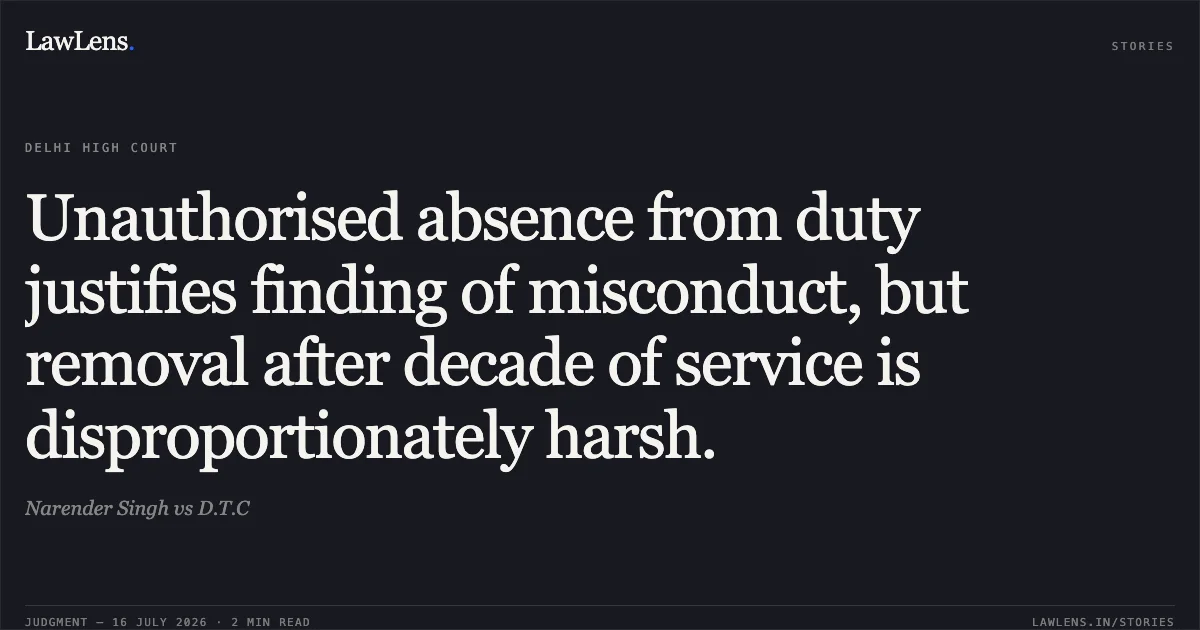
The Court held that while the finding of misconduct was correct, the penalty of removal from service was shockingly disproportionate.
The Court modified the relief, refusing reinstatement but awarding a one-time lump sum compensation of ₹4,00,000/- to be paid by the Respondent within three weeks; the writ petitions were disposed of with these directions.
Source reference: p. 8Acts & Sections Cited
2 provisions across 1 statute referred to in this judgment. Linked provisions open on LawLens.
Industrial Disputes Act, 19472
Original Court PDF
Narender SinghvsD.T.C
Click to open original judgment
Original judgment, available to read, download and summarize on LawLens.in