Facts
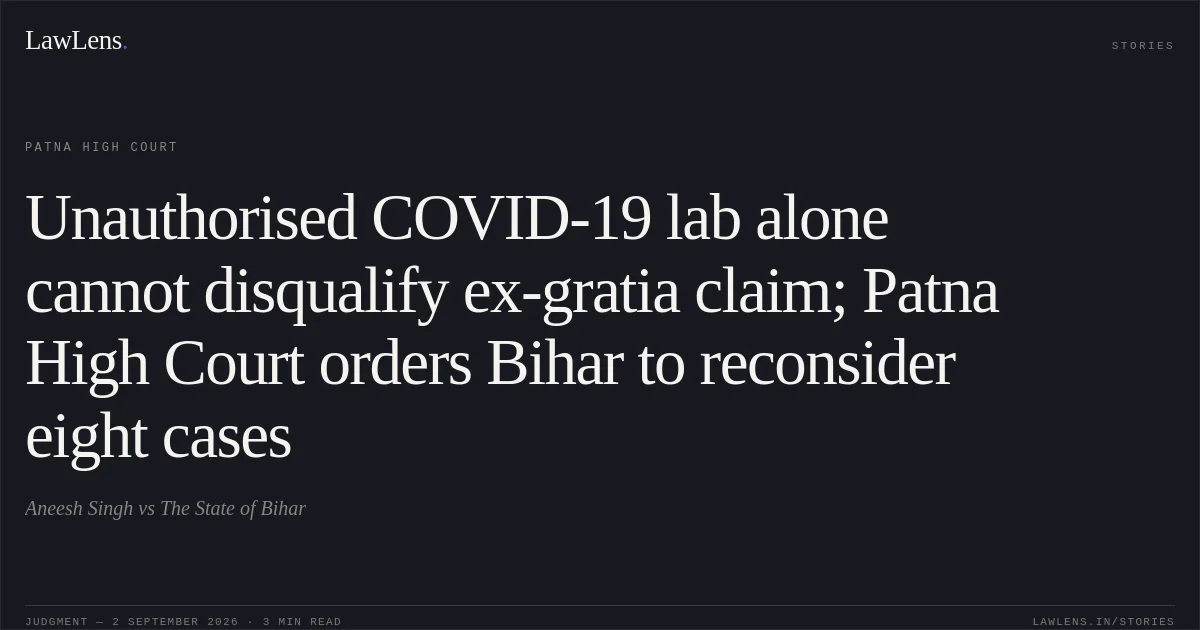
The eight petitioners claimed ex-gratia compensation of ₹4,00,000 each under the Bihar Covid Sahayata Yojana, 2022, alleging that their respective family members contracted Covid-19 during the second wave and died between 20 April and 20 May 2021 in the Mokama and Maranchi areas of Patna District.
Source reference: para. 2; p. 2The deaths were reflected in the State Health Society’s list of Covid-19 deaths, and the petitioners submitted death certificates, medical prescriptions, bank statements and other supporting documents along with representations for compensation.
Source reference: para. 3; p. 2Their claims were rejected by the District Committee on 3 February 2023 and subsequently by the State-level Committee on 18 July 2024, solely because the Covid-19 tests had been conducted at a laboratory in Mokama which was allegedly not authorised by the State Government for RT-PCR/RAT/TruNat testing.
Source reference: paras. 6, 13; pp. 3, 7–8The petitioners relied on the decision in Sushila Devi & Manoj Kumar v. State of Bihar, C.W.J.C. No. 13671 of 2023, where similarly rejected claims were directed to be reconsidered.
Source reference: paras. 5, 11; pp. 3, 6–7Issues
Whether a claim for Covid-19 ex-gratia compensation may be rejected solely because the Covid-19 test was conducted at a laboratory that was not formally authorised by the State Government.
Source reference: paras. 8–12; pp. 4–7Whether the petitioners, whose claims were supported by Covid-19 death records and had been rejected on the same ground as in Sushila Devi, were entitled to parity and reconsideration of their claims.
Source reference: paras. 13–16; pp. 7–9Law Applied
The Court applied the eligibility criteria for Covid-19 deaths recognised by the Supreme Court in Gaurav Kumar Bansal v. Union of India & Anr., M.A. No. 1120 of 2021 in W.P. (C) No. 539 of 2021, read with the guidelines dated 3 September 2021 and 11 September 2021 issued by the Ministry of Health and Family Welfare/ICMR and the National Disaster Management Authority.
Source reference: para. 9; pp. 5–6A death qualifies for Covid-19 ex-gratia assistance where, inter alia, the deceased tested positive through RT-PCR, a molecular test or RAT, was clinically determined to be a Covid-19 case, died within thirty days of diagnosis, remained admitted beyond thirty days as a Covid-19 case, had an MCCD recording Covid-19 as the cause of death, or died by suicide within thirty days of diagnosis.
Source reference: para. 9; pp. 5–6The Court held, following Sushila Devi & Manoj Kumar v. State of Bihar, C.W.J.C. No. 13671 of 2023, that the authorisation or accreditation status of the testing laboratory is not, by itself, a prescribed disqualifying condition where the positive diagnosis and other eligibility requirements are otherwise established.
Source reference: paras. 10–12; pp. 6–7The Court also invoked the welfare-objective of the Disaster Management Act, 2005, and the State’s obligations concerning public welfare and dignity under Article 21 of the Constitution.
Source reference: para. 15; p. 8Reasoning
The Court found that the petitioners’ claims were supported by death certificates, medical records and the State Health Committee’s own serial list of Covid-19 deaths, in which the deceased were recorded at Serial Nos. 11, 14, 15, 18, 19, 23, 24 and 37.
Source reference: para. 13; p. 8Since the claims had been rejected exclusively because the tests were performed at an unauthorised laboratory, and the Supreme Court’s eligibility criteria did not make laboratory authorisation a standalone requirement, the rejection introduced a condition not contained in the governing framework.
Source reference: paras. 9–12; pp. 5–7The Court further held that the petitioners were materially similarly situated to those in Sushila Devi, particularly because the tests had been conducted at the same Mokama laboratory and the rejection was based on the identical ground.
Source reference: paras. 11, 14–15; pp. 6–8Denial of similar reconsideration without any distinguishing circumstance would be inconsistent with equality and the beneficial purpose of the compensation scheme.
Source reference: paras. 11, 14–15; pp. 6–8Holding
The Court held that non-authorisation of the testing laboratory, by itself, could not justify rejection of the petitioners’ Covid-19 compensation claims, provided the positive diagnosis or clinical determination and the other prescribed eligibility conditions were established.
The competent authority was directed to reconsider all eight claims within four weeks from receipt or production of a certified copy of the judgment.
Source reference: para. 16; p. 9If the petitioners were found eligible, the compensation under the Bihar Covid-19 Sahayata Yojana, 2022, together with consequential ex-gratia benefits, was to be released within a further period of four weeks.
Source reference: para. 16; p. 9The writ petition was accordingly disposed of, and pending interlocutory applications, if any, were also disposed of.
Source reference: paras. 17–18; p. 9Acts & Sections Cited
2 provisions across 2 statutes referred to in this judgment. Each provision opens on LawLens.
Disaster Management Act, 20051
Registration of Births and Deaths Act, 19691
Original Court PDF
Aneesh SinghvsThe State of Bihar
Click to open original judgment
Original judgment, available to read, download and summarize on LawLens.in