Facts
The petitioner, a Medical Officer appointed on 1 July 1981, was transferred from Jawaharlal Nehru Medical College, Bhagalpur, and joined the Health Department Secretariat on 17 January 1996 while awaiting posting.
Source reference: pp. 2–5She was directed to work at IGIMS, Patna, from 17 April 1996, but alleged that she was not permitted to discharge duties there.
Source reference: pp. 2–5She was thereafter transferred to Referral Hospital, Mahgama, Godda, on 14 December 1996.
Source reference: pp. 2–5Before the transfer order, she proceeded on leave owing to her husband’s illness and continued sending leave applications to the department.
Source reference: pp. 2–5She attempted to join at Godda on 20 February 1999 but was not accepted and subsequently remained without a regular posting; from 4 May 2000, the department itself kept her waiting for posting.
Source reference: pp. 2–5, 19–21A departmental proceeding was initiated in 2004 under Rule 55 of the Bihar Civil Service (Classification, Control and Appeal) Rules for disobedience of departmental directions and unauthorised absence.
Source reference: pp. 16–18The Enquiry Officer submitted his report on 10 December 2006, finding two charges proved and one partially proved.
Source reference: pp. 16–18The enquiry report was eventually supplied to the petitioner, who submitted her reply to the second show-cause notice.
Source reference: pp. 16–18After obtaining the Bihar Public Service Commission’s opinion, the disciplinary authority dismissed her from service by Memo No. 801(9) dated 2 September 2015, during the pendency of the writ petition.
Source reference: pp. 16–18, 21The petitioner challenged the departmental proceeding and dismissal and sought salary arrears and consequential benefits.
Source reference: no citationIssues
Whether the departmental proceeding and the order of dismissal were liable to be quashed on account of the prolonged delay between the alleged misconduct, initiation of proceedings, and final punishment.
Source reference: pp. 7–10, 19–21Whether the petitioner’s absence from duty was unauthorised and wilful, particularly when she had cited her husband’s illness, regularly informed the department, attempted to join, and was thereafter kept waiting for posting by the department.
Source reference: pp. 19–22Whether dismissal from service was disproportionate to the misconduct alleged, in the absence of corruption, moral turpitude, misappropriation, financial loss, or a prior adverse service record.
Source reference: pp. 22–28Whether, considering the petitioner’s superannuation and the prolonged pendency of the matter, the proceeding should be remitted for fresh consideration or the petitioner should be granted consequential and post-retirement benefits.
Source reference: pp. 27–30Law Applied
The proceeding was governed by Rule 55 of the Bihar Civil Service (Classification, Control and Appeal) Rules, which prescribes the procedure for major departmental proceedings.
Source reference: pp. 11–16The Court relied on Krushna Kant B. Parmar v. Union of India, 2012 (3) SCC 178, for the principle that unauthorised absence does not by itself establish misconduct; the absence must be shown to be wilful, and absence caused by compelling circumstances such as illness cannot automatically constitute failure of devotion to duty.
Source reference: pp. 11–16It also relied on M.V. Bijlani v. Union of India, (2006) 5 SCC 88, for the rule that disciplinary findings must be based on relevant evidence and a conclusion supported by preponderance of probabilities.
Source reference: pp. 13–15Applying Surekha Domaji Bele v. Executive Engineer, Testing Division, MSEDCL, 2026 SCC OnLine SC 1109, the Court held that dismissal, being the severest penalty, must be reserved for grave misconduct and must be proportionate to the employee’s service record, surrounding circumstances, and the actual impact of the misconduct.
Source reference: pp. 22–27Under Allahabad Bank v. Krishna Narayan Tewary, (2017) 2 SCC 308, remand for a fresh enquiry is not mandatory where, due to long delay and supervening circumstances, remand would be unfair or unnecessary.
Source reference: pp. 28–29The Court also relied on Dinesh Chandra Sharma v. Bhartiya Paryatan Vikas Nigam Ltd., SLP (C) No. 8180 of 2020, for granting 50% back wages where the employee had not worked and gainful employment was neither established nor disproved.
Source reference: p. 29Reasoning
The Court found that the petitioner’s absence was substantially explained by her husband’s serious illness, that she had continued communicating with the department, and that she had attempted to join at Godda.
Source reference: pp. 19–22The department’s grant of permission to visit a foreign country further indicated that her whereabouts were known; moreover, from 4 May 2000 she was admittedly kept waiting for posting by the department.
Source reference: pp. 19–22In these circumstances, the absence could not be characterised as wilful or wholly unauthorised under Krushna Kant B. Parmar.
Source reference: pp. 19–22The Court also considered the extraordinary delay: the alleged absence related to the 1990s, the proceeding was initiated in 2004, the enquiry report was submitted in 2006, and dismissal was imposed only in 2015.
Source reference: pp. 7–10, 19–21Even assuming some misconduct was established, the dismissal was disproportionate because the case involved no corruption, moral turpitude, misappropriation, proved financial loss, public scandal, or prior adverse service record, while the petitioner had rendered long service without any previous punishment.
Source reference: pp. 22–28Since she had already superannuated and the matter had remained pending for many years, remanding the case for a fresh proceeding would be unfair and unnecessary.
Source reference: pp. 27–29Holding
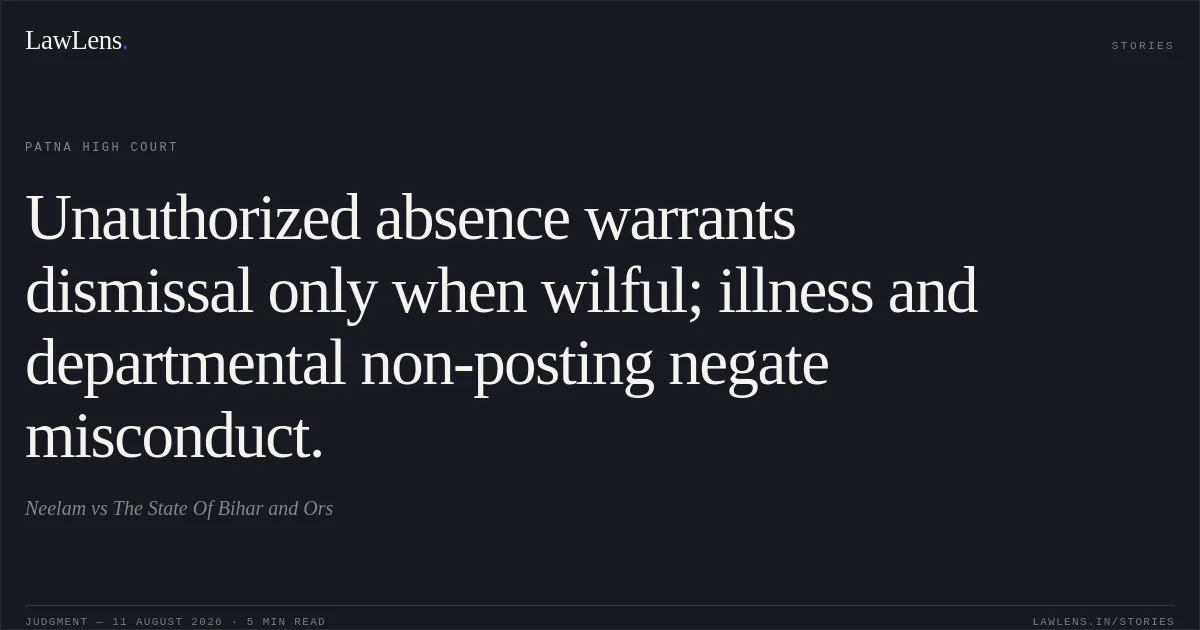
The Court set aside the dismissal order dated 2 September 2015, holding that the petitioner’s absence could not be treated as wilful unauthorised absence and that dismissal was disproportionate.
It declined to remit the matter for a fresh departmental proceeding in view of the petitioner’s superannuation and the prolonged pendency of the dispute.
Source reference: pp. 27–29The respondents were directed to treat the petitioner as having remained in service for all purposes and to grant her the post-retirement benefits to which she would have been entitled before the dismissal order.
Source reference: pp. 29–30As she had not worked during the relevant period and no gainful employment was established, she was awarded 50% of the salary for the period from 25 April 1996 until superannuation, subject to completion of the exercise within four months of production or receipt of the judgment.
Source reference: pp. 29–30The writ petition was accordingly allowed and pending applications were disposed of.
Source reference: p. 30Original Court PDF
NeelamvsThe State Of Bihar and Ors
Click to open original judgment
Original judgment, available to read, download and summarize on LawLens.in