Facts
Respondent No. 5 complained to the Guwahati Municipal Corporation (GMC) that unauthorized construction had been undertaken on a plot at Sahar Ulubari Part-I without an NOC or building permit.
Source reference: p.2The petitioner stated that his family had occupied two old Assam-type houses on part of the plot since 1980 and had paid property taxes since their assessment in 1996.
Source reference: pp.3–4Following notice, a reply and site inspection, the GMC Commissioner made an order under Section 337(3) of the GMC Act, 1971, on 18 March 2026, finding the constructions unauthorized and directing removal of the setback deviation and demolition.
Source reference: p.3The Mayor-in-Council dismissed the petitioner’s appeal, while granting liberty to the GMC to conclude the proceeding in accordance with law.
Source reference: p.3During the writ proceedings, the petitioner obtained a planning permit and GMC NOC for a proposed RCC G+1 residential building on the plot.
Source reference: p.4Issues
Whether the Court should interfere with the GMC’s order directing demolition of the houses as unauthorized constructions, and the appellate order upholding the proceeding.
Source reference: pp.4–5Whether the petitioner should be allowed time to demolish the houses before the GMC carries out the demolition.
Source reference: pp.5–6Law Applied
Section 337(3) of the GMC Act, 1971, was the basis of the Commissioner’s order concerning the unauthorized constructions; Section 438 of the Act provided for the petitioner’s appeal.
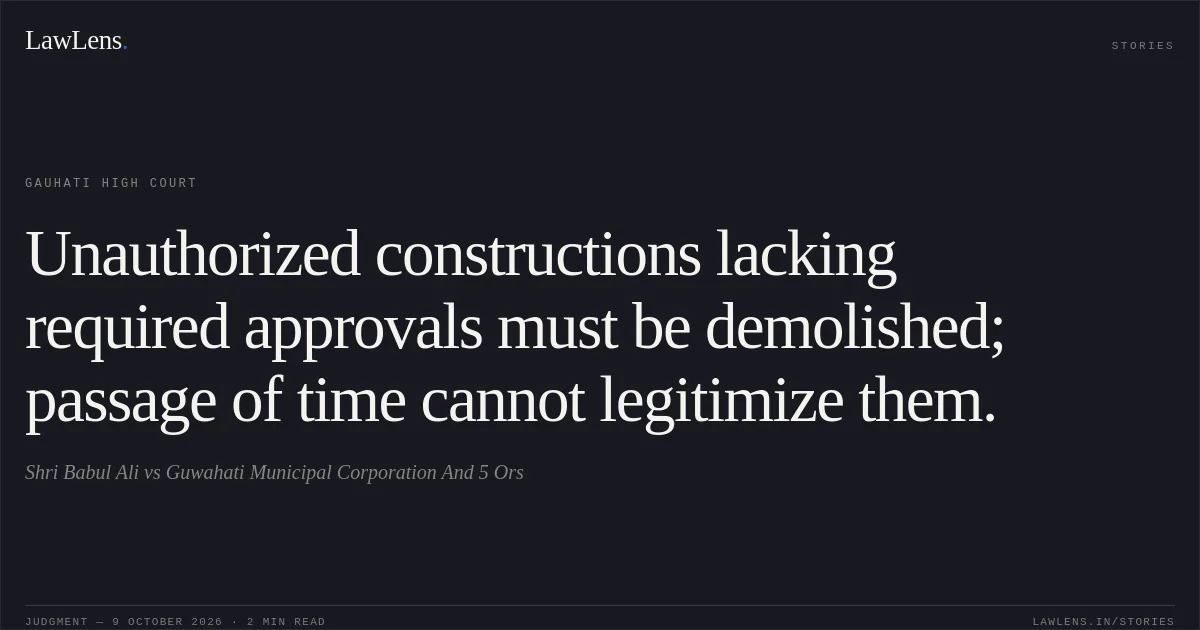
Source reference: pp.3, 5The Court relied on Rajendra Kumar Barjatya v. U.P. Avas Evam Vikas Parishad, 2024 INSC 990, for the principle that illegal construction cannot be legitimized or protected by passage of time, official inaction, or expenditure on the construction, and must be demolished.
Source reference: p.5It also relied on Kaniz Ahmed v. Sabuddin, 2025 INSC 610, which calls for a strict judicial approach to illegal construction and cautions against judicial regularization of buildings erected without requisite permissions.
Source reference: p.5Reasoning
The Court treated the unauthorized status of the houses as admitted: they had been constructed without an NOC, and the petitioner had not shown that the later planning permit and NOC for a proposed RCC building authorized the existing houses.
Source reference: pp.4–5Applying the cited Supreme Court principles, it held that the existing unauthorized constructions could not be protected and found no basis to interfere with either the Commissioner’s demolition order or the appellate order.
Source reference: p.5However, because the petitioner’s family was living in the houses, the Court allowed a three-month period for the petitioner to demolish them before the GMC acted.
Source reference: pp.5–6Holding
The writ petition was dismissed as devoid of merit, and the orders dated 18 March 2026 and 15 June 2026 were not disturbed.
The petitioner was granted three months from the judgment to demolish the unauthorized constructions. If demolition was not completed within that period, the GMC was directed to demolish them and recover the expenditure from the petitioner as arrears of municipal taxes.
Source reference: pp.5–6Acts & Sections Cited
4 provisions across 3 statutes referred to in this judgment. Linked provisions open on LawLens.
Guwahati Municipal Corporation Act, 19712
Assam Unified Building Construction Regulation Bye-laws, 20221
Assam Building Construction (Regulation) Act, 20221
Original Court PDF
Shri Babul AlivsGuwahati Municipal Corporation And 5 Ors
Click to open original judgment
Original judgment, available to read, download and summarize on LawLens.in