Facts
The petitioners, claiming to be farm labourers residing in Village Kanad for over 30 years, challenged eviction notices issued by the Mamlatdar and the Surat Urban Development Authority (SUDA) in 2013
Source reference: para. 2, 4The petitioners occupied Block No. 131, which SUDA identified as "Gauchar" (grazing) land designated for agricultural use in the sanctioned development plan
Source reference: para. 5, 8During the litigation, the petitioners unsuccessfully sought regularization of their unauthorized constructions under the Gujarat Regularization of Unauthorized Development Act (GRUDA)
Source reference: para. 7Consequently, they amended their petition to challenge the constitutional validity of the Gujarat Town Planning and Urban Development Act, 1976 (Act of 1976), and specific provisions of GRUDA
Source reference: para. 2, 3, 7Issues
1. Whether the petitioners, as unauthorized occupants of "Gauchar" (government) land, have a legal right to resist eviction or seek regularization.
Source reference: para. 5, 82. Whether the challenge to the constitutional validity of the Gujarat Town Planning and Urban Development Act, 1976, and the GRUDA is maintainable given the facts of the case.
Source reference: para. 13Law Applied
The Court primarily applied Section 36 of the Gujarat Town Planning and Urban Development Act, 1976, which empowers authorities to remove unauthorized developments and restore land to its original condition
Source reference: para. 9, 10It further relied on the landmark precedent of Jagpal Singh and Ors. v. State of Punjab and Ors. (2011) 11 SCC 396, which categorically prohibits the regularization of encroachments on public utility lands, specifically Gauchar land
Source reference: para. 8The principles of "legitimate expectation" and "promissory estoppel" were evaluated but found inapplicable to unauthorized occupants of public land
Source reference: para. 5Reasoning
The Court observed that the petitioners admitted to having no legal title or interest in the land, relying instead on the payment of electricity dues and house tax as evidence of occupancy
Source reference: para. 4, 5However, the revenue records definitively identified the land as Gauchar land belonging to the Gram Panchayat
Source reference: para. 8, 11Applying the Jagpal Singh precedent, the Court reasoned that such public utility land cannot be regularized for private use
Source reference: para. 8Regarding the challenge to the Act of 1976, the Court noted that despite extensive arguments by Senior Counsel, the petitioners failed to establish a direct nexus between the alleged unconstitutionality and their specific status as unauthorized encroachers
Source reference: para. 13The Court determined that the constitutional challenge was merely a "cloak" or a tactical maneuver to maintain the petition and avoid the realization that the eviction orders under Section 36 were procedurally and legally sound
Source reference: para. 13Holding
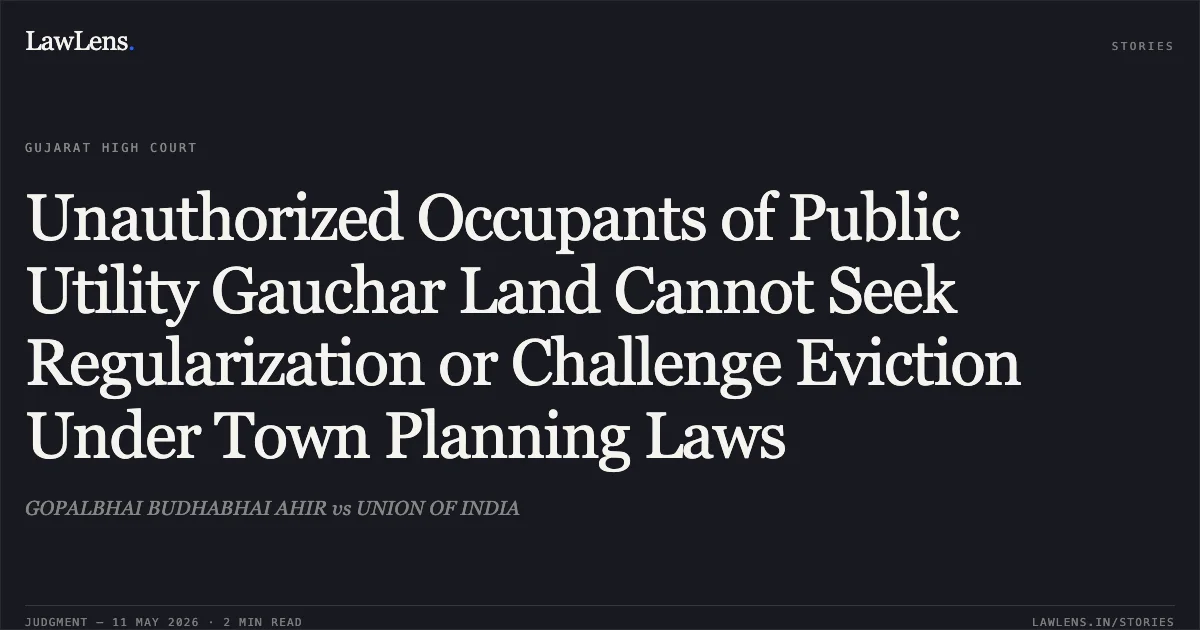
The Court dismissed the writ petition, holding that the petitioners are unauthorized occupants of public utility land and therefore not entitled to relief
The Court affirmed the validity of the eviction orders and the rejection of the regularization application under GRUDA
Source reference: para. 11, 12It declined to adjudicate on the constitutional validity of the Act of 1976, finding the arguments irrelevant to the core factual illegality of the petitioners' occupation
Source reference: para. 13The request to stay the operation of the judgment was rejected
Source reference: para. 15Acts & Sections Cited
5 provisions across 2 statutes referred to in this judgment. Each provision opens on LawLens.
Gujarat Town Planning And Urban Development Act, 19762
Gujarat Regularisation of Unauthorised Development Act, 2011.3
Original Court PDF
GOPALBHAI BUDHABHAI AHIRvsUNION OF INDIA
Click to open original judgment
Original judgment, available to read, download and summarize on LawLens.in