Facts
On August 21, 2024, Food Officer Ajay Singh Khardiya and other officials inspected the godown of the petitioner, Rais Kha, following reports of unauthorized collection of Public Distribution System (PDS) rice
Source reference: para. 2(A)Officials discovered 308.25 quintals of rice, valued at approximately ₹12,05,948/-, along with evidence of sewing gunny bags
Source reference: para. 2(A)A surveyor reported that the seized grain contained fortified rice kernels, indicating it was meant for the PDS
Source reference: para. 2(A)(i), 3The petitioner failed to produce valid licenses or purchase documents
Source reference: para. 2(A)Consequently, an FIR (Crime No. 375/2024) was registered under Sections 3 and 7 of the Essential Commodities Act, 1955
Source reference: para. 2(ii)The petitioner filed this petition under Section 482 of the Cr.P.C. seeking to quash the FIR, alleging the case was based on mere suspicion and faulty sampling
Source reference: para. 1, 3Issues
1. Whether the allegations in the FIR and the materials collected during the investigation prima facie disclose the commission of a cognizable offence under the Essential Commodities Act, 1955
Source reference: para. 6, 8, 122. Whether the High Court should exercise its inherent jurisdiction under Section 482 of the Cr.P.C. to quash the criminal proceedings at the initial stage
Source reference: para. 3, 13Law Applied
The court primarily applied Sections 3 and 7 of the Essential Commodities Act, 1955, which provide penalties for contravening orders regulating essential commodities
Source reference: para. 9, 10It referred to Clause 13 of the Madhya Pradesh Public Distribution System (Control) Order, 2015, which prohibits the substitution, diversion, or unauthorized storage of food grains kept for the PDS
Source reference: para. 9Regarding the scope of Section 482 Cr.P.C., the court relied on the landmark guidelines established in State of Haryana & Others v. Ch. Bhajan Lal & Others (AIR 1992 SC 604)
Source reference: para. 6It further applied the "prima facie" test from Madhavrao Jiwajirao Scindia v. Sambhajirao Chanrojirao Angre (1988 (1) SCC 692)
Source reference: para. 7Principle from Neeharika Infrastructure v. State of Maharashtra (2021 SCC Online SC 315) that courts should not enter into the merits of allegations or interfere with the investigative agency's power when a cognizable offence is disclosed
Source reference: para. 8Reasoning
The court observed that 308.25 quintals of rice were recovered from the petitioner's possession without any supporting documentation
Source reference: para. 4, 12The surveyor’s report explicitly stated that the samples contained 1.05% fortified rice kernels, identifying the grain as PDS stock
Source reference: para. 4, 11Although the petitioner challenged the surveyor's expertise and the sampling procedure, the court held that the veracity of such technical opinions and procedural regularities are matters to be determined during the trial, not at the quashing stage
Source reference: para. 11Applying the Bhajan Lal criteria, the court found that the uncontroverted allegations in the FIR, if taken at face value, established a prima facie case of unauthorized storage and diversion of essential commodities
Source reference: para. 10, 12The court noted that the petitioner failed to explain the presence of such a large quantity of fortified rice in his godown and concluded that the prosecution was not maliciously instituted or an abuse of process
Source reference: para. 12, 13Holding
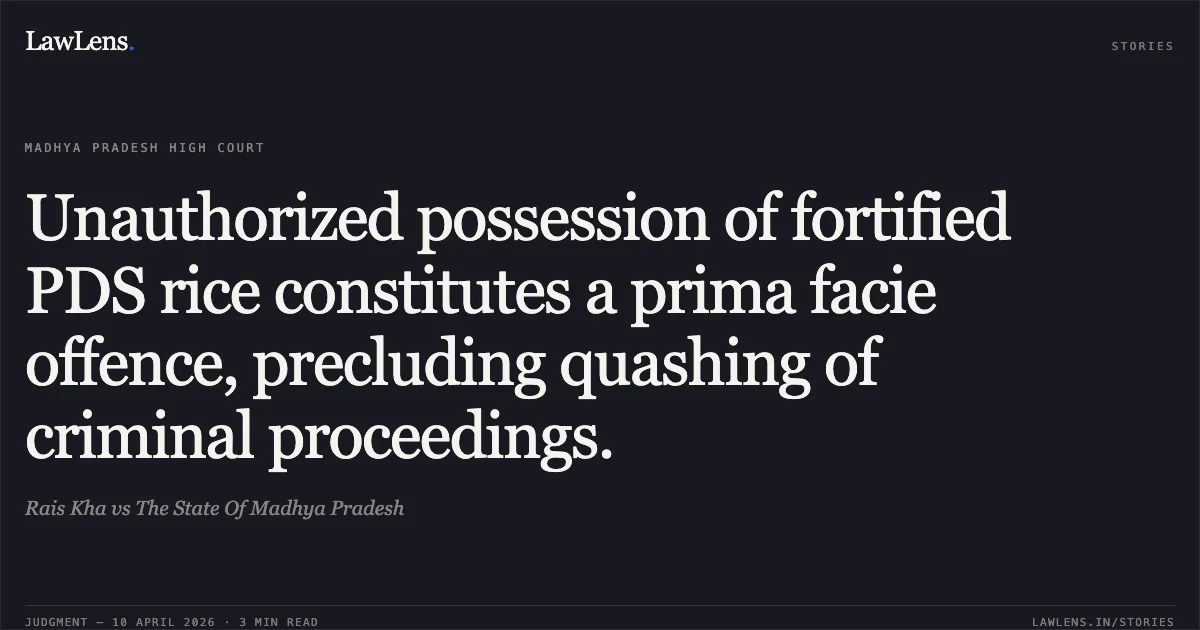
The material on record prima facie constitutes the alleged offence, necessitating a trial
The court concluded that no case was made out for the exercise of inherent jurisdiction under Section 482 of the Cr.P.C., as the allegations were neither absurd nor legally barred
Source reference: para. 13The High Court dismissed the petition, refusing to quash the FIR
Source reference: para. 14Acts & Sections Cited
7 provisions across 3 statutes referred to in this judgment. Each provision opens on LawLens.
Code of Criminal Procedure, 19733
Bharatiya Nyaya Sanhita, 20231
Original Court PDF
Rais KhavsThe State Of Madhya Pradesh
Click to open original judgment
Original judgment, available to read, download and summarize on LawLens.in