Facts
On 17 March 2006, Ningaraju was injured when the bus insured by the appellant collided with the auto-rickshaw in which he was travelling.
Source reference: para. 2–4, 9He filed a claim under Section 166 of the Motor Vehicles Act, 1988, seeking compensation for his injuries.
Source reference: para. 2–4, 9He died on 17 May 2009 while the claim was pending, and his wife and children were brought on record.
Source reference: para. 2–4, 9The Tribunal awarded ₹4,15,750 with interest, treating his death as connected to the accident.
Source reference: para. 2–4, 9The insurer appealed only the finding that the death resulted from the accidental injuries; it did not dispute the accident or the injuries.
Source reference: para. 2–4, 9Issues
Whether the Tribunal’s finding that Ningaraju’s death was due to the accidental injuries, making the insurer liable on a death-claim basis, required interference
Source reference: para. 8Whether the parties should be permitted to adduce additional evidence on the connection between the accident and Ningaraju’s death
Source reference: para. 9Law Applied
The claim was brought under Section 166 of the Motor Vehicles Act, 1988, and the appeal under Section 173(1).
Source reference: p. 2–3The Court referred to the Full Bench decision in Kannamma v. Deputy General Manager, ILR 1990 KAR 4300, which it noted addresses the damages recoverable where an injured claimant dies during the claim proceedings for reasons other than the accidental injuries; in such a case, damages are confined to specified limited heads.
Source reference: para. 5The Court’s consideration turned on whether the evidence established a nexus between the accident injuries and the subsequent death.
Source reference: para. 8–9Reasoning
The evidence established the accident and Ningaraju’s injuries, and the medical bills supported expenditure on treatment.
Source reference: para. 9But the hospital death certificate and PW2’s testimony identified cerebral hypoxia as the cause of death without explaining any connection to the head injury sustained more than three years earlier.
Source reference: para. 9PW2 also stated that Ningaraju had a history of epilepsy, and no post-mortem examination had been conducted.
Source reference: para. 9The Court nevertheless considered PW1’s evidence that Ningaraju continued outpatient treatment after discharge and noted that the insurer had not cross-examined PW2 on the relevant issue.
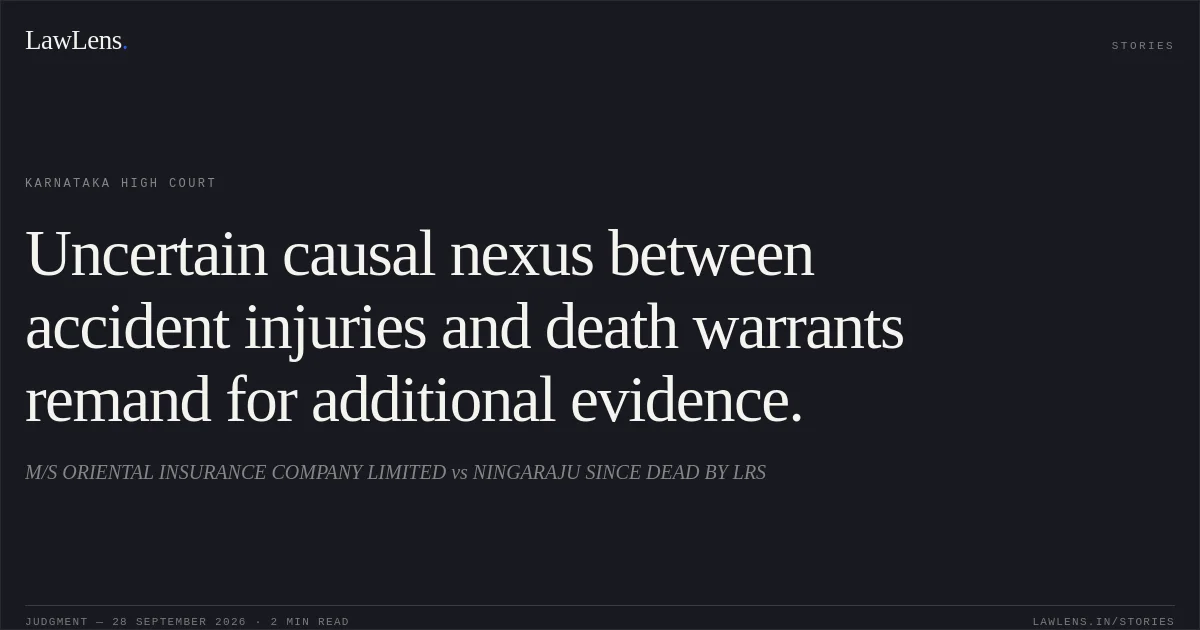
Source reference: para. 9Given these competing evidentiary considerations, it held that both parties should have the opportunity to establish whether the death was causally connected to the accident.
Source reference: para. 9Holding
The Court allowed the appeal in part, set aside the Tribunal’s award, and remitted the matter for fresh disposal with permission for both parties to adduce additional evidence.
It directed that ₹25,000 from the amount in deposit be released to the claimants, subject to the final outcome, and directed the parties to appear before the Tribunal on 3 November 2026.
Source reference: para. 10–11(iv)–(v)Acts & Sections Cited
2 provisions across 1 statute referred to in this judgment. Each provision opens on LawLens.
Motor Vehicles Act, 19882
Original Court PDF
M/S ORIENTAL INSURANCE COMPANY LIMITEDvsNINGARAJU SINCE DEAD BY LRS
Click to open original judgment
Original judgment, available to read, download and summarize on LawLens.in