Facts
The petitioner was appointed as a “Guruji” at an E.G.S. Centre in District Anuppur under the Shiksha Guarantee Scheme in 1997. He claimed that he subsequently qualified in the Samvida Shala Shikshak Grade-III Eligibility Examinations conducted by the M.P. Professional Examination Board in 2005 and 2008 and was therefore entitled to appointment as Samvida Shala Shikshak, Grade-III.
Source reference: para. 2The petitioner had earlier approached the High Court in W.P. No. 242/2005 and W.P. No. 2246/2012(S), seeking consideration of his past service and appointment/accommodation under the applicable State policy. Directions were issued to the competent authorities to examine and decide his claim. He also initiated contempt proceedings, which were disposed of with liberty to challenge the rejection of his claim.
Source reference: para. 2A Committee chaired by the Collector, Anuppur, considered the petitioner’s eligibility and found that he had served only as a local “Guruji” and not as a Daily Rated Employee or Shiksha Karmi Grade-III. The competent authority consequently rejected his claim by order dated 21.11.2014, referred to as Annexure R/2. The petitioner filed the present writ petition seeking appointment on the basis of his examination results.
Source reference: paras. 1, 4Issues
Whether the petitioner was entitled to appointment as Samvida Shala Shikshak, Grade-III merely on the basis of having qualified in the relevant eligibility examinations and having earlier served as a Guruji?
Source reference: paras. 1–4Whether the High Court could grant relief under Article 226 when the competent authority’s order rejecting the petitioner’s claim had not been specifically challenged?
Source reference: paras. 5–7Law Applied
The Court applied the principles governing judicial review under Article 226 of the Constitution of India, namely that writ jurisdiction is exercised to correct a demonstrated illegality, jurisdictional error, or other legal infirmity in the impugned decision.
Source reference: paras. 6–7The Court further applied the procedural principle that an administrative order which specifically adjudicates a claimant’s entitlement must be directly assailed before the Court; in the absence of such a challenge, and where the order remains unassailed, the Court will not ordinarily examine or interfere with it.
Source reference: paras. 6–7The Court also relied on the principle that qualification in an eligibility examination, by itself, does not establish an enforceable right to appointment where the claimant’s underlying eligibility and nature of prior engagement have been rejected by the competent authority.
Source reference: paras. 6–7Reasoning
The Court noted that the petitioner’s claim had already been examined by the competent authority, which recorded that he had been engaged as a local Guruji and not as a Daily Rated Employee or Shiksha Karmi Grade-III.
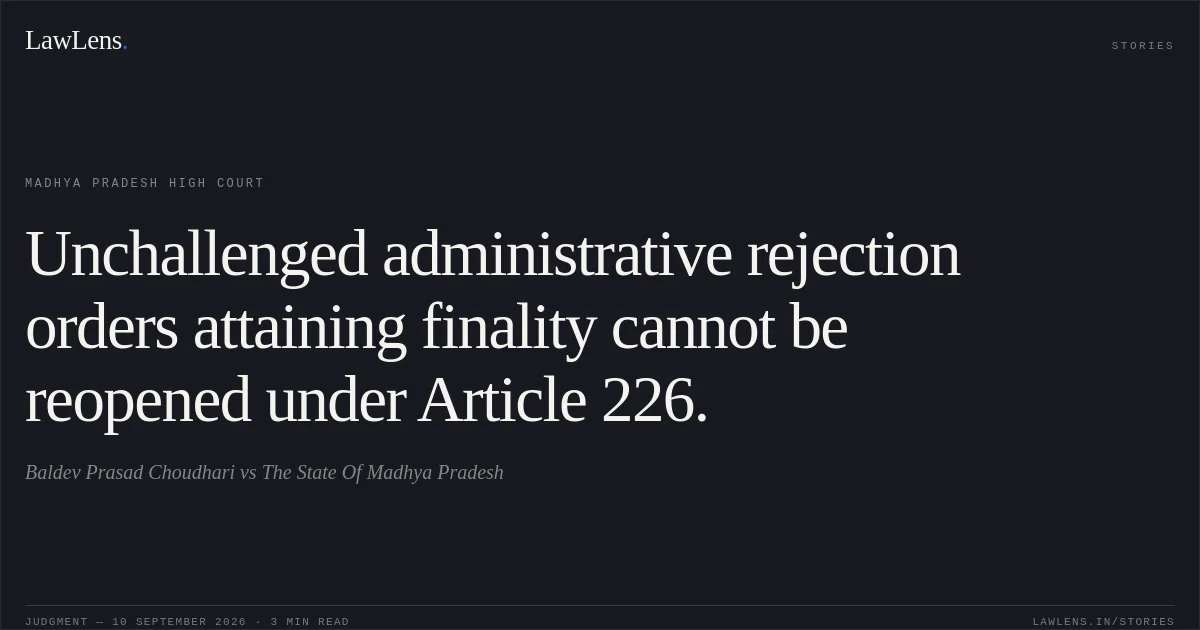
Source reference: para. 4Although the petitioner sought appointment on the basis of his examination results, he did not challenge the rejection order dated 21.11.2014, Annexure R/2, which specifically addressed the nature of his engagement and the reasons for rejecting his claim. Since that order remained unassailed and had attained finality, there was no properly challenged decision before the Court whose legality could be reviewed under Article 226. The petitioner also failed to establish any subsequent cause of action or legal infirmity warranting interference.
Source reference: para. 6Holding
The Court held that the petitioner was not entitled to relief because his claim had already been adjudicated by the competent authority and the relevant rejection order had not been challenged. Consequently, no ground for interference under Article 226 was made out.
The writ petition was accordingly dismissed as devoid of merit.
Source reference: para. 7Original Court PDF
Baldev Prasad ChoudharivsThe State Of Madhya Pradesh
Click to open original judgment
Original judgment, available to read, download and summarize on LawLens.in