Facts
Respondent No. 1 sought demarcation under Section 129 of the Madhya Pradesh Land Revenue Code, 1959, in respect of certain parcels of land situated at Gram Kakra, Tehsil Amarpatan, District Satna.
Source reference: paras. 1–2Demarcation was conducted on 15 June 2019 by preparation of a mauka panchnama.
Source reference: paras. 1–2Relying on that demarcation, respondent No. 1 filed an application under Section 250 of the Code seeking restoration of possession, alleging that the petitioner was occupying his land.
Source reference: paras. 1–2The Tahsildar allowed the application on 12 April 2021; the Sub-Divisional Officer and Additional Commissioner affirmed the decision on 15 January 2022 and 4 March 2022, respectively.
Source reference: paras. 1–2The petitioner challenged the orders under Article 227 of the Constitution, contending that the demarcation was merely a spot inspection, that he had not been served notice, and that it was conducted in his absence in violation of natural justice.
Source reference: para. 3Respondent No. 1 argued that the demarcation had never been challenged and had therefore attained finality.
Source reference: para. 4Issues
Whether the legality of the 15 June 2019 demarcation proceedings, including the alleged absence of notice and violation of natural justice, could be challenged for the first time in proceedings under Section 250 of the Madhya Pradesh Land Revenue Code?
Source reference: paras. 3, 6–8Whether the orders granting restoration of possession under Section 250, based on the unchallenged demarcation proceedings, suffered from any jurisdictional or legal error warranting interference under Article 227 of the Constitution?
Source reference: paras. 1, 9–10Whether confirmation of the 2019 demarcation by the Sub-Divisional Officer under Section 129(4), which became operative from 12 February 2020, was necessary in the present case?
Source reference: para. 9Law Applied
Section 129 of the Madhya Pradesh Land Revenue Code, 1959 governs demarcation proceedings; after the amendment introduced by Madhya Pradesh Amendment Act No. 23 of 2018, effective 25 September 2018, a grievance against demarcation is to be raised before the Sub-Divisional Officer under Section 129(5).
Source reference: paras. 7–8A demarcation order must be challenged before the competent higher revenue authority in accordance with the Code; if it is not challenged, it attains finality and its legality cannot ordinarily be questioned collaterally in proceedings under Section 250.
Source reference: paras. 6–8The Court relied on Murloidhar and Another v. Board of Revenue, M.P. and Others, 2013 (3) MP LJ 184, which held that objections regarding want of notice or hearing in demarcation proceedings must be pursued by appeal or revision and cannot subsequently be used to invalidate possession-restoration proceedings based on the final demarcation order.
Source reference: para. 6The Court further held that Section 129(4), which came into effect on 12 February 2020, did not require confirmation by the Sub-Divisional Officer of a demarcation conducted in 2019.
Source reference: para. 9Reasoning
The Court held that the petitioner was aware of the demarcation conducted on 15 June 2019 but did not challenge it before the competent revenue authority under the applicable statutory remedy.
Source reference: para. 9Consequently, any objections concerning lack of notice, absence during demarcation, or the alleged inadequacy of the mauka panchnama could not be raised collaterally in the Section 250 proceedings.
Source reference: paras. 6–8Applying the principle in Murloidhar, the Court treated the demarcation as final and found that the revenue authorities were entitled to rely upon it while ordering restoration of possession.
Source reference: paras. 6–8Since the demarcation predated the commencement of Section 129(4) on 12 February 2020, subsequent confirmation by the Sub-Divisional Officer was not required.
Source reference: para. 9The impugned orders therefore disclosed no error warranting supervisory interference under Article 227.
Source reference: para. 10Holding
The Court answered the issues against the petitioner.
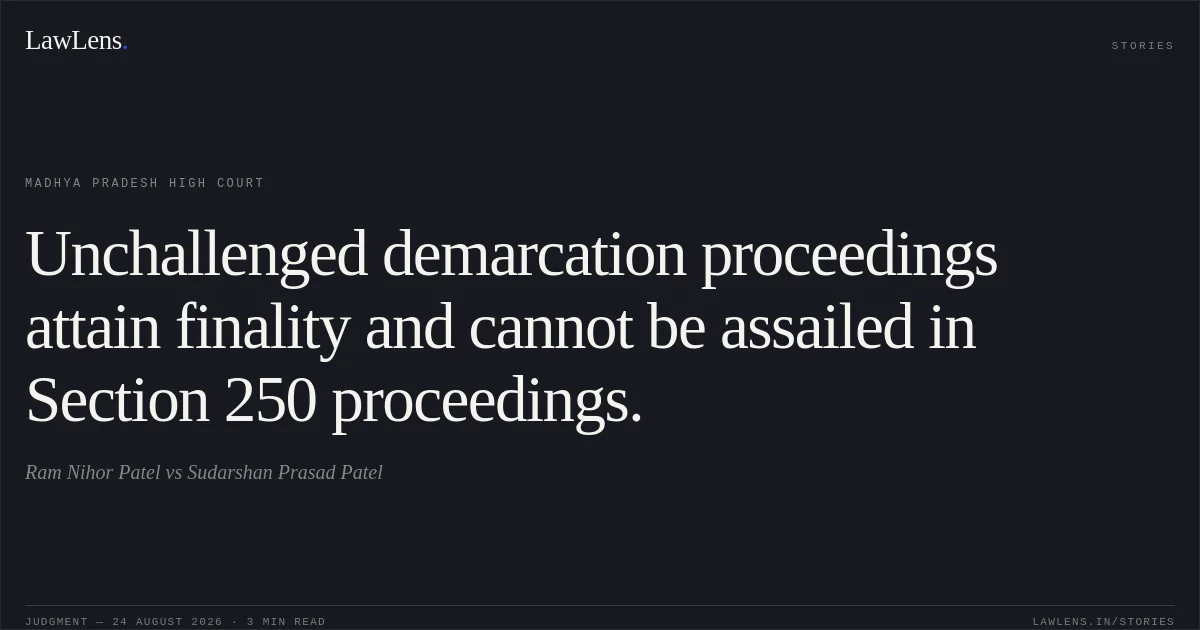
It held that the unchallenged demarcation proceedings had attained finality and that their legality could not be questioned in the subsequent Section 250 proceedings.
Source reference: paras. 9–10The Court further held that confirmation under Section 129(4) was unnecessary because the demarcation had been conducted in 2019, before that provision came into effect.
Source reference: paras. 9–10The orders of the Tahsildar, Sub-Divisional Officer, and Additional Commissioner were affirmed, and the miscellaneous petition was dismissed.
Source reference: paras. 9–10Acts & Sections Cited
4 provisions across 1 statute referred to in this judgment. Linked provisions open on LawLens.
M.P. Land Revenue Code, 19594
Original Court PDF
Ram Nihor PatelvsSudarshan Prasad Patel
Click to open original judgment
Original judgment, available to read, download and summarize on LawLens.in