Facts
The respondent was a consumer holding a 40-Horsepower electricity connection from the appellant since 16 March 1999.
Source reference: para. 2.1, p. 2During a surprise inspection on 27 July 1999, the appellant’s officers allegedly found two holes in the meter box through which wires had been passed to interfere with accurate recording of consumption; scratches and abrasions were also noticed on the meter.
Source reference: para. 2.1, p. 2A spot report was prepared, the meter was sealed and sent for laboratory examination, and the respondent’s representative’s statement was recorded.
Source reference: para. 2.1, p. 2The laboratory examination allegedly confirmed electricity theft, following which the appellant issued a supplementary bill under the ABCD formula for 61,370 units, initially amounting to Rs. 5,16,265.08 and subsequently shown as Rs. 6,25,854.58 in the ledger.
Source reference: para. 2.2, p. 2The appellant instituted Special Civil Suit No. 20 of 2002 for recovery of the amount.
Source reference: para. 2.3–2.4, p. 2Although the respondent admitted the electricity connection and consumer relationship, he disputed the inspection and contended that the supplementary bill was based on assumptions and presumptions.
Source reference: para. 2.3–2.4, p. 2The trial court dismissed the suit, holding that the surprise inspection and the supplementary bill had not been sufficiently proved.
Source reference: para. 2.5, p. 3The appellant preferred the present first appeal.
Source reference: para. 2.6, p. 3Issues
Whether the trial court was justified in examining the legality and factual basis of the supplementary bill in a recovery suit when the respondent had not separately challenged the bill before the prescribed appellate authority.
Source reference: paras. 4.1–4.2, pp. 4–5; para. 7, p. 5Whether the appellant was entitled to recover Rs. 6,25,854.58 under the supplementary bill and ledger account.
Source reference: paras. 6–7, pp. 5–6Whether the trial court’s dismissal of the recovery suit was legally sustainable in light of the inspection report, laboratory examination and applicable Conditions of Supply of Electrical Energy.
Source reference: paras. 6–9, pp. 5–9Law Applied
The court applied the Conditions of Supply of Electrical Energy, under which a consumer found to have indulged in malpractice or electricity theft is liable to additional charges assessed according to the ABCD formula, and an aggrieved consumer must challenge the supplementary bill before the designated Appellate Authority.
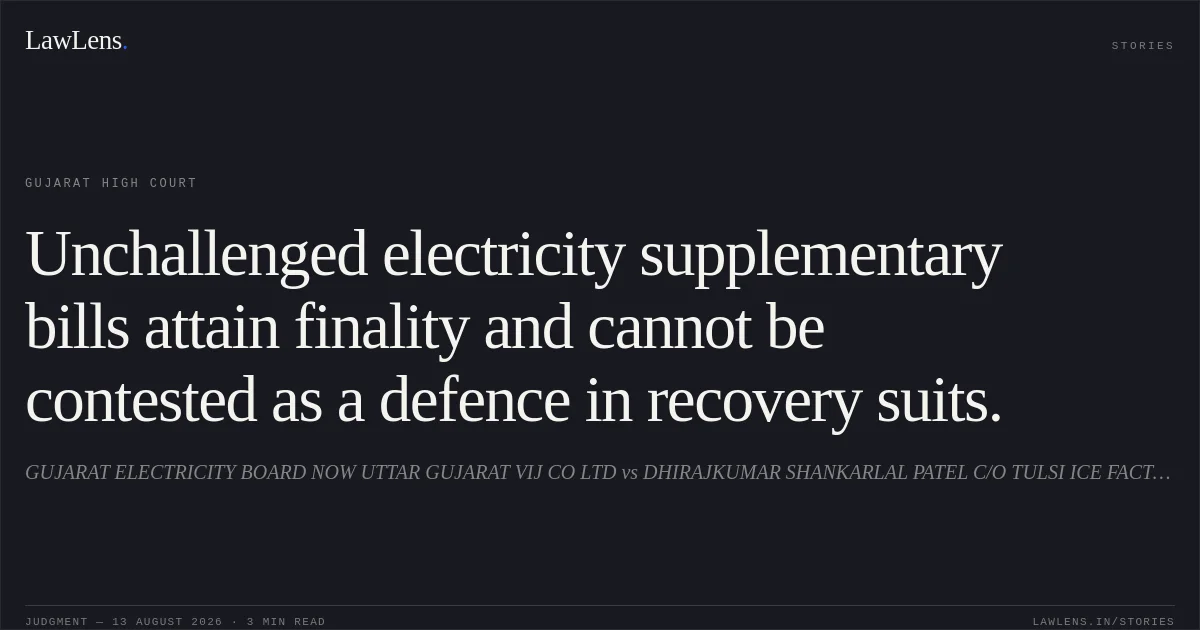
Source reference: para. 8, pp. 6–8Relying on Paschim Gujarat Vij Company Ltd. v. Bhikhabhia Arjanbhai Varu, Second Appeal No. 11 of 2012, and Gujarat Electricity Board (Now Paschim Gujarat Vij Co. Ltd.) v. Pragjibhai Bhagwanbhai Patolia, Second Appeal No. 21 of 2005, the court held that a supplementary bill not challenged through the prescribed appellate remedy attains finality and cannot ordinarily be questioned for the first time as a defence in a recovery suit.
Source reference: para. 8, pp. 5–9The court also referred to Vrajlal Devjibhai v. GEB, First Appeal No. 2506 of 2003, and the Supreme Court decisions in Punjab State Electricity Board v. Ashwani Kumar, (1997) 5 SCC 120, and Hyderabad Vanaspathi Ltd. v. A.P. State Electricity Board, (1998) 4 SCC 470, for the principle that disputes concerning assessment under the statutory and contractual electricity-supply mechanism should be pursued through the prescribed specialised remedy rather than by collateral challenge in a recovery proceeding.
Source reference: para. 8, pp. 7–9Reasoning
The High Court found that the appellant’s documents sufficiently established the surprise inspection, preparation of the spot report, discovery of meter tampering and subsequent laboratory confirmation of theft.
Source reference: para. 6, p. 5The supplementary bill was calculated under the applicable ABCD formula and was supported by the ledger account.
Source reference: para. 7, p. 5Since the respondent had not challenged the bill before the Appellate Authority, the bill had attained finality under the applicable Conditions of Supply.
Source reference: paras. 7–9, pp. 5–9The trial court therefore erred by re-examining the legality of the inspection and the basis of the bill instead of determining the appellant’s claim for recovery on the basis of the outstanding supplementary bill and ledger.
Source reference: paras. 7–9, pp. 5–9Applying the binding principles in the cited authorities, the High Court held that the respondent could not use the recovery suit as a forum to raise a belated challenge to the supplementary bill.
Source reference: para. 8, pp. 6–9Holding
The appeal was allowed.
The judgment and decree dated 10 May 2007 in Special Civil Suit No. 20 of 2002 were quashed and set aside.
Source reference: para. 10, p. 9The appellant’s suit was decreed, and it was held entitled to recover Rs. 6,25,854.58 from the respondent or his property, together with interest at 6% per annum from the date of filing of the suit until realization.
Source reference: paras. 11–12, p. 10A decree was directed to be drawn accordingly, and the record was ordered to be returned to the trial court.
Source reference: paras. 13–14, p. 10Original Court PDF
GUJARAT ELECTRICITY BOARD NOW UTTAR GUJARAT VIJ CO LTDvsDHIRAJKUMAR SHANKARLAL PATEL C/O TULSI ICE FACTORY
Click to open original judgment
Original judgment, available to read, download and summarize on LawLens.in