Facts
The Respondent (Plaintiff) filed a suit for recovery of Rs. 8,50,000/- based on a friendly loan advanced to Defendant No. 1 and her late husband, Sh. R.K. Bhardwaj, under a written Agreement Deed dated 06.11.2015.
Source reference: p. 2-3Multiple cheques issued by the husband were dishonored due to "Insufficient Funds".
Source reference: p. 3-4Following the husband's death, the Plaintiff sued the widow and sons (Appellants) as legal heirs.
Source reference: no citationThe Defendants initially filed a Written Statement alleging forgery of signatures.
Source reference: p. 5However, the Defendants failed to appear during the evidence stage and were proceeded ex-parte on 10.05.2022.
Source reference: p. 6-7The Trial Court dismissed their Application under Order IX Rule 7 CPC for recalling the ex-parte order and subsequently decreed the suit in favor of the Respondent.
Source reference: p. 7Issues
1. Whether the signatures of Sh. R.K. Bhardwaj on the cheques and the Agreement Deed were forged and required forensic examination.
Source reference: p. 5, 9 / para. 17, 362. Whether the Appellants, as legal heirs, are liable even if they claim not to have inherited any assets from the deceased.
Source reference: p. 5, 10 / para. 17, 423. Whether the Trial Court erred in dismissing the Application under Order IX Rule 7 CPC for being delayed, given that no limitation is prescribed.
Source reference: p. 8, 11 / para. 30, 46Law Applied
The court applied Section 96 and Order XLI of the CPC regarding appeals.
Source reference: p. 1-2It relied on the principle that the burden of proof for forgery shifts to the party asserting it once execution is prima facie proved by witnesses.
Source reference: p. 9Under the Code of Civil Procedure, legal heirs are liable for the debts of the deceased to the extent of the estate inherited.
Source reference: p. 10Regarding ex-parte proceedings, the court applied Order IX Rule 7 CPC and Article 137 of the Limitation Act, 1963, emphasizing the requirement of "Sufficient Cause" as established in Arjun Singh v. Mohindra Kumar and Parimal v. Veena @ Bharti.
Source reference: p. 11-12Reasoning
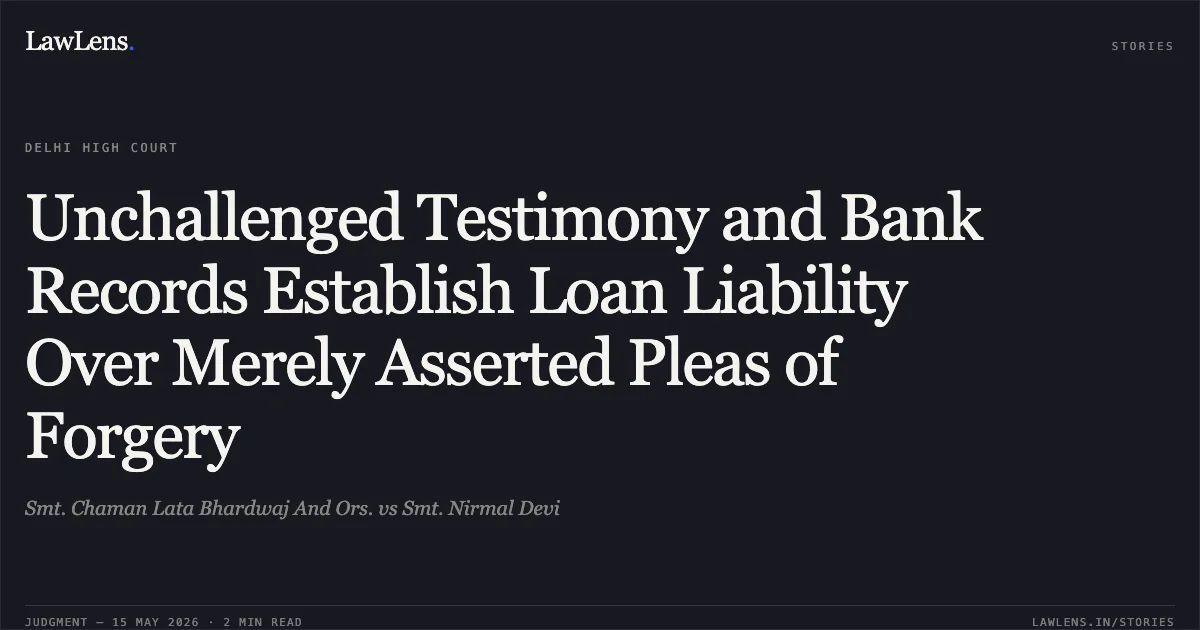
The Court rejected the plea of forgery, noting that while the Appellants raised the defense in their pleadings, they failed to cross-examine the Plaintiff's witnesses (PW-1, PW-4, and PW-5) who identified the signatures.
Source reference: p. 9The Court held that forensic examination is not mandatory when unchallenged ocular evidence exists.
Source reference: p. 10Regarding inheritance, the Court determined that as Class-I legal heirs, the burden was on the Appellants to disclose the deceased's estate; mere denial of inheritance in a Written Statement is insufficient, and such matters are primarily for the Execution stage.
Source reference: p. 10-11Finally, the Court upheld the dismissal of the Order IX Rule 7 Application, reasoning that even if no specific limitation period exists, the Appellants failed to demonstrate "Sufficient Cause" for their prolonged absence and negligence.
Source reference: p. 11-12Holding
The Court held that the Plaintiff successfully proved the loan and the execution of documents through unrebutted testimony.
The Appellants are liable as legal heirs for the sum of Rs. 8,50,000/- with interest @ 12% p.a., with the extent of liability for the debts of the deceased being subject to the estate inherited.
Source reference: p. 7, 10The High Court dismissed the appeal and upheld the Trial Court's judgment, finding no infirmity in the trial court's refusal to set aside the ex-parte order due to the Appellants' lack of diligence.
Source reference: p. 12Acts & Sections Cited
2 provisions across 2 statutes referred to in this judgment. Each provision opens on LawLens.
Code of Civil Procedure, 19081
Limitation Act, 19631
Original Court PDF
Smt. Chaman Lata Bhardwaj And Ors.vsSmt. Nirmal Devi
Click to open original judgment
Original judgment, available to read, download and summarize on LawLens.in