Facts
The petitioners were appointed as Ayurved Chikitsa Adhikari and retired from the same post
Source reference: p. 2Under the State Government’s policy dated 24.01.2008, they were granted the benefit of the second higher time scale of pay (pay scale 12000-16500) effective from 01.04.2006 upon completing 16 years of service
Source reference: p. 2Following their retirement, the respondents issued an impugned order dated 17.11.2017, which modified the eligibility date for the second time pay scale to a later date without prior notice or a hearing
Source reference: p. 2, 4The State contended that a Departmental Committee (DPC) refixed the dates because the petitioners failed to meet specific benchmarks derived from their Annual Confidential Reports (ACRs)
Source reference: p. 3Issues
1. Whether the respondents could legally modify the date of grant of time scale pay using uncommunicated adverse ACRs as a basis for denying/deferring benefits
Source reference: p. 2, 42. Whether the impugned order dated 17.11.2017 was passed in violation of the principles of natural justice
Source reference: p. 2, 4Law Applied
The Court primarily applied the principles of natural justice and Article 14 of the Constitution of India, asserting that any order with civil consequences must involve an opportunity for a hearing
Source reference: p. 2It relied on Abhijit Ghosh Dastidar v. Union of India (2010) and Dev Dutt v. Union of India (2008), which established that non-communication of adverse or "below benchmark" ACR entries is arbitrary and such entries cannot be used to deny promotion or financial upgrades
Source reference: p. 4, 5, 7The Court further cited Gurdial Singh Fijji v. State of Punjab regarding the necessity of affording an opportunity to represent against adverse entries
Source reference: p. 4Union of India v. K.V. Jankiraman (1991) to hold that employees cannot be denied consequential benefits for departmental faults where the employee was not at blame
Source reference: p. 5, 6Reasoning
The Court reasoned that the respondents' action of shifting the eligibility date based on uncommunicated ACRs was legally unsustainable.
Source reference: p. 4The respondents failed to provide a show-cause notice or an opportunity for a hearing before passing an order that carried adverse civil consequences
Source reference: p. 4Applying the Dev Dutt and Abhijit Ghosh Dastidar precedents, the Court noted that even if a grade is not "adverse" but falls below a required benchmark, it must be communicated so the employee may seek an upgrade
Source reference: p. 7Since the petitioners never received these ACRs, the DPC’s reliance on them to modify the time-scale dates was deemed "per se illegal"
Source reference: p. 6, 7Furthermore, as the delay in proper assessment was solely attributable to the department, the petitioners were entitled to full consequential and monetary benefits despite their retirement
Source reference: p. 5, 6Holding
The Court allowed the petition and quashed the impugned order dated 17.11.2017
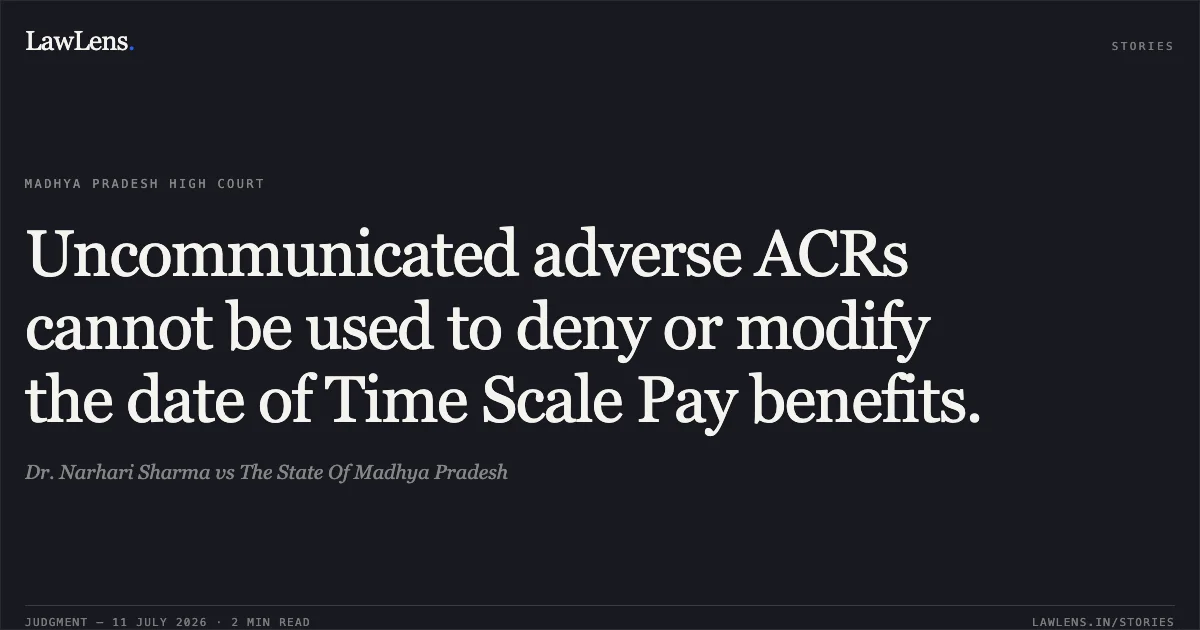
It held that uncommunicated ACRs cannot be used to assess suitability for time-scale pay
Source reference: p. 7The respondents were directed to: (i) continue the benefits of the first and second time pay-scales as originally granted; (ii) revise the petitioners' PPO/GPO; and (iii) pay all arrears and kramonnati benefits with 6% interest per annum within three months, failing which the interest rate would increase to 12%
Source reference: p. 7, 8Original Court PDF
Dr. Narhari SharmavsThe State Of Madhya Pradesh
Click to open original judgment
Original judgment, available to read, download and summarize on LawLens.in