Facts
The petitioner, who had retired as a Station Officer in 1999, claimed promotion to the post of Inspector with effect from 16 March 1980, alleging that his juniors had been promoted.
Source reference: p. 1; paras. 1, 5His representation was rejected by the Director General of Police (“DGP”) on 6 April 2010, primarily on the basis of adverse entries and past punishments in his service record.
Source reference: p. 1; paras. 1, 5The State Public Services Tribunal dismissed his claim petition on 30 November 2012 and his review petition on 10 June 2013.
Source reference: p. 1; paras. 1, 7The petitioner’s writ petition challenging the Tribunal’s decision was dismissed for non-prosecution on 16 February 2015. His restoration application was also dismissed for want of prosecution on 11 December 2015/2025, following which he filed the present recall and restoration applications.
Source reference: p. 1; para. 1During the proceedings, the petitioner, aged over 85 years, regularly appeared in person.
Source reference: p. 1; paras. 1–3The DGP’s order stated that the petitioner had been interviewed and assessed for promotion, but the State could not produce the relevant marksheets, tabulation records, or any material showing how the petitioner had been assessed vis-à-vis the successful candidates.
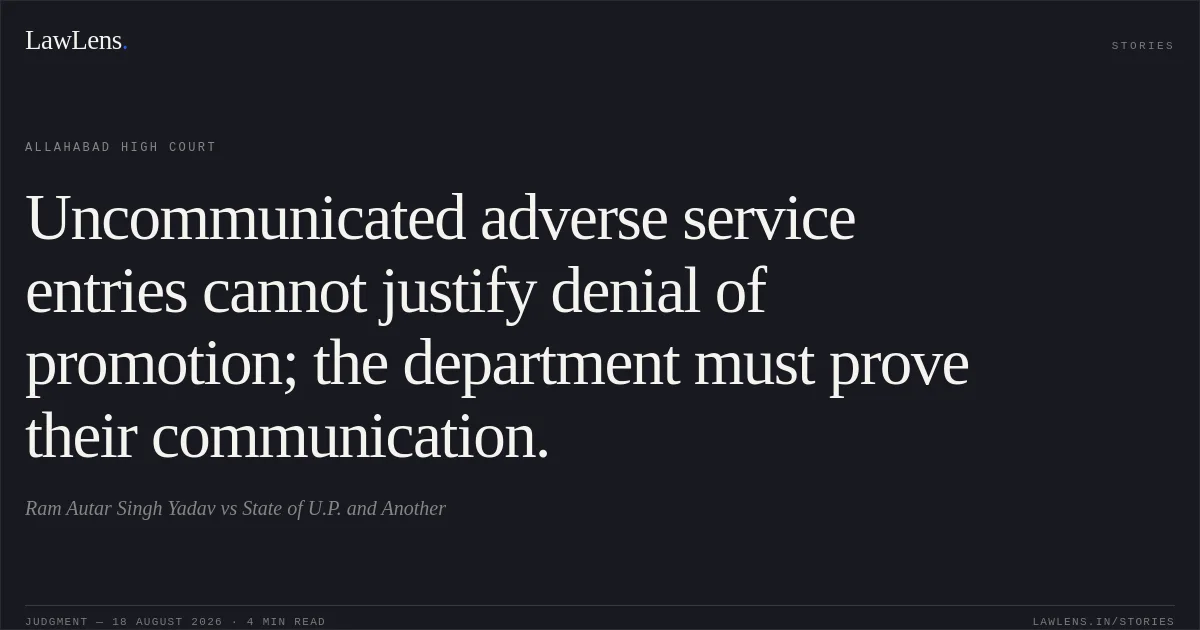
Source reference: p. 4; para. 5The State also failed to establish that the adverse entries relied upon by the DGP had been communicated to the petitioner.
Source reference: p. 5; para. 7Issues
1. Whether the delay in seeking recall and restoration of the proceedings ought to be condoned in the circumstances of the case.
Source reference: p. 2; paras. 3–42. Whether the orders dismissing the restoration application and the writ petition for want of prosecution ought to be recalled and the proceedings restored.
Source reference: p. 2; para. 83. Whether the Tribunal and the DGP acted lawfully in rejecting the petitioner’s promotion claim on the basis of adverse entries which were not shown to have been communicated to him.
Source reference: pp. 4–6; paras. 5–74. Whether the petitioner was unfairly denied promotion when the State could not produce the assessment records or marks on the basis of which the DGP claimed that he had been considered for promotion.
Source reference: pp. 4–5, 7; paras. 5, 9Law Applied
The Court applied Section 5 of the Limitation Act, 1963, under which delay may be condoned where the applicant establishes “sufficient cause”; the provision is to be applied liberally to advance substantial justice rather than defeat claims on technical grounds.
Source reference: p. 2; para. 3It relied on Collector, Land Acquisition, Anantnag v. Mst. Katiji, (1987) 2 SCC 107, which holds that courts should adopt a pragmatic and liberal approach to delay, that refusal to condone delay may defeat adjudication on merits, and that substantial justice should ordinarily prevail over technical considerations.
Source reference: pp. 2–3; para. 4The Court further applied the principle that a person cannot ordinarily be required to prove a negative; where an employee asserts that adverse entries were not communicated, the department, which relies upon those entries, must produce material showing communication.
Source reference: p. 6; para. 7The Court also applied the principles of procedural fairness and non-arbitrariness in public employment, requiring the State to substantiate the asserted assessment process and the basis for denying promotion.
Source reference: pp. 4–5, 7; paras. 5, 9Reasoning
The Court found sufficient cause for condoning the delay because the petitioner was an elderly litigant who had consistently attempted to prosecute his case and had personally appeared before the Court despite his advanced age and language difficulties.
Source reference: p. 2; para. 3Applying the liberal approach in Katiji, the Court held that the petitioner should not be deprived of adjudication on merits merely because the writ petition and earlier restoration application had been dismissed for non-prosecution.
Source reference: pp. 2–3; paras. 4, 8On merits, the Court noted that the DGP relied on adverse entries from several years and past punishments, but the department produced no proof that those adverse entries had been communicated to the petitioner.
Source reference: pp. 3–4; para. 5The Tribunal had improperly required the petitioner to prove the negative fact that the entries were not communicated, whereas the burden lay on the department to demonstrate communication.
Source reference: p. 6; para. 7Further, although the DGP stated that the petitioner had been interviewed and assessed, the State could not produce the assessment records, comparative marks, or any material showing that the petitioner’s case had been considered fairly, either openly or in a sealed cover.
Source reference: pp. 4–5; para. 5The Court therefore concluded that the denial of promotion was unsupported by the record and that the petitioner had been treated unfairly.
Source reference: p. 7; para. 9Holding
The High Court allowed the recall and restoration applications.
It recalled the order dismissing the earlier restoration application, restored and allowed that application, recalled the order dismissing the writ petition for non-prosecution, and restored the writ petition to the file.
Source reference: p. 7; para. 8On the merits, the Court quashed the Tribunal’s judgment dated 30 November 2012 and directed the respondents to grant the petitioner promotion to the post of Inspector of Civil Police with effect from 16 March 1980, together with consequential salary and allowances from that date until retirement and corresponding retiral benefits.
Source reference: p. 7; para. 10The respondents were directed to comply within four weeks of communication of the order, and the writ petition was disposed of accordingly.
Source reference: p. 7; paras. 10–11Acts & Sections Cited
1 provisions across 1 statute referred to in this judgment. Each provision opens on LawLens.
Limitation Act, 19631
Original Court PDF
Ram Autar Singh YadavvsState of U.P. and Another
Click to open original judgment
Original judgment, available to read, download and summarize on LawLens.in