Facts
The respondent (plaintiff) filed a commercial suit (Com.O.S.No.1151/2025) for the recovery of ₹5 crores, alleging that a cheque issued by the petitioner (defendant) for that amount was dishonoured.
Source reference: p. 3-4The petitioner filed an application (I.A. No. 1) under Order XXXVII Rule 3 of the CPC seeking leave to defend, arguing that the claim was barred by limitation and that he had a right to forfeit the ₹5 crores due to the respondent’s breach of the "term sheet".
Source reference: p. 3The Commercial Court found that the petitioner had made out a "substantial defense" but granted leave to defend only on the condition that the petitioner furnish a Bank Guarantee of ₹5,00,00,000/-.
Source reference: p. 2-3The petitioner challenged this conditional order before the High Court under Article 227 of the Constitution.
Source reference: p. 2Issues
1. Whether, after recording a finding that the defendant has disclosed a substantial defence within the meaning of Order XXXVII Rule 3(5) of the CPC, the Commercial Court could nevertheless impose a condition requiring the furnishing of a bank guarantee?
Source reference: p. 7 / para. 9Law Applied
The Court applied Order XXXVII Rule 3(5) of the Code of Civil Procedure (CPC), which governs summary suits. The provision dictates that leave to defend must be granted unconditionally if the defendant discloses a "substantial defence".
Source reference: p. 7-8The Court relied on the Supreme Court precedents of IDBI Trusteeship Services Limited v. Hubtown Limited and B.L. Kashyap and Sons Ltd. v. M/s. JMS Steels and Power Corporation, which established that while the grant of leave is the rule and denial is the exception, the quality of the defense determines the imposition of conditions; specifically, a substantial defense warrants unconditional leave.
Source reference: p. 5-6, para. 33Reasoning
The Court observed that Order XXXVII Rule 3(5) creates a statutory classification based on the nature of the defense: if a defense is frivolous, leave is refused; if it is plausible but doubtful, conditional leave is granted; but if it is substantial, leave must be unconditional.
Source reference: p. 8, para. 9-10The High Court noted that the Commercial Court had explicitly recorded that the petitioner disclosed a "substantial defense" involving questions of law and fact (limitation and forfeiture rights) that required a full-fledged trial.
Source reference: p. 8-9The Court reasoned that once such a finding is made, the trial court loses the discretion to impose onerous conditions like a bank guarantee.
Source reference: p. 10, para. 11It further clarified that the Commercial Court's attempt to "balance equities" or protect the plaintiff's monetary interest cannot override the legislative mandate of Rule 3(5), nor can Order XXXVII be used as a substitute for "attachment before judgment" under the guise of security.
Source reference: p. 10-11, para. 11-12Holding
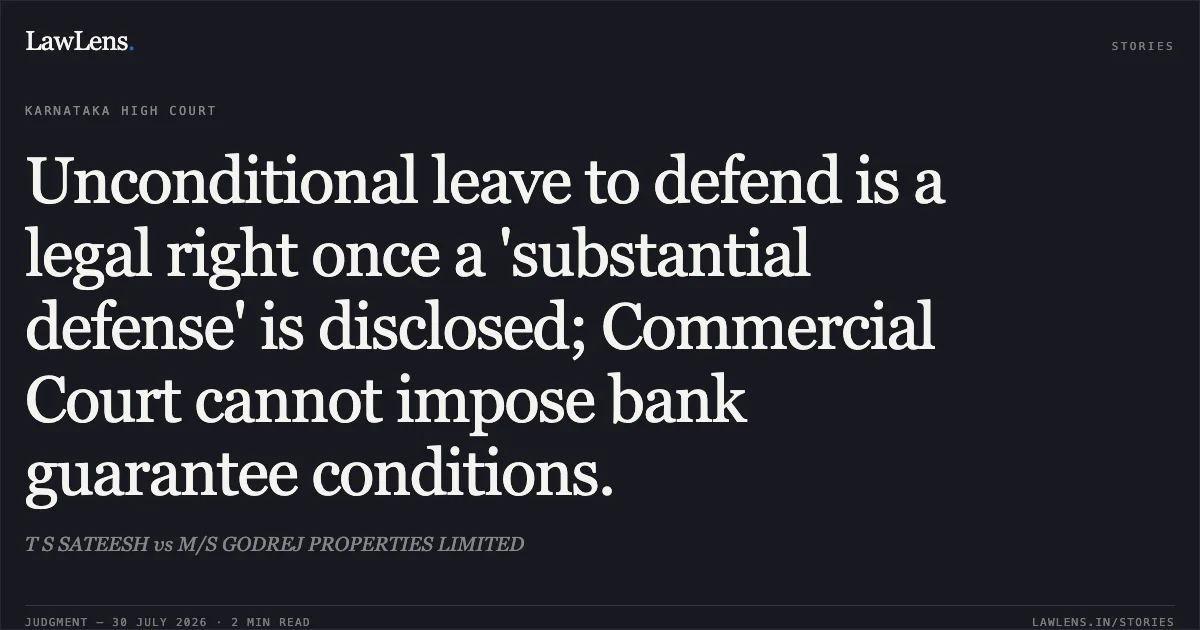
The High Court answered the issue in favor of the petitioner, holding that the Commercial Court’s order was inherently inconsistent.
The Court held that having found the defense to be substantial, the trial court could not legally burden the petitioner with a condition to secure the suit claim.
Source reference: p. 13Consequently, the High Court allowed the writ petition, setting aside the condition to furnish a Bank Guarantee of ₹5,00,00,000/- while affirming the grant of leave to defend.
Source reference: p. 13-14Original Court PDF
T S SATEESHvsM/S GODREJ PROPERTIES LIMITED
Click to open original judgment
Original judgment, available to read, download and summarize on LawLens.in


