Facts
The Appellant previously filed a writ petition, W.P.(C) No. 10752/2025 (“Earlier Writ Petition”), which was disposed of on 08.08.2025
Source reference: p. 1, para 3During those proceedings, the Appellant chose to withdraw the petition unconditionally after the Respondent produced a document dated 24.09.1987
Source reference: p. 3, para 8While withdrawing, the Court noted the Appellant’s request to approach the Respondent for "sympathetic consideration" and observed that the Respondent was free to consider such a request notwithstanding the withdrawal
Source reference: p. 3, para 8On 19.01.2026, the Respondent rejected the Appellant’s representation, stating it could not be considered without a "specific direction from the Court of law"
Source reference: p. 2, para 4The Appellant subsequently filed a second writ petition, W.P.(C) No. 2844/2026, seeking to quash the rejection and obtain the original reliefs
Source reference: p. 2, para 5The learned Single Judge dismissed this second petition on 27.02.2026, ruling that the Appellant was attempting to re-open an abandoned cause of action
Source reference: p. 1-2, para 3Issues
1. Whether the rejection of a representation made on "sympathetic grounds" provides a fresh cause of action to reagitate the same issues that were abandoned in a previously withdrawn writ petition
Source reference: p. 4, para 112. Whether a Court’s observation permitting a Respondent to consider a matter "sympathetically" confers an enforceable right or preserves liberty to institute fresh proceedings on the same cause of action
Source reference: p. 4-5, para 12Law Applied
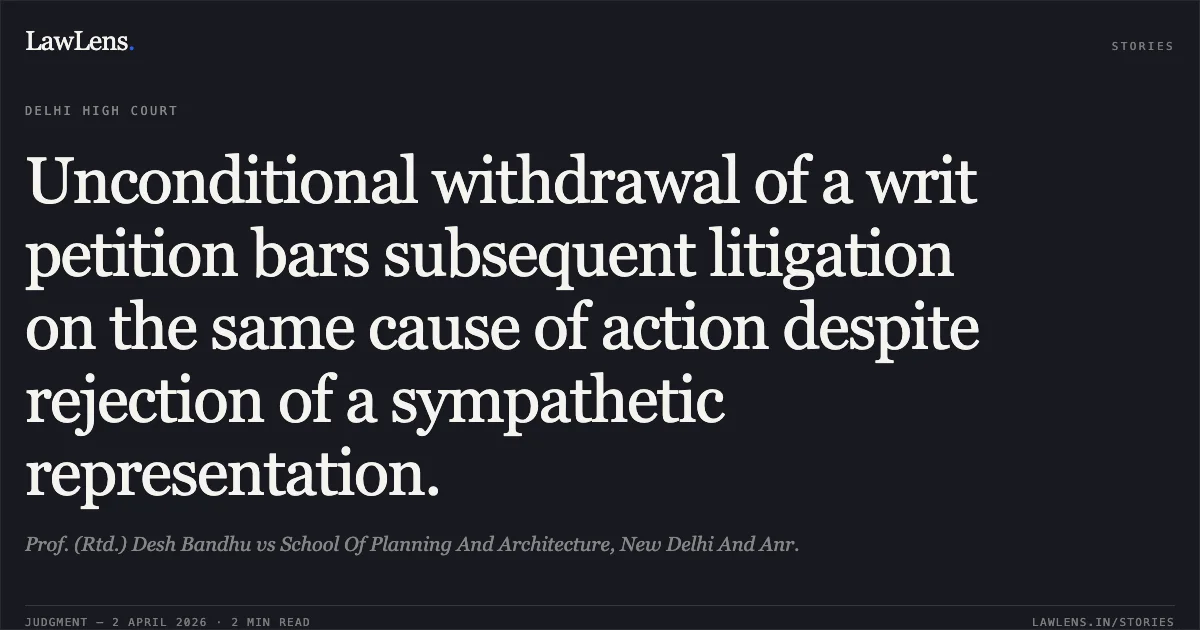
The Court applied the principle that the unconditional withdrawal of a writ petition without obtaining specific liberty from the Court to file afresh precludes a party from reagitating the same cause of action or seeking the same relief in subsequent proceedings
Source reference: p. 2, para 7; p. 5, para 12The Court clarified that an observation allowing "sympathetic consideration" does not equate to a judicial direction, nor does it create a legal or enforceable right that survives the abandonment of the primary claim
Source reference: p. 4, para 11Reasoning
The Court observed that the Appellant's withdrawal of the Earlier Writ Petition was a voluntary act prompted by the Respondent’s counter-affidavit, signaling an abandonment of the merits of the case
Source reference: p. 3, para 8-9The Division Bench emphasized that the "liberty" sought in the earlier round was restricted to making a representation for sympathy, not a reservation of the right to litigate further
Source reference: p. 2, para 6The Court reasoned that since the prayers in the second writ petition were identical to those in the first, the matter stood finally resolved upon the earlier withdrawal
Source reference: p. 3-4, para 9-11Regarding the Respondent’s rejection of the representation, the Court held that even if the Respondent’s reasoning (lack of court direction) was flawed, it did not grant the Appellant a fresh cause of action because there was no mandatory direction to the Respondent to begin with
Source reference: p. 4, para 11Therefore, in the absence of a specific grant of liberty to reagitate the merits, the second petition was legally impermissible
Source reference: p. 5, para 12Holding
The Court answered the issues in the negative and dismissed the appeal
It held that the dismissal of the second writ petition was entirely justified as the limited observation regarding "sympathetic consideration" did not confer any enforceable right or preserve the liberty to file fresh proceedings on the same cause of action
Source reference: p. 4-5, para 12No costs were awarded
Source reference: p. 5, para 13Original Court PDF
Prof. (Rtd.) Desh BandhuvsSchool Of Planning And Architecture, New Delhi And Anr.
Click to open original judgment
Original judgment, available to read, download and summarize on LawLens.in