01Facts
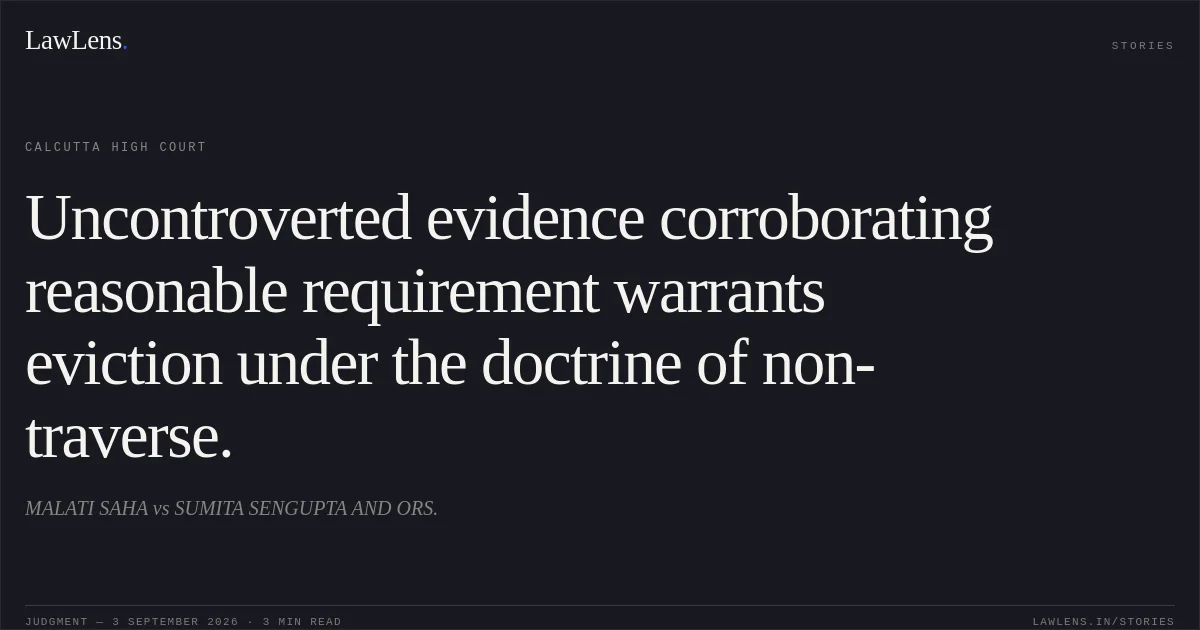
The respondents-plaintiffs instituted a suit seeking eviction of the appellant-tenant on the ground of reasonable requirement.
The Trial Court dismissed the suit, principally holding that the plaintiffs had not established that plaintiff no. 1B was imparting training in physiotherapy, which formed part of the pleaded requirement.
¶ 3 · ¶ 5The First Appellate Court reversed the decree and granted eviction, finding that the plaintiffs’ requirements—including accommodation for a gymnasium, a physiotherapy chamber, separate rooms for male and female patients, and an office—were corroborated by the oral evidence of PW1 and PW2.
¶ 4 · ¶ 6The defendants neither cross-examined the plaintiffs’ witnesses on these matters nor adduced independent evidence.
¶ 5The tenant preferred the present appeal against the judgment of reversal.
The High Court also condoned the delay in depositing the deficit court fees and treated the defect as cured.
¶ 102Issues
i.Whether the First Appellate Court erred in reversing the Trial Court’s dismissal of the eviction suit on the ground of the plaintiffs’ reasonable requirement?
¶ 3–7ii.Whether the plaintiffs’ uncontroverted oral evidence sufficiently corroborated the pleaded requirement, including the need for gymnasium and physiotherapy-related accommodation?
¶ 4–6iii.Whether the appeal raised any substantial question of law warranting interference with the First Appellate Court’s factual findings?
¶ 803Law Applied
In an eviction suit based on reasonable requirement, the Court must assess the landlord’s need by placing itself in the landlord’s position and cannot permit the tenant to dictate the manner or extent of the landlord’s legitimate requirements.
¶ 6 · ¶ 7The doctrine of non-traverse applies where material pleadings are supported by evidence and are not effectively challenged through cross-examination or contrary evidence; in such circumstances, the uncontroverted evidence may be accepted.
¶ 5Under Order XLI Rule 11 of the Code of Civil Procedure, an appellate court may dismiss an appeal at the admission stage where no legally sustainable ground for interference is disclosed.
¶ 904Reasoning
The High Court found that both courts below had considered the facts in detail, but the First Appellate Court correctly concluded that the plaintiffs’ pleaded requirements were supported by the testimony of PW1 and PW2.
¶ 5Since the defendants did not cross-examine those witnesses on the relevant assertions and led no independent evidence, the plaintiffs’ evidence remained uncontroverted and was properly accepted under the doctrine of non-traverse.
¶ 5The Court further held that the plaintiffs were not required to lead elaborate evidence merely to establish that plaintiff no. 1B possessed a physiotherapy degree or that a physiotherapy chamber was reasonably required.
¶ 6The proposed physiotherapy facility was viewed as a natural extension of the existing gymnasium, which the plaintiffs sought to shift from the top floor to the ground floor because of excessive heat affecting clients’ training.
¶ 6Applying the principle that the tenant cannot dictate the landlord’s requirements, the Court found no illegality in the First Appellate Court’s decree.
¶ 7The appellant’s submissions essentially challenged the appreciation of evidence and did not raise a question of law.
¶ 805Holding
The High Court held that the First Appellate Court was justified in granting eviction on the ground of reasonable requirement and that no question of law arose for consideration.
¶ 9The appeal, SAT 93 of 2026, was dismissed under Order XLI Rule 11 CPC.
¶ 9Consequently, CAN 1 of 2026 was also dismissed.
¶ 10The delay in depositing the deficit court fees was condoned and the court fees were accepted.
¶ 1No order was made as to costs.
¶ 11Original Court PDF
MALATI SAHAvsSUMITA SENGUPTA AND ORS.
Click to open original judgment
Original judgment, available to read, download and summarize on LawLens.in