Facts
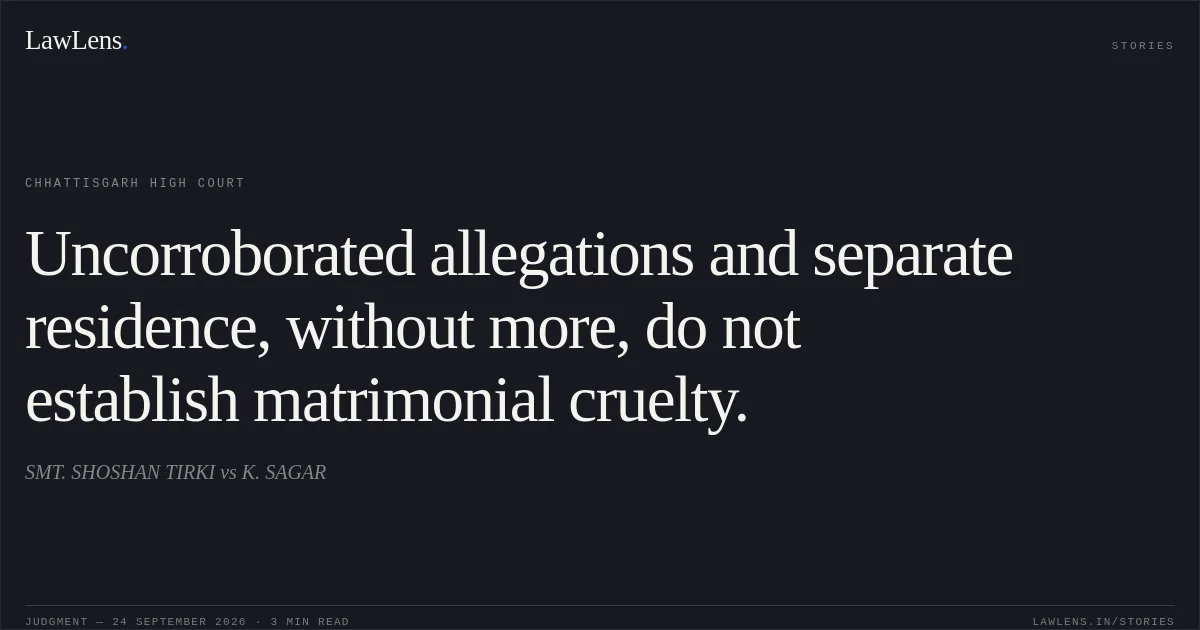
The parties, belonging to the Christian community, initially married under the Special Marriage Act, 1954, at Durg on 25 July 2016 and subsequently underwent a customary Christian marriage on 24 February 2017. The husband alleged that the wife mistreated his parents and relatives, insisted that he live separately from them, refused to return to the matrimonial home, abused his family members, and deprived him of matrimonial and sexual companionship. On these allegations, he sought dissolution of marriage on the ground of cruelty.
Source reference: para. 3The wife denied the allegations. She contended that the husband’s family had not accepted her, that the parties had lived together at her residence for approximately ten months, and that the husband had subsequently left her and returned to his parents without justification. She further alleged that she had suffered ill-treatment and miscarriage and maintained that she was willing to discharge her matrimonial obligations. The III Additional Principal Judge, Family Court, Durg, held that the husband had established cruelty and passed a decree dissolving the marriage on 7 August 2021 in Civil Suit No. 298-A/2018. The wife challenged that decree in the present appeal.
Source reference: para. 4; para. 1; para. 5Issues
Whether the husband proved that the wife had treated him with such cruelty as would entitle him to dissolution of marriage under the Special Marriage Act, 1954?
Source reference: para. 9Whether the Family Court was justified in relying on the husband’s allegations concerning abuse, refusal to cohabit, insistence on separate residence, and denial of matrimonial companionship without adequate corroboration?
Source reference: paras. 10–12Law Applied
The Court applied the provisions of the Special Marriage Act, 1954 governing dissolution of marriage on the ground of cruelty.
Source reference: paras. 10–12It reiterated the principle that matrimonial cruelty cannot be presumed merely from marital differences, separate residence, occasional quarrels, or incompatibility; the alleged conduct must be proved and must be sufficiently grave to make continuation of the matrimonial relationship reasonably impossible. The burden initially lies on the spouse seeking dissolution to establish the alleged cruelty. Serious allegations such as abuse of in-laws or relatives require reliable corroboration, and mere repetition of allegations in pleadings or testimony is insufficient proof. Similarly, non-cohabitation or absence of sexual relations constitutes cruelty only where the refusal is shown to be deliberate, unjustified, and persistent.
Source reference: paras. 10–12Reasoning
The Court found that the Family Court had substantially relied on the husband’s allegations without adequately testing them against the wife’s defence and the surrounding circumstances. The wife’s case that she had not been accepted by the husband’s family, had lived with the husband at her residence, and remained willing to reside with him raised a serious dispute regarding the actual cause of separation.
Source reference: para. 13; para. 11Her desire for a separate matrimonial residence, in the circumstances, could not by itself amount to cruelty, particularly where acceptance by the husband’s family was disputed. The allegation that she deliberately denied sexual relations was also not sufficiently established by proof of a deliberate, unjustified, and persistent refusal. The husband’s admission that the parties had no dispute or quarrel, together with the wife’s expressed willingness to live with him, weakened the case that her conduct had made matrimonial life intolerable. Accordingly, the evidence did not establish cruelty to the required legal standard.
Source reference: paras. 12–14Holding
The Court held that the husband failed to prove that the wife had subjected him to matrimonial cruelty warranting dissolution of marriage under the Special Marriage Act, 1954. The findings of the Family Court were held to be unsustainable.
The appeal was allowed, the judgment and decree dated 7 August 2021 dissolving the marriage were set aside, and the decree was directed to be drawn accordingly. There was no order as to costs.
Source reference: para. 14Original Court PDF
SMT. SHOSHAN TIRKIvsK. SAGAR
Click to open original judgment
Original judgment, available to read, download and summarize on LawLens.in