Facts
On the night of 20–21 June 1996, Babu Lal Yadav (PW-4) and Ram Awadh Yadav (PW-2) were allegedly sleeping on the roof of the informant’s house when 20–25 persons gathered near the main door. During the incident, one firearm shot allegedly struck Ram Awadh Yadav in the stomach.
Source reference: paras. 3–4; pp. 1–2The initial fardbeyan was recorded on 21 June 1996, and an FIR was registered against 20–25 unknown persons under Haspura P.S. Case No. 37 of 1996.
Source reference: paras. 3–4; pp. 1–2The police submitted a final report describing the case as “true but no clue.” The informant’s protest petition was subsequently treated as a complaint, leading to cognizance against the appellant and others under Sections 395, 397 IPC and Section 27 of the Arms Act.
Source reference: para. 5; p. 2The Trial Court acquitted two co-accused but convicted Uday Mahto under Sections 307 IPC and 27 of the Arms Act, sentencing him to ten years’ rigorous imprisonment.
Source reference: para. 7; p. 3The prosecution examined seven witnesses. The principal evidence against the appellant consisted of the testimony of the injured witness, PW-2, who identified the appellant four days after the occurrence and alleged that he had fired the shot.
Source reference: paras. 17–21; pp. 9–19The doctor who prepared the injury report and the Investigating Officer were not examined; no firearm, cartridge, torch, blood-stained clothing, or other physical evidence was seized or produced.
Source reference: paras. 25–30; pp. 15–19Issues
Whether the testimony of the injured witness, PW-2, was sufficiently credible and corroborated to establish beyond reasonable doubt that the appellant had fired at him?
Source reference: paras. 20–24; pp. 10–14Whether the prosecution had proved the alleged firearm injury and the place and manner of occurrence in the absence of the examining doctor, Investigating Officer, seizure evidence, and independent witnesses?
Source reference: paras. 25–30; pp. 15–19Whether the evidence established the ingredients of an offence under Section 307 IPC and Section 27 of the Arms Act against the appellant?
Source reference: paras. 31–32; pp. 19–21Whether the appellant was entitled to the benefit of reasonable doubt?
Source reference: paras. 33–35; pp. 21–22Law Applied
The Court applied Section 307 IPC, which requires proof of an act done with the intention or knowledge that, if it caused death, it would amount to murder, and Section 27 of the Arms Act concerning the use of arms in contravention of the statute.
Source reference: para. 31; pp. 19–20Relying on State of Maharashtra v. Kashirao, (2003) 10 SCC 434, the Court noted that an offence under Section 307 IPC requires an attempt to cause death, an act capable of causing death or performed with the requisite intention, and conduct sufficiently dangerous to create a risk of death or serious injury.
Source reference: para. 31; pp. 19–20The Court further relied on Vijendra v. State of Delhi, (1997) 6 SCC 171, regarding the limited evidentiary value of an injury report when its author is not examined; Takhaji Hiraji v. Thakore Kubersing Chamansing, (2001) 6 SCC 145, and Parminder Kaur v. State of Punjab, (2020) 8 SCC 811, concerning adverse inference from the non-examination of material witnesses; and Tamilselvan v. State, (2008) 7 SCC 755, regarding the difficulty of identification when the assailants themselves are carrying or flashing torches.
Source reference: paras. 25, 27–30; pp. 15–19The Court applied the fundamental rule that conviction must rest on evidence proving guilt beyond reasonable doubt.
Source reference: paras. 16, 33–34; pp. 8–9, 21–22Reasoning
The Court found material inconsistencies between PW-2’s testimony and the informant’s version. The FIR named no accused, although PW-2 allegedly identified the appellant and two others only after regaining consciousness four days later.
Source reference: paras. 22–24; pp. 12–14PW-2 stated that he was sitting on the northern side of the roof and that the shot came from the southern street, making his identification doubtful.
Source reference: paras. 24–26; pp. 14–16His account that the bullet struck his urinary tract also differed from PW-4’s assertion that it struck his stomach, while the injury report itself was not properly proved because the doctor was not examined.
Source reference: paras. 24–26; pp. 14–16The Court also noted that PW-4, who claimed to have been pelting bricks at the assailants, could not identify any of them, whereas PW-2 allegedly identified three persons in the darkness.
Source reference: paras. 26–30; pp. 16–19The prosecution did not examine two other allegedly injured persons, did not produce medical records from the hospital at Gaya, and did not examine the Investigating Officer.
Source reference: paras. 26–30; pp. 16–19No firearm, empty cartridge, torch, blood-stained article, or brick was seized, leaving both the place of occurrence and the source of identification uncorroborated.
Source reference: paras. 26–30; pp. 16–19The Court further held that the acquittal of the co-accused and the failure to prove the alleged dacoity or robbery weakened the foundational prosecution narrative.
Source reference: paras. 31–34; pp. 19–22In the cumulative absence of reliable identification, medical corroboration, objective evidence, and proof of the requisite intention for Section 307 IPC, the evidence did not meet the standard of proof beyond reasonable doubt.
Source reference: paras. 31–34; pp. 19–22Holding
The High Court held that the prosecution failed to prove beyond reasonable doubt that Uday Mahto had fired at PW-2 or that he committed offences under Section 307 IPC and Section 27 of the Arms Act.
The appellant was therefore entitled to the benefit of doubt.
Source reference: paras. 33–34; pp. 21–22The judgment of conviction dated 10 February 2004 and order of sentence dated 11 February 2004 were set aside; the appeal was allowed, and the appellant was discharged from the liability of his bail bonds, subject to his not being required in any other case.
Source reference: paras. 35–36; p. 22The Court also directed the Patna High Court Legal Services Committee to pay Rs. 5,500 to the learned Amicus Curiae.
Source reference: para. 37; p. 22Original Court PDF
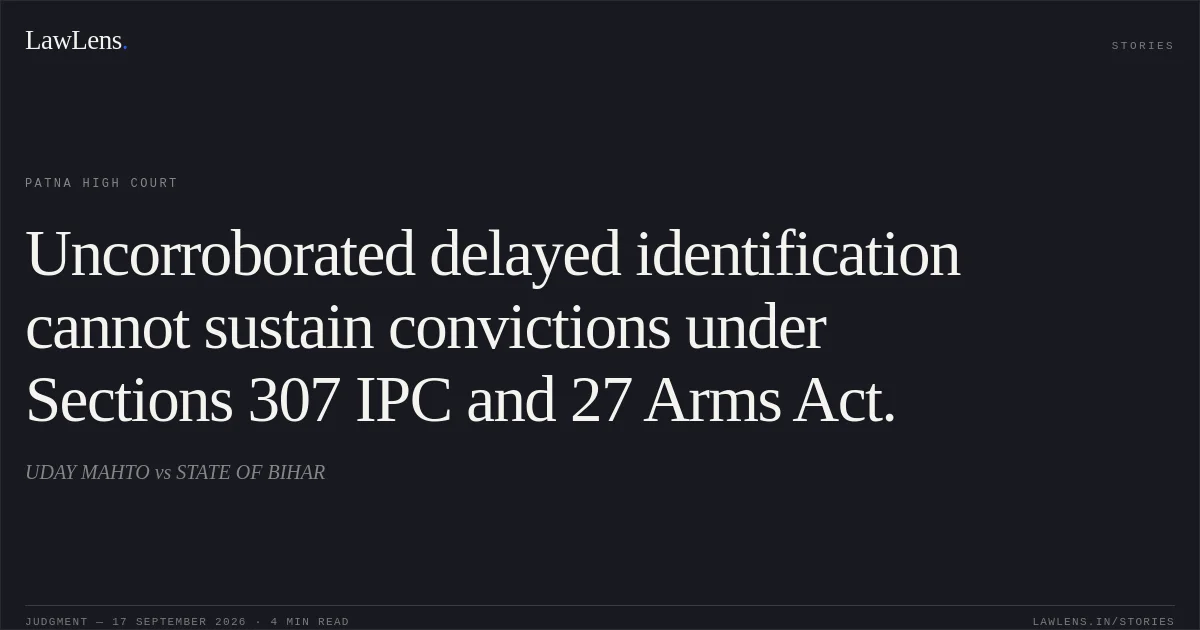
UDAY MAHTOvsSTATE OF BIHAR
Click to open original judgment
Original judgment, available to read, download and summarize on LawLens.in
![Relief is made contingent on the Supreme Court’s eventual determination in the analogous pending case.. Ashok Tolani vs REVENUE. CAT - ['Jaipur']. LawLens](/stories/thumbnails/relief-is-made-contingent-on-the-supreme-courts-eventual-determination-in-the-analogous-pe-0a05b6600e0644cf9facfda571d15955.webp)