Facts
The assessee, a key person in the Citizen Group, filed his return for assessment year 2020–21 declaring income of ₹1,74,57,470.
Source reference: para. 8Following search and survey proceedings, the Assessing Officer relied on seized and impounded documents concerning alleged cash-loan transactions and added ₹3,01,59,831 as unexplained money and ₹4,46,38,775 as interest under Section 69A of the Income-tax Act, 1961.
Source reference: paras. 9–13On appeal, the Commissioner of Income Tax (Appeals) enhanced the total addition to ₹11,35,00,000.
Source reference: para. 14The ITAT set aside the appellate order and directed deletion of the addition.
Source reference: para. 15The Revenue appealed, proposing questions concerning the Tribunal’s deletion of the addition, its consideration of the merits, and its treatment of the seized material and the assessee’s retraction.
Source reference: paras. 2, 16Issues
1. Whether the ITAT’s direction to delete the addition under Section 69A, including the enhancement to ₹11,35,00,000, raised a substantial question of law.
Source reference: paras. 2–3, 5–62. Whether the ITAT’s findings were perverse because it accepted the assessee’s retraction and allegedly ignored corroborative seized or impounded material.
Source reference: para. 2(iv)Law Applied
Section 69A of the Income-tax Act, 1961 permits an addition where money or other specified assets are found to be owned by an assessee and are not satisfactorily explained.
Source reference: no citationUnder Dhakeswari Cotton Mills Ltd. v. Commissioner of Income Tax, West Bengal, an income-tax authority is not bound by technical rules of evidence but cannot make an assessment based on pure guesswork without material.
Source reference: para. 25Under Omar Salay Mohamed Sait v. Commissioner of Income-tax, Madras, a fact-finding tribunal must consider relevant evidence and cannot base findings on suspicion, conjecture, surmise, or no evidence.
Source reference: para. 26Chuharmal v. Commissioner of Income Tax, M.P., Bhopal recognises that, although the Evidence Act’s strict rules do not apply to tax proceedings, its general principles—including those concerning possession and ownership—may be applied where the facts justify them.
Source reference: para. 27Reasoning
The High Court found that the ITAT had considered the seized and impounded documents, the timing of the search, and the assessee’s retraction of his survey statement.
Source reference: paras. 17–20The Tribunal also found no substantive corroborative material establishing that the assessee had advanced cash loans or earned interest, and noted that the alleged borrowers were not examined despite contact details having been provided.
Source reference: paras. 18–22Applying the principles in Dhakeswari Cotton Mills, Omar Salay Mohamed Sait, and Chuharmal, the High Court held that the Tribunal’s assessment of the evidence was not perverse or unsupported; the Revenue’s proposed questions therefore concerned factual findings rather than substantial questions of law.
Source reference: paras. 23–30Holding
The High Court held that no substantial question of law arose and dismissed the Revenue’s appeal.
The stay application, GA No. 2 of 2026, was also dismissed; the Court noted that the delay-condonation application, GA No. 1 of 2026, had already been allowed.
Source reference: para. 31No order as to costs was made.
Source reference: para. 32Acts & Sections Cited
12 provisions across 3 statutes referred to in this judgment. Linked provisions open on LawLens.
Income Tax Act, 1961
Indian Evidence Act, 18721
Indian Income-tax Act, 19221
Original Court PDF
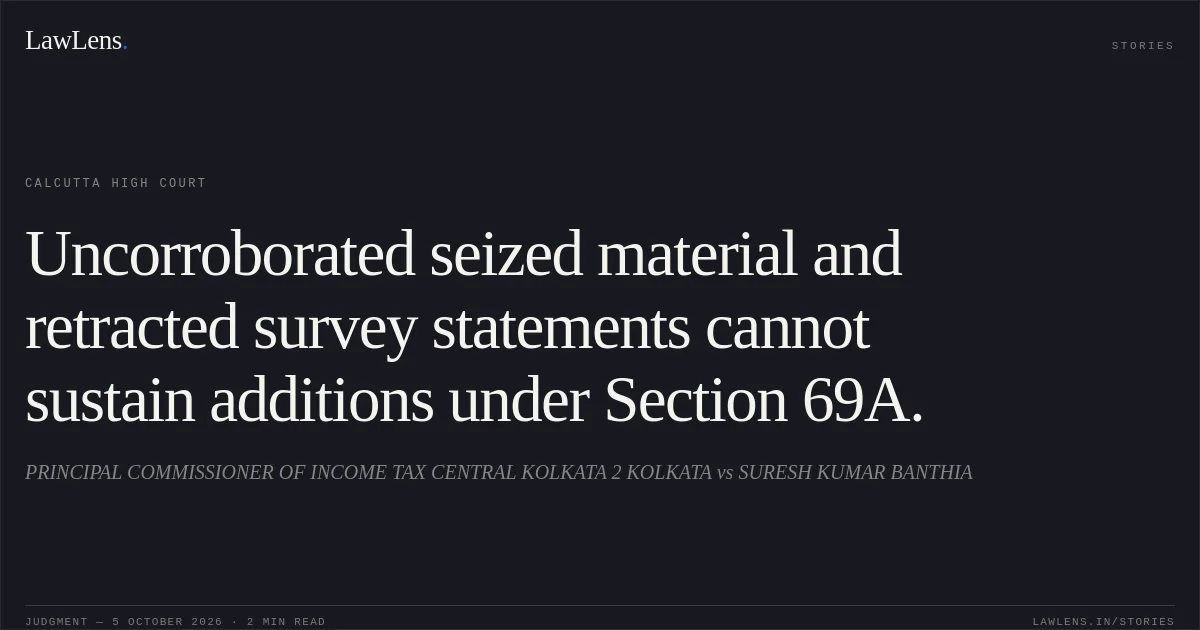
PRINCIPAL COMMISSIONER OF INCOME TAX CENTRAL KOLKATA 2 KOLKATAvsSURESH KUMAR BANTHIA
Click to open original judgment
Original judgment, available to read, download and summarize on LawLens.in