Facts
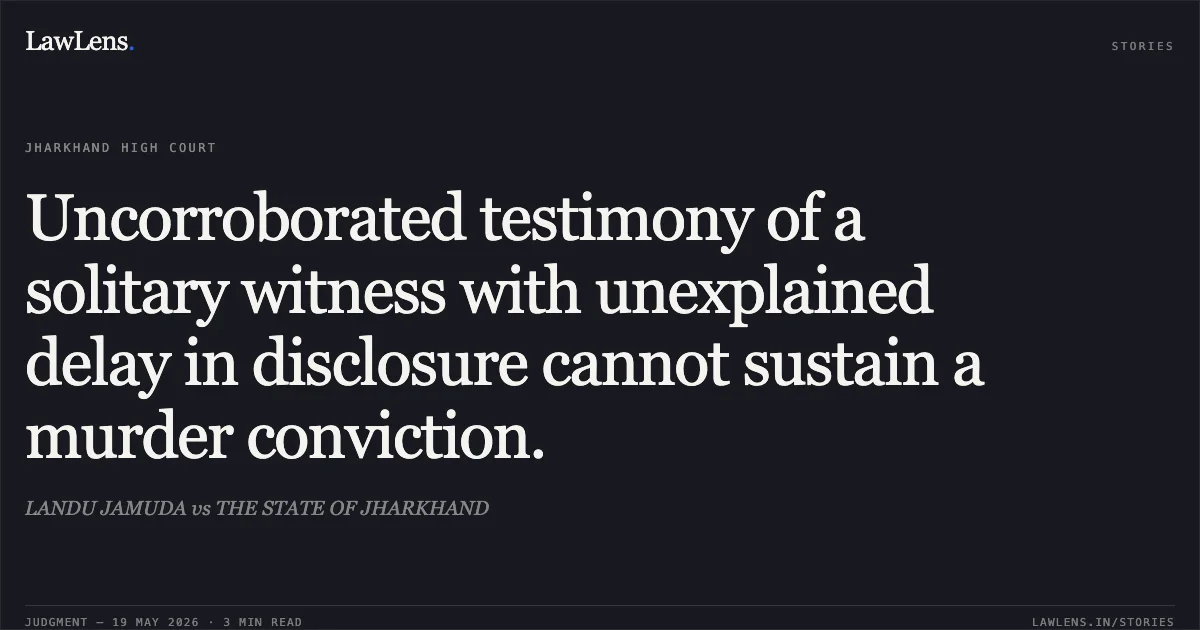
The Appellants were convicted by the Additional Sessions Judge-II, West Singhbhum, for the murder of Budhram Mahli and his wife Kunti, based on an incident allegedly occurring on 23.08.2011
Source reference: p. 2The informant, Soma Mahli (P.W. 1), claimed to have seen the Appellants dragging the victims from their home and assaulting them under a tree on suspicion of practicing witchcraft
Source reference: p. 3-4He further claimed they were taken toward hillocks; their decomposed bodies were recovered from a forest ditch four days later, on 27.08.2011
Source reference: p. 4The Appellants were sentenced to life imprisonment under Section 302/34 IPC and additional terms under Sections 307/34, 201/34 IPC, and Sections 3/4 of the Prevention of Witch (DAAIN) Practices Act
Source reference: p. 2P.W. 1 acted as the sole eyewitness to the initial assault, though he remained silent for four days before reporting the matter
Source reference: p. 5, 18Issues
1. Whether the informant Soma Mahli (P.W. 1) is a trustworthy and reliable witness to sustain the conviction of the appellants?
Source reference: p.17 / para. 452. Whether the prosecution successfully established a complete chain of circumstantial evidence to prove the guilt of the accused beyond a reasonable doubt?
Source reference: p. 17 / para. 45Law Applied
The Court applied the "Panchsheel" principles of circumstantial evidence established in Sharad Birdhichand Sarda v. State of Maharashtra, requiring that the chain of evidence be so complete as to exclude any hypothesis consistent with the innocence of the accused
Source reference: p. 21-22It relied on Hanumant v. State of Madhya Pradesh to emphasize that moral certainty cannot replace legal proof
Source reference: p. 19Regarding the reliability of a solitary witness, the Court applied Govindaraju @ Govinda v. State, holding that the testimony of a sole eyewitness must be of "sterling quality" and free from blemish
Source reference: p. 31State of Orissa v. Brahmananda Nanda was applied to establish that unexplained delay by an eyewitness in disclosing the names of assailants is a serious infirmity that destroys witness credibility
Source reference: p. 32-33Reasoning
The Court found the prosecution's case rested on an incomplete chain of circumstantial evidence and a highly suspect sole witness
Source reference: p. 18-19The Court noted significant contradictions in P.W. 1’s testimony regarding the source of light (torch) used for identification
Source reference: p. 25Crucially, the distance between P.W. 1’s house and the crime scene was approximately 1 km, making it improbable for him to have heard the "halla" (commotion) and reached the scene in time
Source reference: p. 25, 29The Court characterized P.W. 1’s four-day silence as "unnatural conduct," especially given that the victims were his own brother and sister-in-law
Source reference: p. 29, 32The prosecution's failure to examine the village Chowkidar—to whom the informant allegedly reported the event—created a vital gap in the evidence
Source reference: p. 32Additionally, the medical evidence confirmed the victims died of sharp-cut injuries to the neck (beheading), whereas P.W. 1 only described an assault with lathi (sticks), failing to account for the actual cause of death at the second location
Source reference: p. 12, 15, 24Holding
The High Court answered both issues in the negative, holding that the prosecution failed to prove the charges beyond a reasonable doubt
The Court held that the testimony of P.W. 1 lacked the necessary "sterling quality" to sustain a conviction
Source reference: p. 33Consequently, the Court set aside the judgment of conviction dated 26.05.2017 and the order of sentence dated 27.05.2017. The Appellants were acquitted of all charges and ordered to be released forthwith from custody
Source reference: p. 36-37Acts & Sections Cited
9 provisions across 4 statutes referred to in this judgment. Each provision opens on LawLens.
Code of Criminal Procedure, 19732
Bharatiya Nagarik Suraksha Sanhita, 20231
Indian Penal Code, 18604
Original Court PDF
LANDU JAMUDAvsTHE STATE OF JHARKHAND
Click to open original judgment
Original judgment, available to read, download and summarize on LawLens.in