Facts
The plaintiffs sought a declaration that they and the defendants were joint owners in possession of the suit land in equal shares, and that Mutation Nos. 69 and 115, sanctioned in favour of defendant No. 1, were illegal and non-binding. They also sought a permanent injunction against their dispossession.
Source reference: para. 2The defendants asserted that the property was ancestral coparcenary property and that a partition had taken place in 1985, under which different portions were allotted to the parties. They relied upon earlier litigation instituted by Kartar Chand, the predecessor-in-interest, and contended that the present suit was barred by res judicata.
Source reference: para. 3The Trial Court held that the earlier litigation did not determine the parties’ precise shares and partly decreed the suit by declaring the parties’ respective inheritance shares.
Source reference: para. 7The First Appellate Court reversed the decree, holding that the alleged partition had not been proved, that the plaintiffs were not entitled to an injunction because defendant No. 1 was in possession, and that the revenue mutations had been sanctioned without considering the appellate judgment in the earlier proceedings.
Source reference: para. 8Defendant No. 1 preferred the present second appeal, which was admitted on three substantial questions of law.
Source reference: para. 9Issues
1. Whether the earlier adjudication regarding partition and the nature of the suit property operated as res judicata in the subsequent suit.
Source reference: paras. 9(i), 14–172. Whether the earlier judgments conclusively established that Kartar Chand was the Karta of a joint Hindu family consisting of himself and his two sons, thereby precluding contrary findings in the present proceedings.
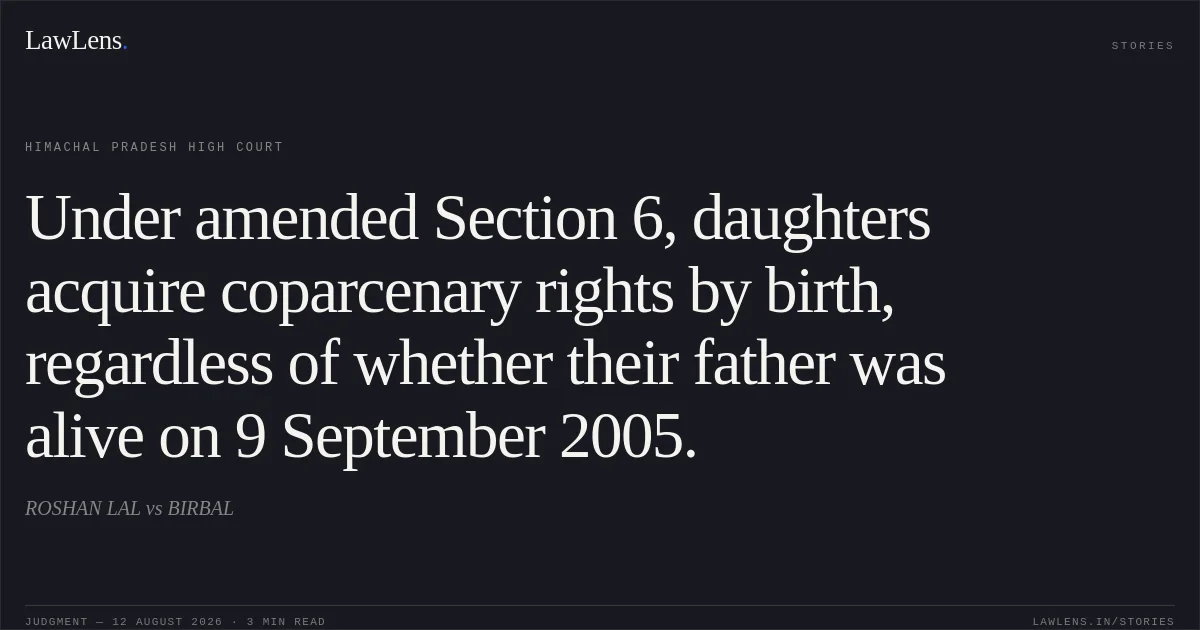
Source reference: paras. 9(ii), 14–173. Whether daughters born before 9 September 2005 acquired coparcenary rights under the substituted Section 6 of the Hindu Succession Act, 1956, or whether the 2005 amendment operated only prospectively.
Source reference: paras. 9(iii), 18–20Law Applied
The Court applied the doctrine of res judicata, holding that an issue directly and substantially decided between the same parties in earlier litigation cannot be reopened in subsequent proceedings.
Source reference: paras. 14–17It also applied the substituted Section 6 of the Hindu Succession Act, 1956, as amended in 2005, under which a daughter becomes a coparcener by birth, with the same rights and liabilities as a son.
Source reference: paras. 18–19Relying on Vineeta Sharma v. Rakesh Sharma, (2020) 9 SCC 1, the Court held that the daughter’s coparcenary right is not dependent upon the father being alive on 9 September 2005; however, rights of daughters born before that date operate from 9 September 2005, subject to the statutory savings relating to prior dispositions, alienations, partitions or testamentary dispositions.
Source reference: paras. 18–19Reasoning
The Court examined the earlier judgment of the District Judge dated 8 December 1994, which had rejected the alleged compromise as an unregistered and invalid partition deed and had held that defendant No. 1 was in possession, without granting the plaintiff possession.
Source reference: para. 15Consequently, defendant No. 1 was barred by res judicata from again asserting in the present proceedings that a valid partition had taken place and that he had been allotted a one-third share.
Source reference: para. 16At the same time, the earlier findings that the property was joint Hindu coparcenary property were not disturbed by either court below. The First Appellate Court’s conclusion that the precise shares need not be determined in the injunction/declaration proceedings was therefore not contrary to the earlier adjudication.
Source reference: para. 17On the succession issue, the Court applied Vineeta Sharma and rejected the appellant’s contention that daughters born before the 2005 amendment were excluded from coparcenary rights. Such daughters acquired coparcenary status by birth, subject to the statutory protection of transactions completed before the relevant cut-off dates.
Source reference: paras. 18–20Holding
The Court answered the first and second substantial questions against the appellant, holding that the plea of a prior partition was barred by res judicata, while the findings concerning the property’s coparcenary character remained binding.
It answered the third question by holding that daughters born before 9 September 2005 were also entitled to coparcenary rights under amended Section 6 of the Hindu Succession Act, subject to statutory savings.
Source reference: paras. 18–20Finding no infirmity in the First Appellate Court’s judgment and decree, the High Court dismissed the second appeal and directed that the pending applications, if any, also stood disposed of.
Source reference: paras. 21–24Original Court PDF
ROSHAN LALvsBIRBAL
Click to open original judgment
Original judgment, available to read, download and summarize on LawLens.in