01Facts
On 23.11.2000, SI Sukhbir Singh, while on patrol near Raj Cinema, Kula Road, Bhuna, apprehended the appellant Jagdish, who was carrying a plastic container and walking swiftly away from the police party.
¶ 2Upon checking, about 1 kg of opium was recovered from the container.
¶ 2FIR No. 283 dated 23.11.2000 was registered under Section 18 of the NDPS Act at Police Station Bhuna, and after investigation and filing of the final report under Section 173 CrPC, the appellant was tried.
¶ 3The Additional Sessions Judge, Fatehabad, convicted the appellant under Section 18(c) NDPS Act and, by order dated 16.12.2005, sentenced him to three years' rigorous imprisonment and a fine of Rs. 20,000/- (in default, one year further RI).
¶ 4, 5The appellant did not challenge the conviction and confined the appeal to sentence.
¶ 9The appellant had already undergone two years, eleven months and five days of imprisonment, had faced prosecution for more than 26 years, had no other prosecution in that period, and was approximately 53 years old.
¶ 10, 11, 15, 16(d)–(f)The State contended that the sentence was already on the lower side and that the appeal lacked merit.
¶ 1202Issues
i.1. Whether the sentence of three years' rigorous imprisonment under Section 18(c) NDPS Act, imposed for possession of a non-commercial quantity of opium, is harsh and warrants modification in light of the time elapsed, the protracted litigation, the period already undergone, the appellant's subsequent conduct and age.
¶ 15, 16, 17ii.2. Whether the sentence already undergone by the appellant is adequate to meet the ends of justice.
¶ 1803Law Applied
Section 18(c) of the NDPS Act, under which the appellant was convicted and sentenced, under which no minimum sentence is prescribed for the offence in the quantity involved.
¶ 11, 16(a)The appellate court's jurisdiction to interfere with the quantum of sentence, which is subject to rationalization where the sentence is harsh in the circumstances.
¶ 17A sentence may be tempered with a lenient view where the convict has suffered prolonged proceedings, has undergone substantial imprisonment, has not reoffended, and has aged, so that the sentence already undergone serves the ends of justice.
¶ 15, 16, 18The judgment cites no precedent and no specific statutory provision for reducing the sentence.
The principle that the prosecution must prove its case beyond reasonable doubt was raised by counsel but not applied, as the conviction was not challenged.
¶ 8, 14Provisions in the judgment · 2 · Linked ones open on LawLens
Narcotic Drugs and Psychotropic Substances Act, 1985 Section 18
Code of Criminal Procedure, 1973 Section 173
04Reasoning
Because the appellant confined his challenge to sentence, the court examined the evidence only to confirm the conviction, found the prosecution evidence consistent and sufficient, and affirmed the finding under Section 18(c).
¶ 14On sentence, the court weighed six factors: the non-commercial quantity, the 26-year lapse since the incident, the protracted trial and appeal, the period already served (over two years of a three-year term), absence of any further offence showing reformation, and advanced age.
¶ 16(a)–(f)Treating the three-year term as harsh in these circumstances, the court held that the sentence required interference.
¶ 17The judgment does not address the fine of Rs. 20,000/- or the default sentence, and does not explain how the reduction was reconciled with the statutory framework for the offence.
05Holding
The conviction under Section 18(c) NDPS Act is upheld.
¶ 14, 19The sentence already undergone by the appellant is adequate to meet the ends of justice.
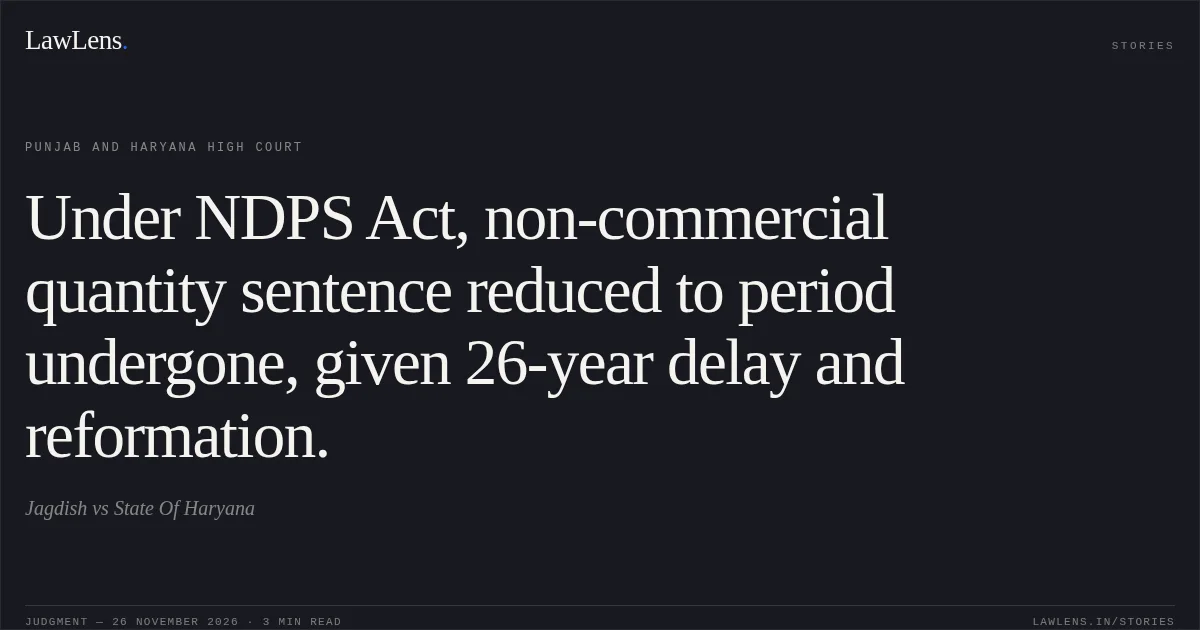
¶ 18The appeal is partly allowed. The order on quantum of sentence is modified, and the sentence of three years' rigorous imprisonment is reduced to the period already undergone by the appellant.
¶ 18, 19Pending miscellaneous applications stand disposed of.
¶ 20Original Court PDF
JagdishvsState Of Haryana
Click to open original judgment
Original judgment, available to read, download and summarize on LawLens.in