01Facts
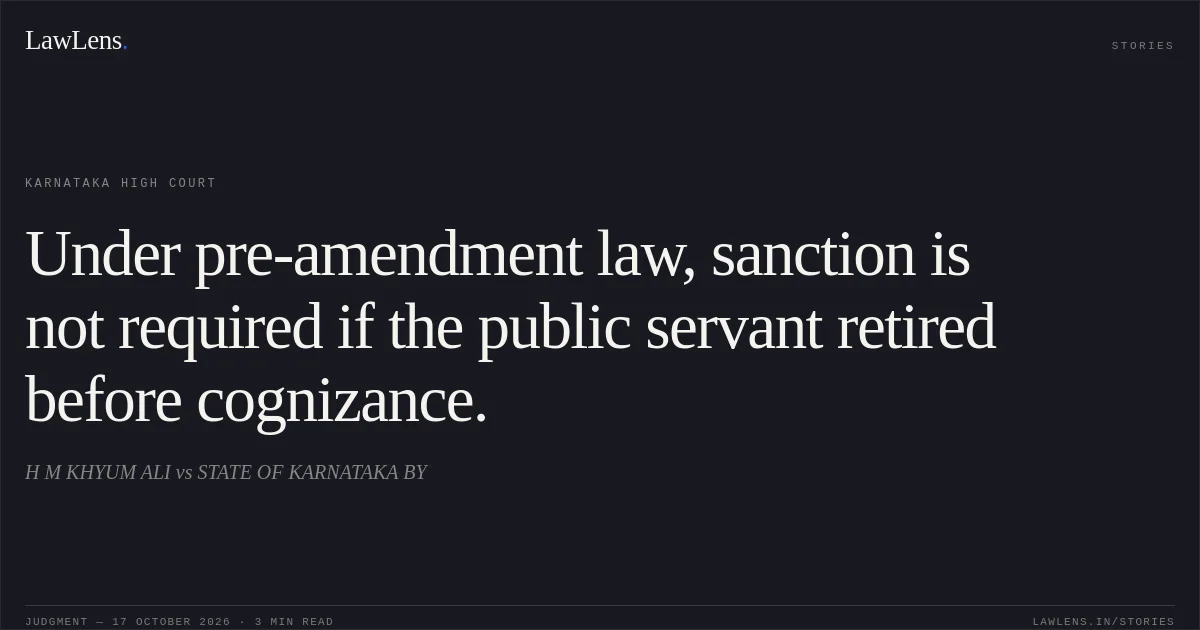
In Crl.P. No. 3849/2019, the petitioner, a retired officer of the Department of Mines and Geology, challenged proceedings under Sections 13(1)(e) and 13(2) of the Prevention of Corruption Act, 1988 (“PC Act”). The prosecution alleged disproportionate assets of approximately 70.81%; the petitioner maintained that information and supporting material he had supplied concerning his assets, income and expenditure had not been considered before the charge sheet was filed.
¶ 3–6Charges had been framed, the petitioner’s discharge application had been dismissed, and prosecution witnesses P.W.1 to P.W.6 had been examined and cross-examined.
¶ 20, 38In W.P. No. 48145/2018, a former IAS officer challenged an investigation and prosecution alleging disproportionate assets of 116.41%. The State had considered the question of sanction and referred the matter to the Central Government; the petitioner retired while that consideration was pending, after which the authorities treated sanction as unnecessary.
¶ 23–25, 43–44Both petitioners also challenged the cognizance orders as mechanical and relied on the 2018 amendment to Section 19 of the PC Act.
¶ 11–15, 25, 27–3002Issues
i.1. Whether the petitioner in Crl.P. No. 3849/2019 had established grounds to quash the criminal proceedings, including on the grounds of absence of sanction, inadequate investigation and mechanical cognizance.
¶ 36 · ¶ 37–41ii.2. Whether the petitioner in W.P. No. 48145/2018 had established grounds to quash the FIR, charge sheet and orders of cognizance and charge, including on the grounds of sanction, delay and mechanical cognizance.
¶ 36 · ¶ 42–4703Law Applied
The Court considered Sections 13(1)(e), 13(2) and 19 of the PC Act, and the High Court’s inherent jurisdiction under Section 482 of the Code of Criminal Procedure, 1973 (“CrPC”), alongside the writ jurisdiction invoked under Articles 226 and 227.
¶ 3, 5, 22Relying principally on State by Deputy Superintendent of Police v. B.T. Ramesh & Anr., [2025] 8 S.C.R. 202, and State of Telangana v. Managipet alias Mangipet Sarveshwar Reddy, (2019) 19 SCC 87, the Court held that the 2018 amendment to Section 19 did not assist the petitioners where the charge sheets and cognizance pre-dated the amendment, and that a retired public servant was not entitled to Section 19 protection where cognizance was taken after retirement.
¶ 17, 19, 40–41, 44The Court also applied the principle that a challenge under Section 482 or writ jurisdiction is not ordinarily the forum to determine disputed defence material or conduct a mini-trial.
¶ 38, 41, 46–47It held that recording that the final report had been perused before taking cognizance was sufficient, in the circumstances, to reject the claim that cognizance had been taken mechanically.
¶ 39, 45Provisions in the judgment · 8 · Linked ones open on LawLens
Code of Criminal Procedure, 1973 Section 190Section 197Section 202Section 204Section 227Section 482
Prevention of Corruption Act, 1988 Section 13Section 19
04Reasoning
In the criminal petition, the Court treated the petitioner’s explanations about omitted assets, income and supporting schedules as disputed matters for trial, particularly since evidence had commenced and P.W.1 to P.W.6 had been examined and cross-examined.
¶ 38, 41It rejected the sanction argument because the charge sheet and cognizance preceded the 2018 amendment and, applying the authorities it considered controlling, held the amendment did not retrospectively require sanction in these circumstances.
¶ 40–41In the writ petition, the Court found that the sanction question had remained pending before the Central Government when the petitioner retired; it therefore rejected the contention that the authorities had deliberately waited for his retirement to avoid obtaining sanction.
¶ 43–45In both matters, the cognizance orders recorded that the final report had been perused, and the Court found no basis to interfere on the ground of mechanical cognizance.
¶ 39, 45It further held that the allegations, calculations of disproportionate assets, delay and defence material required consideration at trial rather than determination in a quashing proceeding.
¶ 46–4705Holding
The Court answered both issues in the negative.
¶ 41, 47–48It dismissed Crl.P. No. 3849/2019 and W.P. No. 48145/2018, declining to quash the respective criminal proceedings, FIRs, charge sheets or challenged court orders.
¶ 41, 47–48Original Court PDF
H M KHYUM ALIvsSTATE OF KARNATAKA BY
Click to open original judgment
Original judgment, available to read, download and summarize on LawLens.in