Facts
On 28 November 2020, DRI officers intercepted Nagendra Hiralal Tiwari and Purmanand Ramchandra Mishra while travelling from Nagpur to Prayagraj and recovered three gold bars weighing 2,997 grams, bearing “Valcambi Suisse”/“Suisse” markings, concealed inside their shoes.
Source reference: para. 4(a)–(b)The carriers stated under Section 108 of the Customs Act, 1962 that they were transporting foreign-origin smuggled gold at the direction of Anand Navalchand Pugaliya, proprietor of M/s Pugaliya Jewellers.
Source reference: para. 4(a)–(b)A search of Pugaliya’s residential and business premises resulted in the seizure of silver bullion weighing 2,43,640.64 grams and Indian currency totalling approximately ₹29.71 lakh.
Source reference: para. 4(c)Pugaliya produced GST invoices, books of account, stock records and documents asserting lawful acquisition; however, inconsistencies emerged concerning the sellers, the number of gold pieces allegedly sent to a refiner, and the absence of entries specifically corresponding to the seized bars.
Source reference: para. 4(e)–(g), paras. 10–15The adjudicating authority ordered absolute confiscation of the gold and silver, confiscation of the cash under Section 121, and imposed penalties under Section 112(b).
Source reference: para. 4(j)The Commissioner (Appeals) set aside the confiscations and penalties, and the CESTAT affirmed that decision.
Source reference: para. 4(k)–(l)The Revenue challenged the common CESTAT order under Section 130 of the Customs Act.
Source reference: para. 4(m)Issues
1. Whether the CESTAT erred in law in interpreting Sections 2(39) and 111 of the Customs Act, 1962 concerning “smuggling” and confiscation of the seized goods.
Source reference: para. 3, Question I2. Whether the CESTAT’s finding that the respondents had discharged the burden of proof under Section 123 of the Customs Act was perverse.
Source reference: para. 3, Question II3. Whether the confiscation of the seized silver bullion and Indian currency was sustainable in the absence of sufficient evidence connecting them with smuggling.
Source reference: paras. 37–41Law Applied
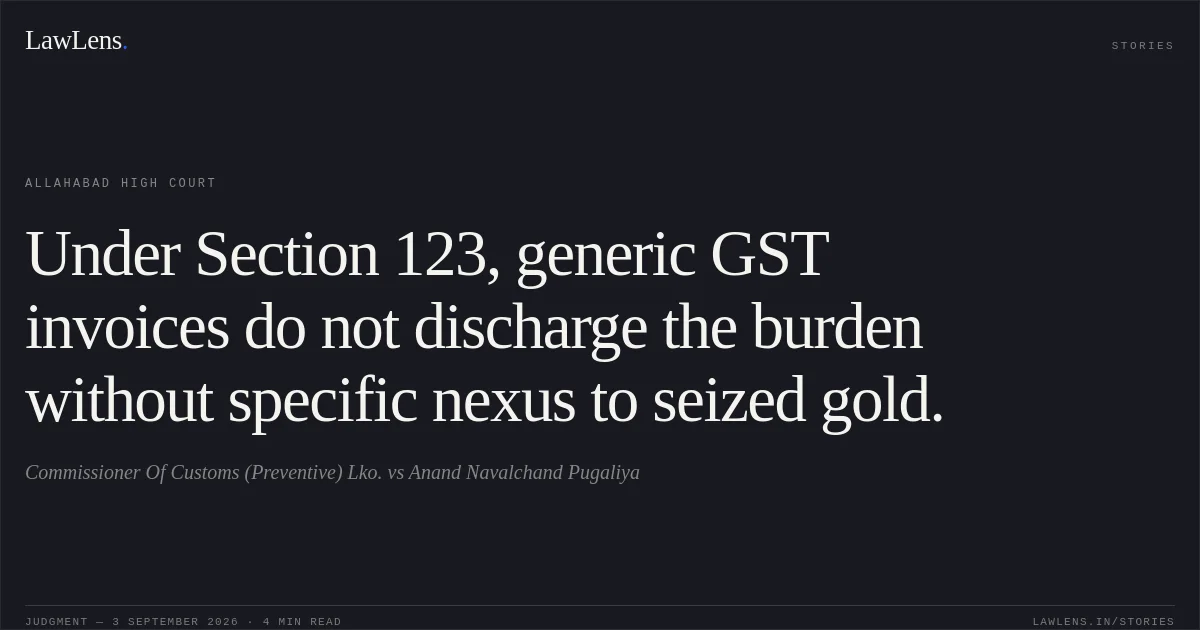
Section 123 of the Customs Act places the burden of proving that notified goods are not smuggled on the person from whose possession they are seized and, where another person claims ownership, also on that claimant; however, the Revenue must first establish seizure under the Act pursuant to a reasonable belief that the goods are smuggled.
Source reference: paras. 6–9The burden is discharged only through specific, credible and traceable evidence establishing lawful acquisition of the seized goods, not merely through general business records or unrelated invoices.
Source reference: paras. 34–36Sections 110 and 123 require reasonable belief based on material indicating smuggling; mere suspicion is insufficient, as recognised in Gian Chand v. State of Punjab, Collector of Customs v. Nathella Sampathu Chetty and Shanti Lal Mehta v. Union of India.
Source reference: paras. 38–40A finding of fact may be interfered with under Section 130 where material evidence has been ignored, irrelevant considerations relied upon, or the conclusion is perverse, as explained in Commissioner of Customs v. Vijay Dasharath Patel, Arulvelu v. State and S.R. Tewari v. Union of India.
Source reference: paras. 28–32Sections 111(a), (b), (h) and (m) authorise confiscation of improperly imported or otherwise prohibited goods; Section 121 applies to sale proceeds of smuggled goods; and Section 112(b) provides for penalties for acts rendering goods liable to confiscation.
Source reference: paras. 4(j), 42–43Reasoning
The Court held that the statutory preconditions for invoking Section 123 were satisfied in relation to the gold: the goods were notified gold, seized under the Customs Act, and reasonably believed to be smuggled because they were foreign-marked, of exceptionally high purity, clandestinely concealed, and accompanied by the carriers’ Section 108 statements admitting smuggling.
Source reference: paras. 8–9, 23The burden therefore shifted to Pugaliya and the carriers.
Source reference: no citationTheir defence was found insufficient because the owner gave inconsistent accounts regarding the sellers and whether 35 or 38 pieces had been sent for conversion; the refiner stated that he had produced unmarked bars and had not supplied the marked bars recovered; the invoices did not specifically correspond to the seized gold; and the books lacked matching inward or outward entries.
Source reference: paras. 22–25The Commissioner (Appeals) and CESTAT committed a jurisdictional and evidentiary error by treating the production of GST invoices and a Chartered Accountant’s certificate as conclusive, while disregarding the carriers’ statements, the refiner’s evidence, the foreign markings, the purity and the identity mismatch.
Source reference: paras. 26–36In contrast, the silver was seized from premises, bore no foreign markings, and was not linked by the carriers or other evidence to smuggling; hence the Revenue failed to establish the initial reasonable belief necessary to shift the burden under Section 123.
Source reference: paras. 37–40The Indian currency was likewise outside Section 123, and the Revenue failed to prove that it represented sale proceeds of smuggled goods; reliance on the pending benami proceedings and general suspicion was inadequate.
Source reference: para. 41Holding
The substantial questions of law were answered in the affirmative concerning the three gold bars.
The Court set aside the CESTAT and Commissioner (Appeals) findings insofar as they related to the gold and restored the adjudicating authority’s order of confiscation under Section 111.
Source reference: para. 42The findings in favour of the respondents concerning the silver bullion and Indian currency were upheld, as the Revenue had not established their smuggled character or connection with the sale proceeds of smuggled goods.
Source reference: paras. 40–42The penalties imposed on Pugaliya, Tiwari and Mishra were reduced to 50% of the amounts imposed by the adjudicating authority, and Custom Appeals Nos. 1–3 of 2026 were partly allowed and disposed of accordingly.
Source reference: paras. 43–44Acts & Sections Cited
12 provisions across 2 statutes referred to in this judgment. Each provision opens on LawLens.
Customs Act,1962
Prohibition of Benami Property Transactions Act, 19882
Original Court PDF
Commissioner Of Customs (Preventive) Lko.vsAnand Navalchand Pugaliya
Click to open original judgment
Original judgment, available to read, download and summarize on LawLens.in