Facts
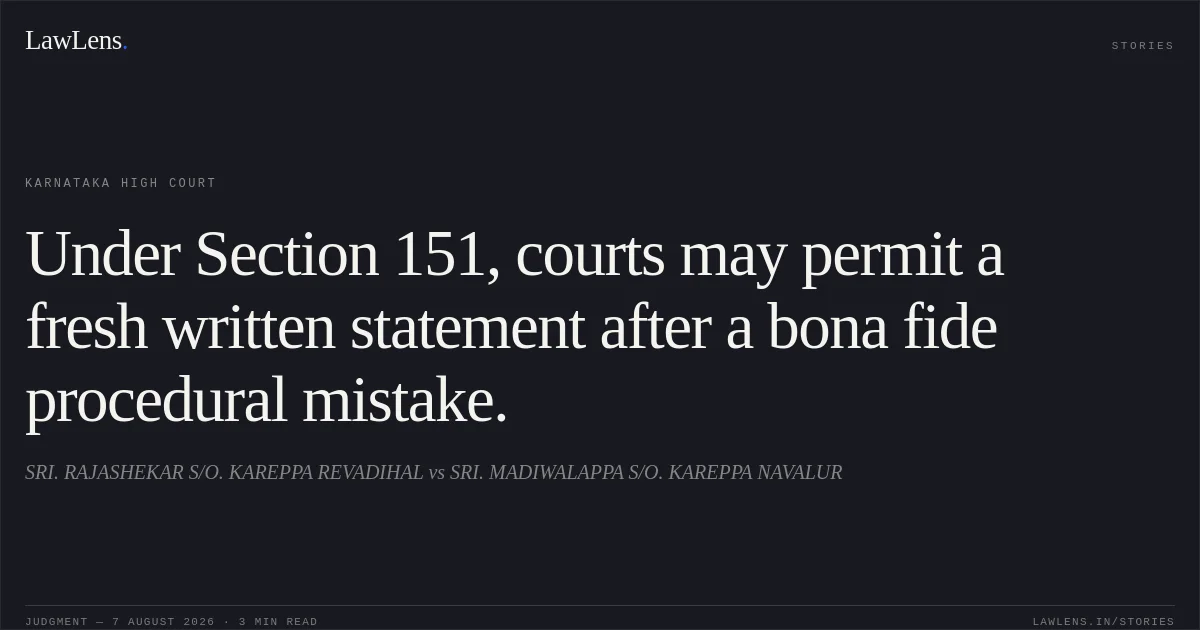
The petitioners, defendant Nos. 3 to 6 in O.S. No.415 of 2017, challenged the Trial Court’s rejection of their application under Section 151 of the Code of Civil Procedure, 1908 (“CPC”).
Source reference: paras. 1, 3The plaintiff had instituted two separate suits, O.S. Nos.413 and 415 of 2017.
Source reference: no citationWhile serving summons in O.S. No.415 of 2017, the plaintiff inadvertently supplied a copy of the plaint from O.S. No.413 of 2017.
Source reference: no citationRelying on the incorrect plaint, the petitioners prepared and filed a written statement in O.S. No.415 of 2017 on 28 August 2019.
Source reference: no citationUpon discovering the mistake, they sought permission to withdraw that written statement and file a fresh written statement corresponding to the pleadings in O.S. No.415 of 2017.
Source reference: no citationThe Trial Court rejected the application on the ground that the CPC contains no provision permitting withdrawal of a written statement.
Source reference: paras. 1, 3The plaintiff did not dispute that the incorrect plaint had been supplied inadvertently.
Source reference: para. 9Issues
Whether, in the absence of an express provision in the CPC, a Civil Court may exercise its inherent powers under Section 151 CPC to permit withdrawal of a written statement and filing of a fresh written statement in exceptional circumstances?
Source reference: para. 4Whether the petitioners should be permitted to replace the written statement filed on the basis of the plaint in another suit, where the mistake was bona fide and admitted by the plaintiff?
Source reference: paras. 9–13Law Applied
The Court held that the CPC contains no specific provision permitting withdrawal and substitution of an already-filed written statement, although Order VI Rule 17 provides for amendment of pleadings and Order VIII Rule 9 deals with subsequent pleadings.
Source reference: para. 5This omission does not amount to a prohibition where the Court’s intervention is necessary to secure the ends of justice or prevent abuse of process under Section 151 CPC.
Source reference: paras. 6–8Relying on Padam Sen v. State of Uttar Pradesh, AIR 1961 SC 218, and Manohar Lal Chopra v. Rai Bahadur Rao Raja Seth Hiralal, AIR 1962 SC 527, the Court reiterated that inherent powers supplement the CPC where it is silent but cannot override an express statutory provision.
Source reference: para. 8Under K.K. Velusamy v. N. Palanisamy, (2011) 11 SCC 275, Section 151 is an inherent procedural power to be exercised sparingly, with circumspection, and only in exceptional situations where refusal would cause manifest injustice or permit abuse of process.
Source reference: para. 8The Court also referred to Ram Chand & Sons Sugar Mills Pvt. Ltd. v. Kanhayalal Bhargava, (1966) 3 SCR 856, and Salem Advocate Bar Association v. Union of India, AIR 2005 SC 3353.
Source reference: paras. 8, 12Reasoning
The Trial Court adopted an unduly technical approach by treating the absence of an express CPC provision as an absolute bar to granting relief.
Source reference: para. 10The petitioners were not claiming a statutory right to withdraw their written statement; they invoked the Court’s inherent jurisdiction to correct an admitted procedural mistake.
Source reference: para. 10Since the written statement had been prepared on the basis of pleadings belonging to another suit, it could not constitute a meaningful defence to O.S. No.415 of 2017.
Source reference: para. 11Compelling the petitioners to rely on it would deprive them of an effective opportunity to contest the suit on merits and cause manifest injustice.
Source reference: para. 11The mistake was bona fide, the plaintiff admitted the underlying error, and permitting a correct written statement would neither prejudice the opposing party nor conflict with any express provision of the CPC.
Source reference: paras. 9, 13The Court further held that the Karnataka amendment to Order VIII Rule 1, introducing a 120-day outer limit and forfeiture consequence, did not prevent relief in the present pending suit, particularly in the exceptional circumstances warranting supervisory interference under Article 227.
Source reference: para. 12Holding
The Court answered the issue in the affirmative and allowed the writ petition.
It quashed the Trial Court’s order rejecting the petitioners’ application and allowed their application under Section 151 CPC.
Source reference: no citationThe written statement dated 28 August 2019 was directed not to be acted upon for adjudication of O.S. No.415 of 2017.
Source reference: para. 15The petitioners were permitted to file a fresh written statement within four weeks from receipt of the certified copy of the order, and the Trial Court was directed to receive it on record and proceed with the suit in accordance with law.
Source reference: para. 15Acts & Sections Cited
1 provisions across 1 statute referred to in this judgment. Linked provisions open on LawLens.
Code of Civil Procedure, 19081
Original Court PDF
SRI. RAJASHEKAR S/O. KAREPPA REVADIHALvsSRI. MADIWALAPPA S/O. KAREPPA NAVALUR
Click to open original judgment
Original judgment, available to read, download and summarize on LawLens.in