Facts
M/s. Le Meridian, Bengaluru, owned by M/s. Mac Charles (I) Ltd., had erected a hoarding on its premises. The BBMP issued demand notices concerning hoarding and billboard taxes and directed removal of the hoarding.
Source reference: paras. 4–6Despite the pending dispute and interim protection, the BBMP alleged that the hoarding had not been removed after publications in Kannada and English newspapers requiring its removal by 30 August 2018. A complaint was lodged on 1 October 2018, resulting in registration of Crime No.138/2018 under Section 3 of the Karnataka Open Places (Prevention of Disfigurement) Act, 1981 (“KOPD Act”).
Source reference: paras. 8, 14–15A charge sheet was subsequently filed in C.C. No.32777/2018 before the VIII Additional Chief Metropolitan Magistrate, Bengaluru.
Source reference: no citationM/s. Le Meridian sought quashing of the complaint and FIR in Crl.P. No.7959/2018. M.S. Reddy, described in the proceedings both as the company’s Vice-President (Finance) and Company Secretary and as an employee/Assistant Manager (Finance), sought quashing of the entire proceedings, including the charge sheet, in Crl.P. No.2208/2019.
Source reference: paras. 4–7Issues
1. Whether the erection and exhibition of the hoarding on the petitioners’ private premises, without written permission from the local authority, attracted Section 3 of the KOPD Act, notwithstanding the exemption relating to advertisements connected with business conducted on the land or building?
Source reference: paras. 10–12, 16, 222. Whether the pendency of writ proceedings and the interim order concerning the BBMP’s tax demand barred or invalidated the subsequent criminal proceedings under Section 3 of the KOPD Act?
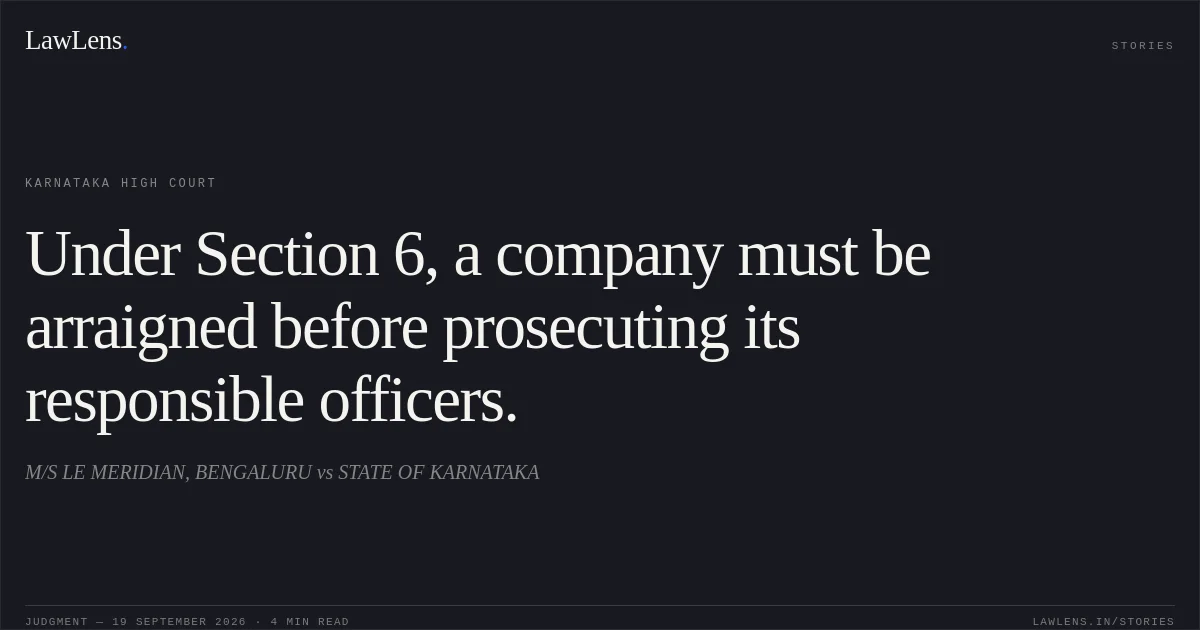
Source reference: paras. 15–16, 223. Whether prosecution of M.S. Reddy could continue under Section 6 of the KOPD Act when the company allegedly responsible for the hoarding had not itself been arraigned as an accused?
Source reference: paras. 13, 23–24Law Applied
Section 3 of the KOPD Act penalises affixing, erecting, inscribing or exhibiting an advertisement in a place open to public view without written permission of the competent local authority, subject to specified exemptions, including an advertisement relating to the trade, profession or business carried on within the land or building on or over which it is exhibited.
Source reference: para. 11Section 6 provides that where the offence is committed by a company, both the company and every person who was in charge of and responsible for the conduct of its business are deemed guilty, subject to the statutory defence; liability may also extend to directors, managers, secretaries or officers where consent, connivance or gross negligence is proved.
Source reference: para. 13The Court relied on Links Advertisers and Business Promoters v. Commissioner, Corporation of the City of Bangalore, (1977) 3 SCC 204, for the principle that an advertisement visible from a public street may attract municipal regulation notwithstanding its location on another person’s premises; Novva Ads v. Secretary, Department of Municipal Administration and Water Supply, (2008) 8 SCC 42, for the principle that hoardings on private property may also be regulated through licensing where they abut or are visible from public places; and P. Narayana Bhat v. State of Tamil Nadu, (2001) 4 SCC 554, concerning the regulatory power over hoardings and the requirement of obtaining requisite permission.
Source reference: paras. 17–20Reasoning
The Court held that the hoarding’s location on private property did not, by itself, take it outside Section 3. The complaint alleged that the hoarding was visible to the public, that no permission had been obtained, and that the petitioners failed to remove it despite public notices and an opportunity to do so.
Source reference: paras. 14, 16, 21–22The Court further distinguished the writ proceedings, observing that the interim order related to the BBMP’s tax demand and did not authorise continued display of the hoarding or prevent independent criminal action for unauthorised exhibition under the KOPD Act.
Source reference: paras. 15–16, 22However, on the question of corporate liability, the Court found that the alleged violation was attributed to the owner/company, M/s. Le Meridian, while the company had not been arraigned as an accused. Applying Section 6, the Court held that the company was required to be made an accused before proceeding against the individual officer alleged to be responsible for its affairs.
Source reference: paras. 23–24The failure to implead the company rendered the prosecution against M.S. Reddy an abuse of process.
Source reference: paras. 23–24Holding
The Court answered that the hoarding could, in principle, attract Section 3 of the KOPD Act even though it stood on private property, and that the writ proceedings concerning tax demands did not bar criminal prosecution.
Nevertheless, because the company alleged to have committed the offence had not been arraigned as an accused, the proceedings against M.S. Reddy could not be sustained under Section 6.
Source reference: paras. 24–25Both criminal petitions were consequently allowed, and the proceedings in C.C. No.32777/2018—including the charge sheet dated 13 December 2018, complaint and FIR dated 1 October 2018 in Crime No.138/2018—were quashed.
Source reference: paras. 24–25Acts & Sections Cited
3 provisions across 2 statutes referred to in this judgment. Each provision opens on LawLens.
Code of Criminal Procedure, 19731
Original Court PDF
M/S LE MERIDIAN, BENGALURUvsSTATE OF KARNATAKA
Click to open original judgment
Original judgment, available to read, download and summarize on LawLens.in