Facts
The complainant alleged that, under a 1998 agreement to sell three parcels of land, he paid ₹2,00,000 to Applicant No. 2, who acted as his mother’s power-of-attorney holder, but the agreed sale deeds were not executed.
Source reference: para. 1–2He further alleged that one parcel was later sold to a third party and that the applicants refused to convey the land or return the money. An FIR under Sections 406, 420 and 120-B IPC was registered on 1 April 2017.
Source reference: para. 1–2The applicants sought quashing under Section 482 CrPC, relying, among other things, on a registered sale deed executed in the complainant’s favour for one parcel in 2006, the delay in lodging the FIR and the absence of dishonest intent from the outset.
Source reference: para. 3–3.3The application had abated against Applicant No. 1, who had died.
Source reference: para. 5A charge-sheet had been filed while the quashing application was pending.
Source reference: para. 8Issues
Whether the FIR and consequential proceedings disclosed the essential ingredients of offences under Sections 406 and 420 IPC, or instead concerned a contractual dispute lacking criminal intent.
Source reference: para. 7.2–7.3, 9–12Whether the High Court could consider the registered sale deed and other undisputed material, and quash the proceedings despite the filing of a charge-sheet.
Source reference: para. 8, 10–11Whether the delay, alleged suppression of the registered sale deed and failure to pursue civil remedies rendered the prosecution an abuse of process.
Source reference: para. 7.1, 7.4–7.5, 11–12Law Applied
Section 482 CrPC empowers the High Court to prevent abuse of process and secure the ends of justice; the filing of a charge-sheet does not remove that power.
Source reference: para. 8For cheating under Section 420 IPC, dishonest intention must exist when the inducement is made; a later breach of contract, without such initial intent, does not by itself constitute cheating.
Source reference: para. 7.2; para. 7.7Section 406 IPC requires entrustment and dishonest misappropriation; the Court held that advance consideration paid under an agreement to sell did not constitute entrustment in this case.
Source reference: para. 7.3Under State of Haryana v. Bhajan Lal, 1992 Supp (1) SCC 335, quashing may be appropriate where the allegations disclose no offence or the proceedings are manifestly mala fide.
Source reference: para. 11The Court also relied on the principle that undisputed, unimpeachable public documents may be considered when exercising Section 482 jurisdiction.
Source reference: para. 11Reasoning
The Court treated the registered sale deed executed in the complainant’s favour for Survey No. 565/3 as an undisputed public document and found that the FIR’s omission of that transaction presented an incomplete account of the parties’ dealings.
Source reference: para. 7.1, 11.3, 11.1It considered the partial performance inconsistent with an intention to deceive at the inception of the 1998 agreement and concluded that the failure to convey the remaining parcels, on the material before it, amounted at most to a civil breach.
Source reference: para. 7.2It further found no entrustment to support Section 406 IPC.
Source reference: para. 7.3The long interval between the agreement, the last payment and the FIR, together with the absence of a timely civil claim, supported the Court’s conclusion that the criminal process was being used to revive a stale civil dispute.
Source reference: para. 7.4–7.5, 11.5The Court held that the registered deed could be considered without conducting an impermissible mini-trial and that the pending charge-sheet did not bar quashing.
Source reference: para. 8, 10–11Holding
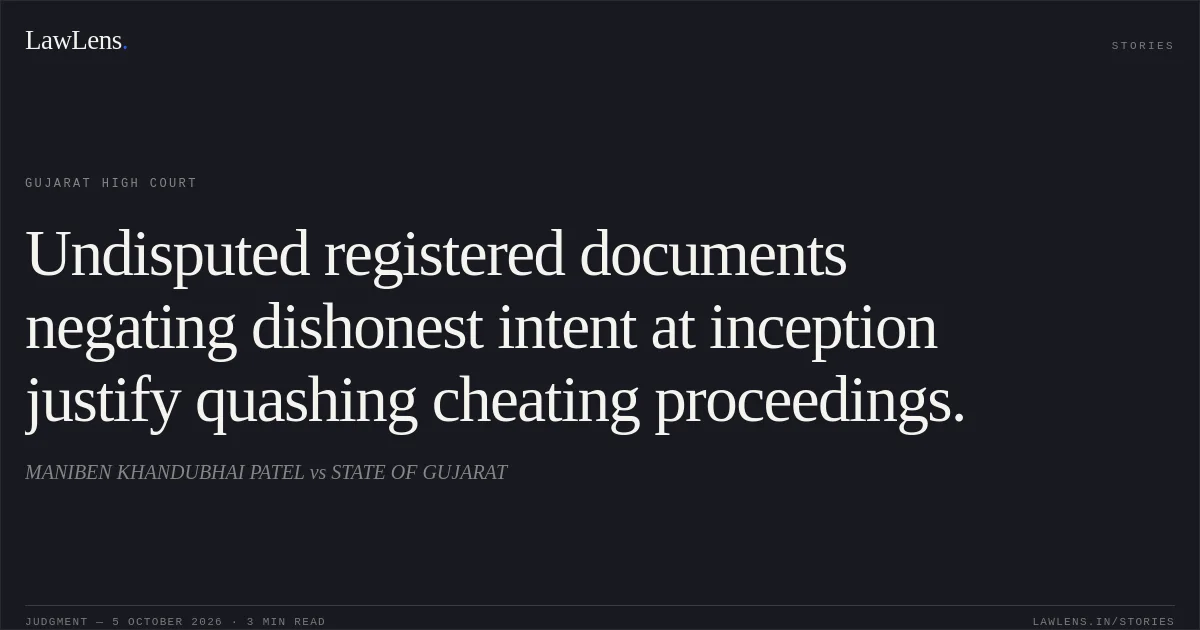
The Court allowed the application and quashed FIR C.R. No. I-47 of 2017 and all consequential proceedings qua Applicant No. 2, finding that their continuation would amount to an abuse of process.
The application against Applicant No. 1 had already abated following her death.
Source reference: para. 5, 13Rule was made absolute to that extent.
Source reference: para. 14Acts & Sections Cited
5 provisions across 3 statutes referred to in this judgment. Each provision opens on LawLens.
Code of Criminal Procedure, 19731
Indian Penal Code, 18603
Limitation Act, 19631
Original Court PDF
MANIBEN KHANDUBHAI PATELvsSTATE OF GUJARAT
Click to open original judgment
Original judgment, available to read, download and summarize on LawLens.in