Facts
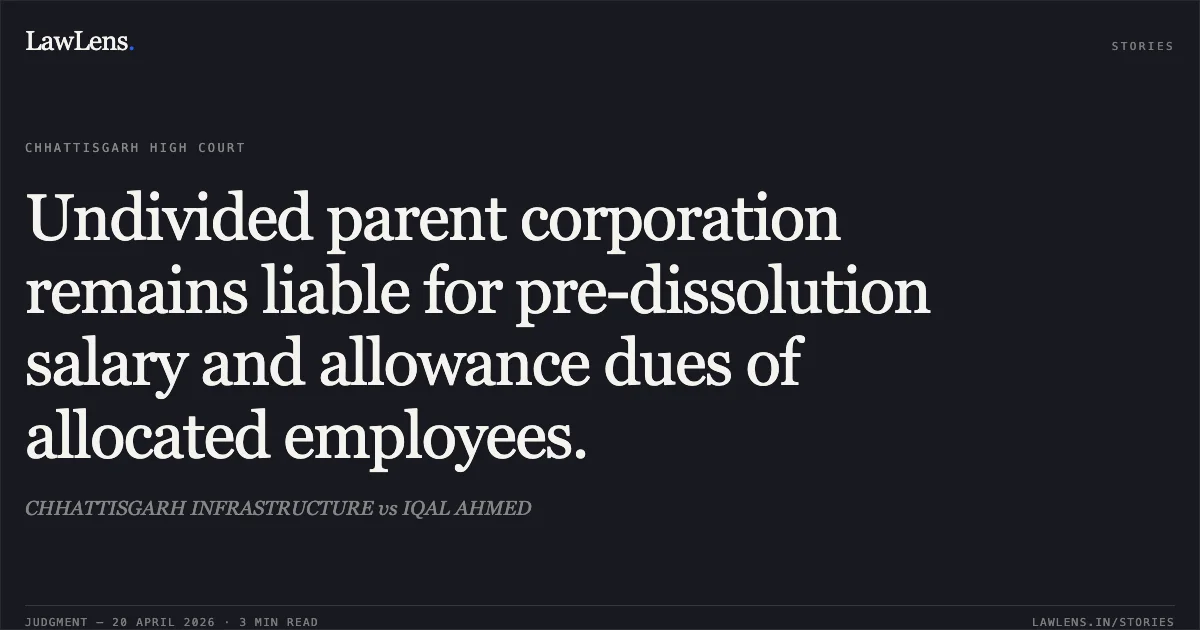
The respondents (workmen) were originally employees of the Madhya Pradesh State Road Transport Corporation (MPSRTC). Following the reorganization of the State and the creation of Chhattisgarh, their services were allocated to the Chhattisgarh Infrastructure Development Corporation (CIDC).
Source reference: para. 2In 2014, the workmen filed applications under Section 15(2) of the Payment of Wages Act, 1936, claiming arrears for overtime and night halt allowances for the period between 1993 and 2002.
Source reference: para. 3, 13The Labour Court initially rejected these claims on the ground of limitation.
Source reference: para. 5On appeal, the Industrial Court of Chhattisgarh reversed this decision, holding that the claims were not barred by limitation and directing CIDC to settle the dues.
Source reference: para. 1, 5CIDC challenged this order before the High Court, contending that the claims were time-barred and that, per a Central Government notification dated 27.12.2002, liabilities arising prior to 31.12.2002 were the responsibility of MPSRTC, not CIDC.
Source reference: para. 4, 6Issues
Whether the claims for arrears of wages and allowances were barred by the limitation period prescribed under Section 15(2) of the Payment of Wages Act, 1936.
Source reference: para. 13-14Whether the liability to pay arrears for the period 1993–2002 rests with the successor corporation (CIDC) or the original undivided corporation (MPSRTC) under the reorganization notifications.
Source reference: para. 17, 21Law Applied
The court primarily applied Section 15(2) of the Payment of Wages Act, 1936, which stipulates a twelve-month limitation period for wage claims but allows for condonation of delay upon showing sufficient cause.
Source reference: para. 12It relied on the precedent established in M.R. Gupta v. Union of India (1995) 5 SCC 628, which held that persistent non-payment of dues constitutes a "continuing wrong," giving rise to a recurring cause of action each month salary is incorrectly paid.
Source reference: para. 15Furthermore, the court applied the Central Government Notification dated 27.12.2002 issued under the Madhya Pradesh Reorganization Act, 2000, specifically Clause 4, which mandates that staff salaries and dues until the date of dissolution must be paid by the existing undivided corporation.
Source reference: para. 18, 22Reasoning
Regarding limitation, the Court affirmed the Industrial Court's finding that the failure to pay allowances created a recurring cause of action, citing M.R. Gupta to conclude that the claims were not barred despite the passage of several years.
Source reference: para. 14-15On the merits of the claim, the Court noted that documents issued by the Depot Manager (Ex. P/1 to P/7) established the workmen's entitlement to the allowances.
Source reference: para. 16However, on the critical issue of liability, the Court found that the Industrial Court erred in fastening the burden on CIDC.
Source reference: para. 17-18, 21Applying the Division Bench's reasoning in State of Chhattisgarh v. G.K. Gupta (WA No. 419 of 2011), the Court interpreted Clause 4 of the 27.12.2002 Notification to mean that any liability pertaining to salary or allowances accruing before the corporation's dissolution remains with the MPSRTC.
Source reference: para. 17-18, 21Since the claims related to the period 1993–2002 (prior to the effective transition), the liability could not be shifted to CIDC.
Source reference: para. 21-22Holding
The High Court allowed the writ petitions and modified the Industrial Court’s order.
It held that while the workmen are entitled to the arrears, the liability rests solely with MPSRTC (now MPRTC) and not CIDC.
Source reference: para. 22The Court directed MPSRTC to make the payment of arrears for overtime and night halt allowances to the workmen within 90 days of receiving the order.
Source reference: para. 22-23Acts & Sections Cited
1 provisions across 1 statute referred to in this judgment. Linked provisions open on LawLens.
Payment Of Wages Act, 19361
Original Court PDF
CHHATTISGARH INFRASTRUCTUREvsIQAL AHMED
Click to open original judgment
Original judgment, available to read, download and summarize on LawLens.in