Facts
The State of Madhya Pradesh and its officers filed an intra-court appeal under Section 2(1) of the Madhya Pradesh Uchcha Nyayalaya (Khand Nyaypeeth Ko Appeal) Adhiniyam, 2005, challenging the order dated 15 October 2025 by which the learned Single Judge allowed W.P. No. 10230 of 2021 and set aside recovery of ₹1,81,826 from the respondent.
Source reference: p.1The appeal was filed with a delay of approximately 211 days.
Source reference: p.1In I.A. No. 11809 of 2026, the appellants attributed the delay to obtaining the certified copy, departmental examination, legal opinion, appointment of the Officer-in-Charge, and preparation of the appeal by the Advocate General’s office.
Source reference: p.1The Court noted that no action had been proposed against the officers responsible for the delay and that the State counsel offered ₹5,000 as costs.
Source reference: p.2Issues
1. Whether the appellants established sufficient cause for condonation of the 211-day delay in filing the writ appeal.
Source reference: p.2–32. Whether the writ appeal could be entertained when the application for condonation of delay was liable to be rejected.
Source reference: p.3–4Law Applied
The Court applied the requirement that delay in filing an appeal may be condoned only upon demonstration of “sufficient cause.”
Source reference: no citationIt relied on the Supreme Court’s decision in State of Madhya Pradesh v. Ramkumar Choudhary, 2024 SCC OnLine SC 3612, concerning the need for a legally adequate and specific explanation for delay.
Source reference: p.2The Court also referred to the State Government circular dated 4 April 2026 and earlier circulars issued in 2018 and 2026, which prescribed adherence to proper procedures in matters involving delayed appeals.
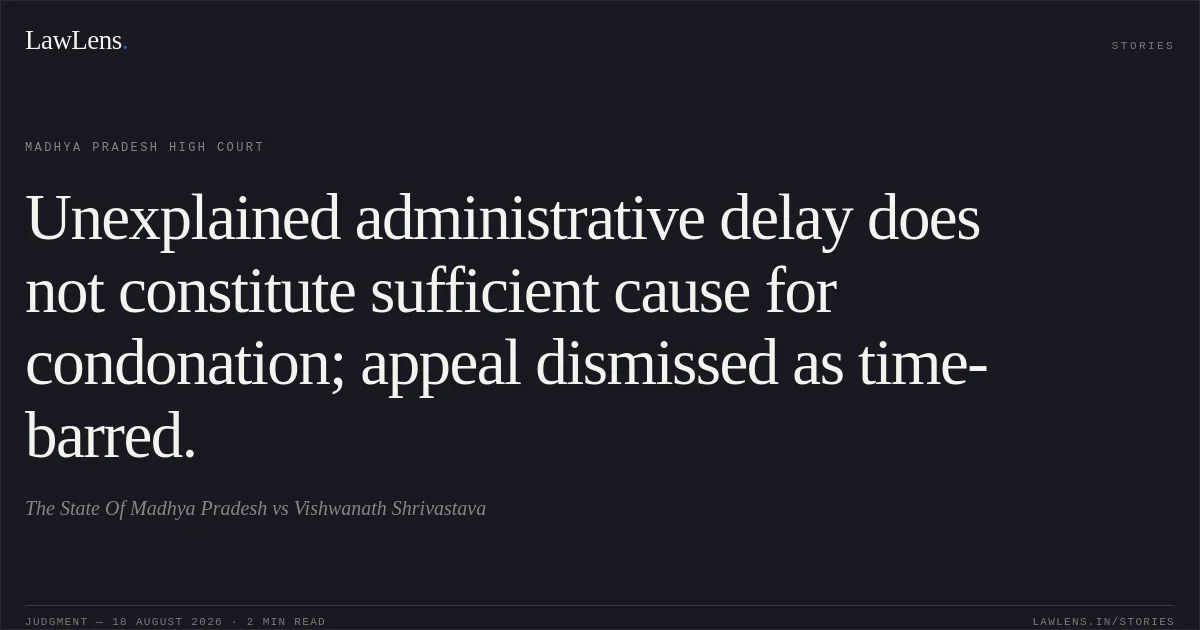
Source reference: p.2Although the appellants cited decisions advocating a pragmatic and liberal approach in condoning delay by the State, including State of Haryana v. Chandra Mani, Special Tehsildar, Land Acquisition v. K.V. Ayisumma, and State of M.P. v. Pradeep Kumar, the governing principle remained that administrative or procedural delay, without a satisfactory factual explanation, does not by itself constitute sufficient cause.
Source reference: p.1–3Reasoning
The Court found that the application merely described the movement of the matter through administrative and legal channels and stated that approximately 211 days were consumed in those processes.
Source reference: p.1–3It did not identify specific dates, responsible officers, or concrete circumstances explaining the entire period of delay.
Source reference: p.1–3The Court held that the explanation disclosed no reason, “much less any sufficient reason,” for failure to file the appeal within limitation.
Source reference: p.2–3It further criticised the Government Advocates for failing to draft the application in accordance with the Supreme Court’s law and the State’s circulars, observing that they appeared to follow the instructions of the Officer-in-Charge rather than legal requirements.
Source reference: p.2The offer to impose ₹5,000 as costs could not cure the absence of sufficient cause, particularly when no action had been proposed against the erring officers.
Source reference: p.2–3Holding
The Court rejected I.A. No. 11809 of 2026 because the appellants had failed to establish sufficient cause for condoning the 211-day delay.
Consequently, the writ appeal challenging the order dated 15 October 2025 in W.P. No. 10230 of 2021 was dismissed as barred by limitation.
Source reference: p.3–4Acts & Sections Cited
1 provisions across 1 statute referred to in this judgment. Linked provisions open on LawLens.
M.P. Uchcha Nyayalaya (Khand Nyayapeeth Ko Appeal) Adhiniyam, 20051
Original Court PDF
The State Of Madhya PradeshvsVishwanath Shrivastava
Click to open original judgment
Original judgment, available to read, download and summarize on LawLens.in