Facts
The petitioner challenged the detention order (No. PITNDPS 13 of 2025 dated 15.03.2025) passed by the Divisional Commissioner, Jammu, under Section 3 of the Prevention of Illicit Traffic in Narcotic Drugs and Psychotropic Substances (PITNDPS) Act, 1988.
Source reference: para 1The detenu was involved in two FIRs (No. 53/2024 at P/S Damana and No. 194/2024 at P/S Nawabad) under the NDPS Act, but had already been granted bail in both cases prior to the detention order.
Source reference: para 3, 9The petitioner contended that the grounds for detention were stale, the last alleged activity occurred on 06.12.2024 (approx. 95 days prior to the order), and that copies of relied-upon documents were neither furnished nor explained in a language he understood, hindering his right to make an effective representation.
Source reference: para 2, 11, 19Issues
1. Whether the invocation of preventive detention was legally justified when the detenu was already enlarged on bail under ordinary criminal law and no violation of bail conditions was alleged.
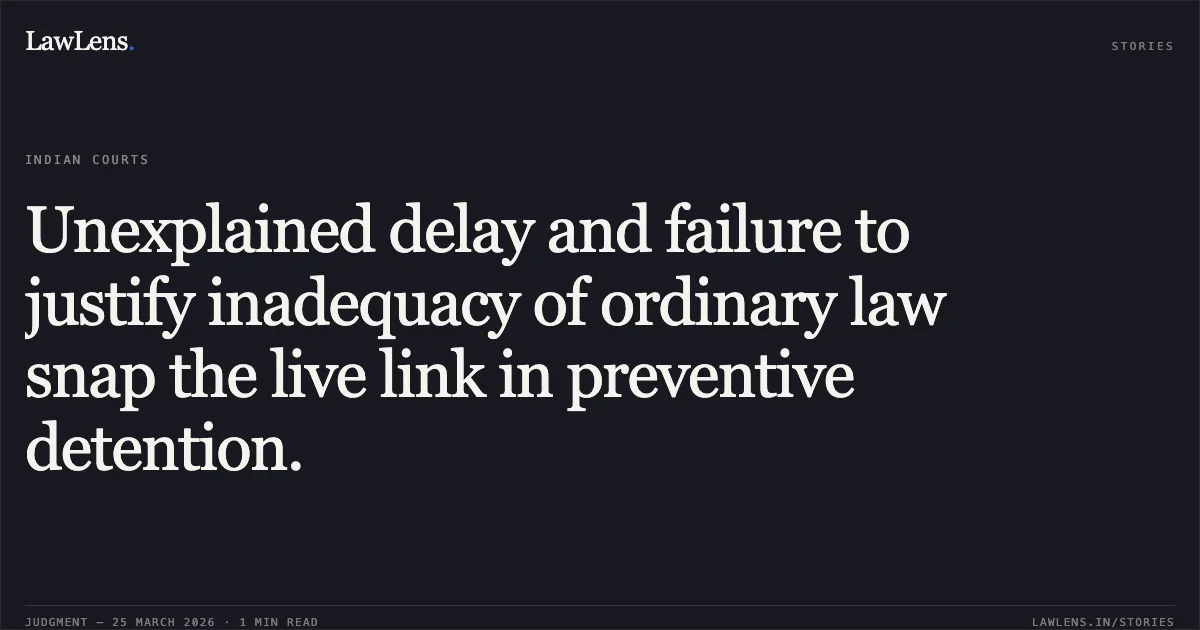
Source reference: para 92. Whether the delay of approximately 95 days between the last prejudicial activity and the passing of the detention order snapped the "live and proximate link" required for such an order.
Source reference: para 11, 193. Whether the failure to provide all relied-upon documents and inform the detenu of his right to represent before the Advisory Board constituted a violation of procedural safeguards under Article 22(5) of the Constitution.
Source reference: para 15, 17, 18Law Applied
The court primarily applied Section 3 of the PITNDPS Act, 1988, which empowers authorities to detain persons to prevent illicit drug trafficking, subject to the communication of grounds within specific timelines.
Source reference: para 8It relied on the constitutional safeguards under Article 22(5) and Article 21 regarding the right to representation and personal liberty.
Source reference: para 17, 21The court followed Rekha v. State of Tamil Nadu, establishing that preventive detention should only be used if ordinary criminal law is insufficient.
Source reference: para 10Furthermore, it applied the "live-link" doctrine from Rajinder Arora v. Union of India and Sushanta Kumar Banik v. State of Tripura, which mandates that an unexplained delay between the offense and detention renders the order unsustainable.
Source reference: para 13, 14Reasoning
The court observed that the detaining authority failed to explain why ordinary criminal law was insufficient, especially since the detenu was already facing prosecution and the state had not sought cancellation of his bail.
Source reference: para 9The court determined that the 95-day gap between the last FIR (06.12.2024) and the detention order (15.03.2025) was inordinate and unexplained, effectively snapping the "live and proximate link" between the alleged activity and the necessity of detention.
Source reference: para 11, 19Regarding procedural lapses, the court found that the detenu was not provided with the complete record or explained the grounds in his vernacular language, which is a mandate of Article 22(5) to ensure a meaningful right to representation.
Source reference: para 15-17The court noted that the "grounds of detention" were a mere replica of the police dossier, indicating a lack of independent subjective satisfaction by the detaining authority.
Source reference: para 2, 20Holding
The court allowed the petition and quashed the detention order (No. 13 of 2025 dated 15.03.2025).
It held that the order suffered from non-application of mind, lacked a proximate link to prejudicial activities, and violated the procedural safeguards under Article 22(5) of the Constitution and Section 3(3) of the PITNDPS Act.
Source reference: para 22The court directed the respondents to release the petitioner from preventive custody immediately.
Source reference: para 23Acts & Sections Cited
4 provisions across 2 statutes referred to in this judgment. Each provision opens on LawLens.
Narcotic Drugs and Psychotropic Substances Act, 19853
Prevention of Illicit Traffic in Narcotic Drugs and Psychotropic Substances Act, 19881
Original Court PDF
ABDUL HAMEED @MEEDHU TH NASEEMA BEGUMvsUT OF J AND K TH PRINCIPAL SECRETARY TO GOVERNMENT HOME DEPARTMENT JAMMU AND OTHERS
Click to open original judgment
Original judgment, available to read, download and summarize on LawLens.in