Facts
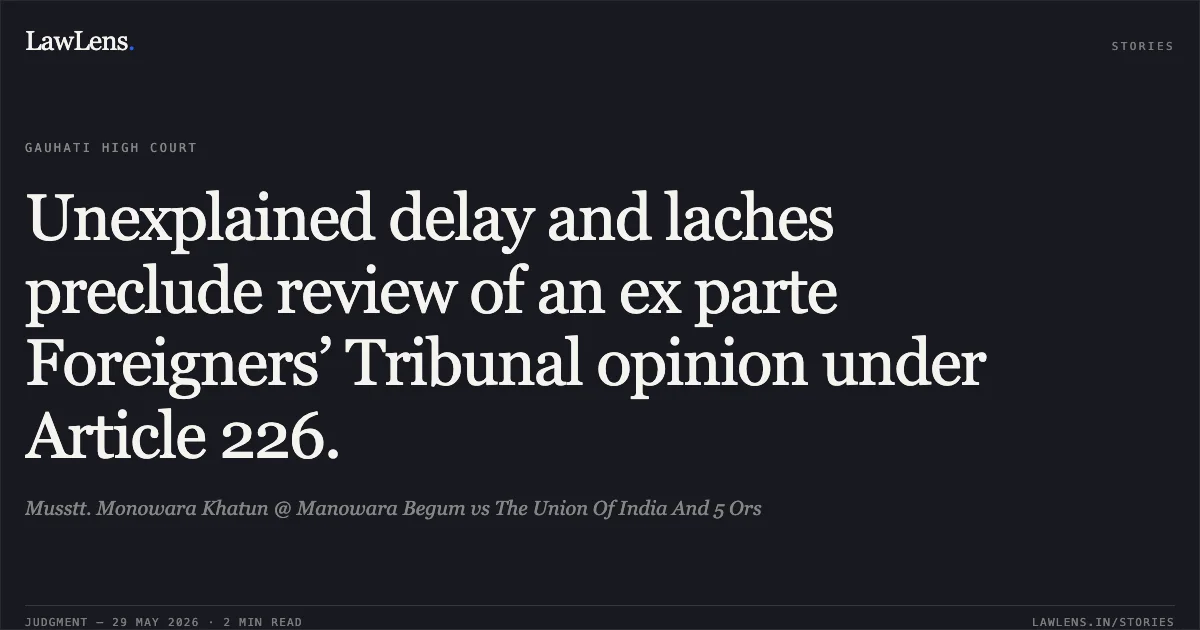
The petitioner was declared a foreigner who entered India post-25.03.1971 by an ex parte opinion dated 13.03.2021 passed by the Foreigners’ Tribunal (FT), Jorhat
Source reference: p. 3The petitioner failed to appear before the Tribunal on 20 separate dates
Source reference: para. 20A writ petition [WP(C) 6775/2025] challenging the FT order was dismissed on 09.02.2026 primarily due to an unexplained delay of 4 years, 7 months, and 7 days
Source reference: p. 3, para. 17The petitioner filed the present review petition alleging that the delay was due to the COVID-19 pandemic and the failure of intermediaries/counsel to communicate case status
Source reference: p. 6-7Issues
1. Whether a review of the judgment dated 09.02.2026 is maintainable on grounds of discovery of new facts regarding the negligence of the petitioner's previous counsel and intermediaries.
Source reference: p. 8 / para. 21-222. Whether the Court’s refusal to interfere with the ex parte opinion of the Foreigners’ Tribunal constitutes an error apparent on the face of the record.
Source reference: p. 13-15 / para. 20-21Law Applied
The Court applied Section 114 and Order XLVII Rule 1 of the Code of Civil Procedure (CPC), 1908, governing review jurisdiction, which limits review to the discovery of new evidence, errors apparent on the face of the record, or other analogous sufficient reasons
Source reference: para. 21It cited Malishwari v. K. Dutt Saguna & Anr. (2025) to emphasize that review is not an appeal in disguise and cannot be used to substitute a view
Source reference: para. 21Regarding the writ of certiorari under Article 226, the Court followed T.C. Basappa v. T. Nagappa (1954), holding that the High Court does not act as an appellate tribunal and only interferes in cases of lack of jurisdiction or palpable error
Source reference: para. 19-20The Court noted the statutory mandate under Order 3, Clauses (13) & (14) of the Foreigners (Tribunals) Order, 1964, requiring references to be decided within 60 days
Source reference: para. 12, 21Reasoning
The Court reasoned that review jurisdiction is highly restrictive and does not permit a rehearing of the case
Source reference: para. 21It found that the petitioner’s excuse—blaming intermediaries and counsel for the three-and-a-half-year delay following the end of the COVID-19 pandemic—could not be classified as a "new fact" or an "error apparent" under Order XLVII Rule 1, but rather reflected gross negligence by the petitioner
Source reference: para. 22The Court observed that the Tribunal had granted 20 opportunities for appearance, satisfying the requirements of natural justice
Source reference: para. 20Since the petitioner failed to show that the original dismissal was without jurisdiction or legally perverse at the "first blush," the Court held that the petitioner was seeking to re-argue the merits, which is impermissible in review proceedings
Source reference: para. 16, 21Holding
The Court dismissed the review petition, holding that no grounds for review were established
The Court affirmed its earlier holding that the enormous, unexplained delay of 1,682 days remained unsatisfied by the petitioner’s new explanations. Consequently, the judgment dated 09.02.2026 in WP(C) 6775/2025 was maintained without alteration
Source reference: para. 18, 23Acts & Sections Cited
1 provisions across 1 statute referred to in this judgment. Each provision opens on LawLens.
Code of Civil Procedure, 19081
Original Court PDF
Musstt. Monowara Khatun @ Manowara BegumvsThe Union Of India And 5 Ors
Click to open original judgment
Original judgment, available to read, download and summarize on LawLens.in