Facts
The Petitioner (Shriram Pistons) and Respondent (Usha International) entered into an agency agreement on 30.04.1999 for export sales
Source reference: p.3, para 7A subsequent modification agreement was executed on 31.03.2000
Source reference: p.3, para 8Upon termination of the relationship in 2004, disputes arose regarding unpaid commissions. The Respondent invoked arbitration based on the 1999 Agreement
Source reference: p.4, para 12The Sole Arbitrator passed an award dated 04.05.2013, directing the Petitioner to pay Rs. 68.57 lakhs with 10% interest
Source reference: p.2, para 2The Petitioner challenged the award under Section 34 of the Arbitration and Conciliation Act, 1996, primarily contending that the 1999 Agreement was unsigned and thus the tribunal lacked jurisdiction
Source reference: p.7, para 26Issues
1. Whether a valid arbitration agreement existed between the parties despite the Petitioner’s claim that the 1999 Agreement was unsigned and superseded
Source reference: p.14, para 52; p.29, para 742. Whether the arbitral award was vitiated by patent illegality due to an 18-month delay in pronouncement and alleged failure to adjudicate specific issues
Source reference: p.11, para 42; p.13, para 463. Whether the Arbitrator erroneously reversed the burden of proof, thereby violating the fundamental policy of Indian law
Source reference: p.10, para 35; p.34, para 91Law Applied
The court primarily applied Section 34 of the Arbitration and Conciliation Act, 1996, which limits judicial interference to grounds of patent illegality, jurisdictional error, and conflict with public policy
Source reference: p.20, para 72It relied on the "perversity test" from Associate Builders v. DDA and Ssangyong Engg. & Construction Co. Ltd. v. NHAI, holding that an award is patently illegal only if the arbitrator's view is not even a "possible view" or ignores vital evidence
Source reference: p.22-27, paras 41, 68, 71The court also applied the principle from OPG Power Generation (P) Ltd. v. Enexio Power Cooling Solutions, reinforcing that a mere erroneous application of law or re-appreciation of evidence does not warrant setting aside an award
Source reference: p.20, para 31, 74Reasoning
The Court found that the Arbitrator had specifically addressed the jurisdictional objection, concluding that both parties had acted upon the 1999 Agreement for years, thus establishing a binding contract through conduct regardless of a formal signature
Source reference: p.30, para 78-79Regarding the burden of proof, the Court noted that the Arbitrator analyzed the Respondent's documentary evidence (TDS certificates and commission statements) before concluding the Petitioner failed to rebut it; this was a matter of appreciation of evidence, which is the Arbitrator's sole domain
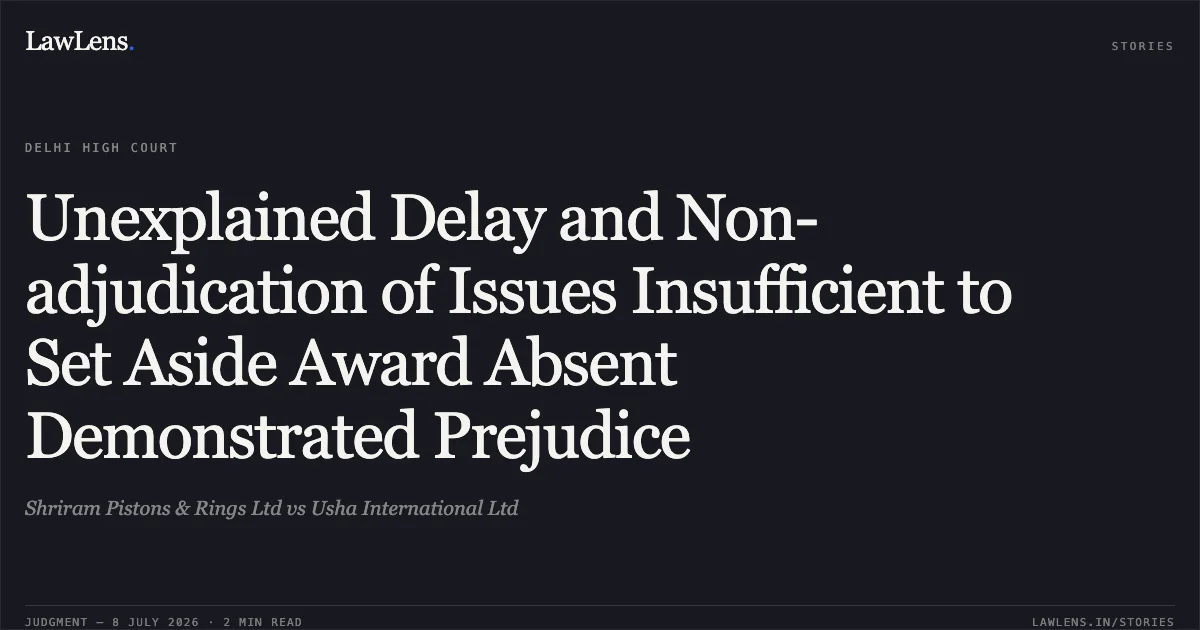
Source reference: p.34, para 94-96On the issue of delay, the Court held that while an 18-month delay is undesirable, it does not invalidate an award unless the Petitioner proves specific prejudice, which was absent here given the detailed nature of the award
Source reference: p.35-36, paras 102-104Finally, the Court ruled that the failure to provide issue-wise headings (Issue IV and VII) did not mean the substance of the claims was neglected, as the award addressed the underlying controversies holistically
Source reference: p.37, para 110-111Holding
The Court dismissed the Section 34 petition, holding that the Petitioner failed to establish any patent illegality or jurisdictional infirmity
The Court affirmed that the Arbitrator's interpretation was a "possible view" entitled to judicial deference. Consequently, the Enforcement Petition (O.M.P. (ENF.) (COMM) 216/2025) was allowed to proceed, and the Judgment Debtor was directed to deposit the entire awarded amount with interest within four weeks
Source reference: p.31, para 80; p.39, para 120-121Acts & Sections Cited
9 provisions across 2 statutes referred to in this judgment. Each provision opens on LawLens.
Arbitration and Conciliation Act, 19968
Indian Contract Act, 18721
Original Court PDF
Shriram Pistons & Rings LtdvsUsha International Ltd
Click to open original judgment
Original judgment, available to read, download and summarize on LawLens.in