Facts
The petitioner challenged a preventive detention order (No.21/DMB/PSA/2019) issued by the District Magistrate, Baramulla, on August 6, 2019, under the J&K Public Safety Act.
Source reference: para. 1The petitioner had previously been detained in 2016, but that order was quashed by the High Court.
Source reference: para. 3The respondents justified the 2019 order by labeling the petitioner an "incorrigible secessionist" whose activities threatened state security.
Source reference: para. 5Despite the order being issued in August 2019, it remained unexecuted for over three years until the High Court stayed it on November 9, 2022.
Source reference: para. 4, 9The respondents claimed the delay was due to the petitioner’s chronic asthma and subsequent evasive behavior after recovery.
Source reference: para. 4However, no medical records were produced to substantiate that his ailment was severe enough to prevent custody for that entire duration.
Source reference: para. 10Issues
1. Whether an order of preventive detention can be challenged at the pre-execution stage.
Source reference: para. 82. Whether an inordinate and unexplained delay in executing a detention warrant vitiates the subjective satisfaction of the detaining authority.
Source reference: para. 7-10Law Applied
The court relied on the principles established by the Supreme Court in Additional Secretary to Govt. of India v. Smt. Alka Subash Gadia (1992), Deepak Bajaj v. State of Maharashtra (2009), and Subash Popatlal Dave v. Union of India (2014), which permit judicial review of detention orders at the pre-execution stage on specific grounds, including the lack of genuine subjective satisfaction.
Source reference: para. 8It further applied the ratio from Mohd. Farooq v. Joint Secretary to Govt. of India (2002), which holds that unexplained slackness by executing agencies in serving a warrant throws doubt on the necessity of the detention.
Source reference: para. 10Reasoning
The Court observed that while a detention order can be challenged at the pre-execution stage, such review excludes the "sufficiency of material" but includes the conduct of the authorities.
Source reference: para. 8In this case, the warrant remained unexecuted for over two years prior to the court's stay order.
Source reference: para. 9The Court found the respondents' justification—the petitioner's health—insufficient because they failed to place any medical records in the detention file to prove the ailment was life-threatening or prevented detention.
Source reference: para. 10The Court reasoned that the "slackness and remissness" of the executing agency destroyed the "proximity" between the alleged prejudicial activities and the purpose of detention, thereby rendering the subjective satisfaction of the District Magistrate inherently doubtful.
Source reference: para. 7, 10Holding
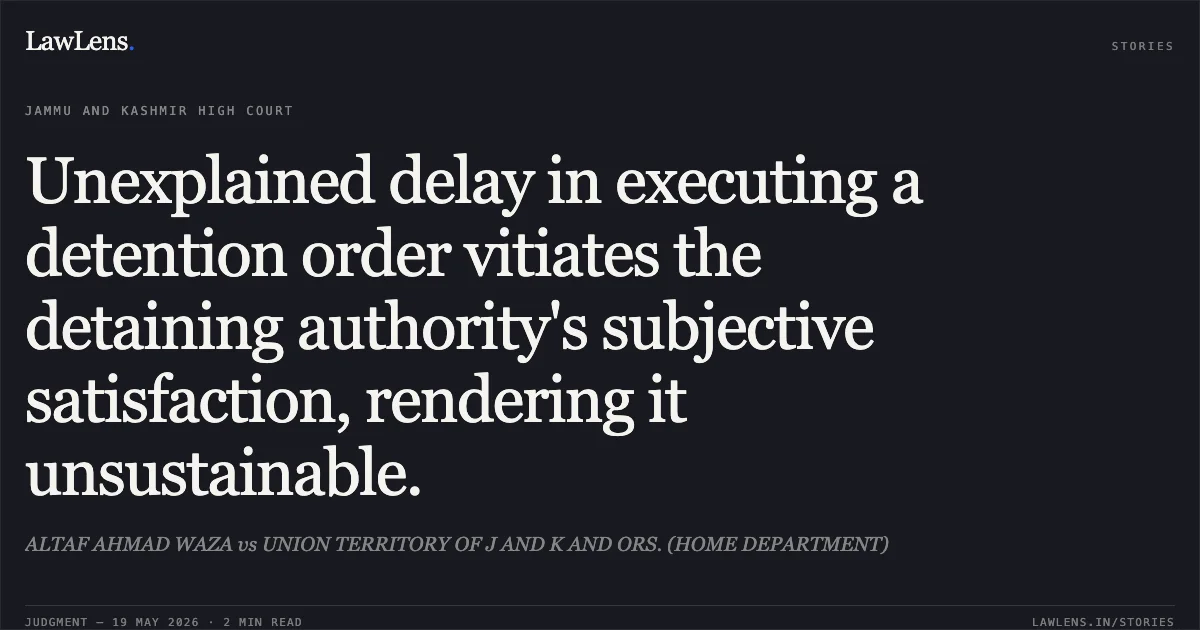
The Court answered the issues in the affirmative, holding that the unexplained delay in execution rendered the detention order unsustainable in law.
The petition was allowed, and detention order No.21/DMB/PSA/2019 dated August 6, 2019, was quashed.
Source reference: para. 11The Court directed the return of the detention records to the respondents' counsel.
Source reference: para. 12Acts & Sections Cited
1 provisions across 1 statute referred to in this judgment. Linked provisions open on LawLens.
Jammu And Kashmir Public Safety Act, 19781
Original Court PDF
ALTAF AHMAD WAZAvsUNION TERRITORY OF J AND K AND ORS. (HOME DEPARTMENT)
Click to open original judgment
Original judgment, available to read, download and summarize on LawLens.in


