Facts
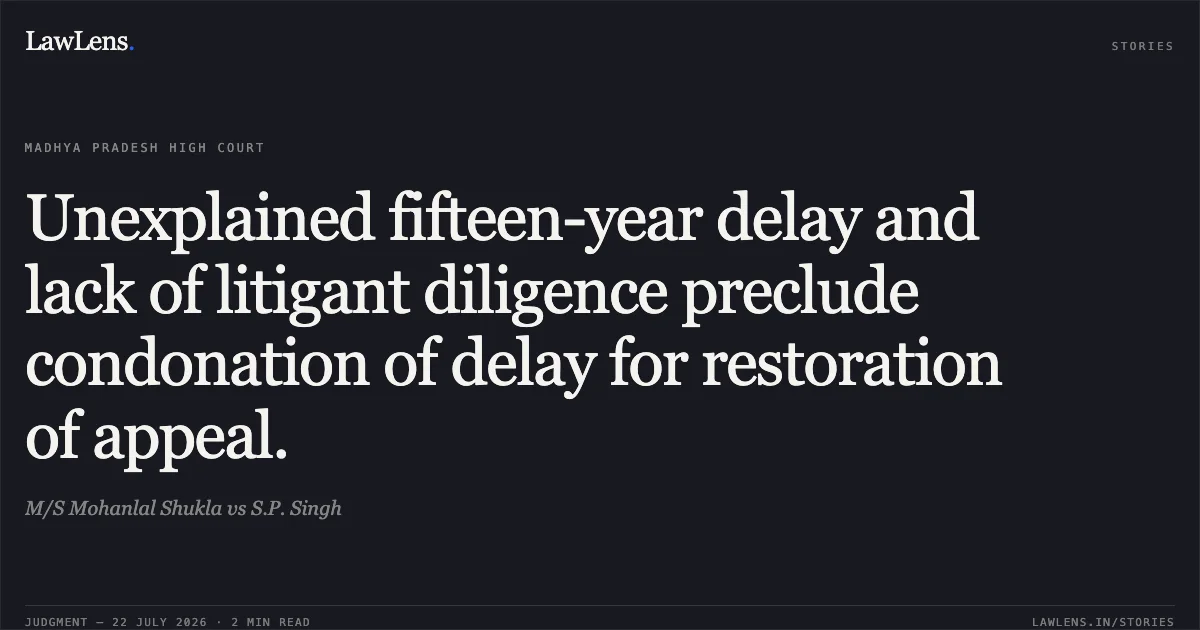
The appellant, a wholesale coal trader under a National Coalfields Limited (NCL) scheme, filed a civil suit in 1996 for specific performance due to alleged breach of contract.
Source reference: para. 2During the suit, interim orders for coal supply were issued but allegedly ignored, leading the appellant to initiate execution/contempt proceedings under Order XXXIX Rule 2-A of the CPC.
Source reference: para. 2These proceedings were dismissed on 06.02.2001 following an undertaking by NCL, which the appellant challenged via Miscellaneous Civil Appeal No. 6/2001; this was subsequently dismissed for want of prosecution on 26.10.2004.
Source reference: para. 2After a delay of fifteen years, the appellant moved for restoration under Order IX Rule 9 CPC along with an application under Section 5 of the Limitation Act.
Source reference: para. 2The District Judge, Singrauli, dismissed the application on 12.02.2020, citing a lack of sufficient cause for the delay.
Source reference: para. 2Issues
1. Whether the appellant established "sufficient cause" under Section 5 of the Limitation Act to condone a 15-year delay in filing a restoration application.
Source reference: para. 72. Whether a litigant can be granted relief solely on the grounds of an advocate’s negligence in the face of a decade-and-a-half long period of inaction.
Source reference: para. 8Law Applied
Section 5 of the Limitation Act, 1963, which requires the applicant to satisfy the court that there was "sufficient cause" for not preferring the appeal or application within the prescribed period.
Source reference: para. 7Order XLIII Rule 1(c) of the CPC regarding appeals against orders rejecting restoration.
Source reference: para. 1, 8The principle of "due diligence," establishing that while a party should not suffer for a counsel's lapse, this doctrine is superseded by the requirement for a prudent litigant to exercise minimum diligence and perform reasonable enquiries regarding their case's progress.
Source reference: para. 7-8Reasoning
The Court observed that the 15-year delay was extraordinary and unsupported by documentary evidence.
Source reference: para. 7The Court rejected the appellant's primary contention—that he relied on his counsel's advice that personal presence was unnecessary—stating that such advice does not justify complete inaction for 15 years.
Source reference: para. 7The Court noted the absence of any correspondence, diary entries, or receipts to prove the appellant remained in contact with his advocate.
Source reference: para. 7The plea regarding the death of the counsel was found to be vague and lacking specific dates or a direct nexus to the 15-year failure to prosecute.
Source reference: para. 7The Court reasoned that the discretionary power to condone delay should not be exercised where a litigant has failed to show "reasonable care and caution," and it found no perversity in the lower court's refusal to condone the delay.
Source reference: para. 8Holding
The High Court held that the appellant failed to establish sufficient cause for the "extraordinary delay" and that the doctrine of advocate negligence cannot be invoked when the litigant themselves showed a complete lack of diligence for 15 years.
The Court found no jurisdictional error or perversity in the impugned order and dismissed the miscellaneous appeal.
Source reference: para. 8-9Acts & Sections Cited
1 provisions across 1 statute referred to in this judgment. Each provision opens on LawLens.
Limitation Act, 19631
Original Court PDF
M/S Mohanlal ShuklavsS.P. Singh
Click to open original judgment
Original judgment, available to read, download and summarize on LawLens.in