Facts
The Union of India challenged the Tribunal’s order dated 2 April 2019 disposing of the respondents’ application concerning pensionary benefits, after the parties agreed that they could work out their rights depending on the outcome of a pending Supreme Court appeal.
Source reference: p.6, para. 16–17In January 2024, at the Union’s request and with the respondents’ consent, the Tribunal corrected the appeal reference in its order.
Source reference: p.7–8, para. 18–19The Union later filed a writ petition in 2024, withdrew it with liberty to seek review before the Tribunal, and pursued a review application that was ultimately dismissed on 20 May 2026.
Source reference: p.3–5, paras. 8–13The Union filed the present writ petition in 2026, challenging the 2019, 2024 and 2026 orders.
Source reference: p.5, para. 13Issues
1. Whether the writ petition should be dismissed for delay and laches, given the interval between the Tribunal’s 2019 order and the 2026 filing, and the intervening proceedings.
Source reference: p.5, para. 142. Whether the Tribunal’s orders, including its dismissal of the review application, disclosed a basis for interference on the merits, notwithstanding that the original disposal was by consent and the appeal reference was corrected at the Union’s request.
Source reference: p.6–9, paras. 17–25Law Applied
The Supreme Court’s decisions in State of Odisha v. Managing Committee of Namatara Girls High School and Mrinmoy Maity v. Chhanda Koley establish that highly belated writ petitions should not ordinarily be entertained and that bureaucratic delay does not, by itself, justify their entertainment.
Source reference: p.2, paras. 3–4Under Manjunath Tirakappa Malagi v. Gurusiddappa and Pushpa Devi Bhagat v. Rajinder Singh, a consent order cannot ordinarily be challenged; an allegation that consent was unauthorized or contrary to law must be raised before the court that recorded it.
Source reference: p.8, para. 20The Tribunal’s stated review standard was whether an error apparent on the face of the record could be identified.
Source reference: p.4, order dated 20 May 2026 reproduced at para. 12Reasoning
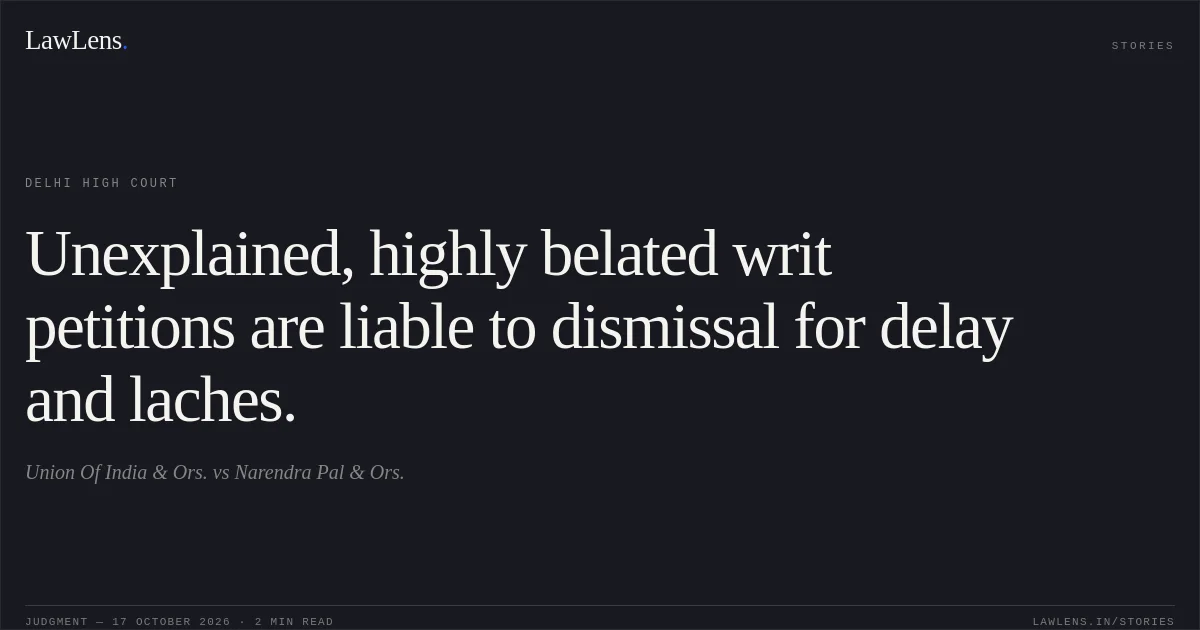
The Court held that the petition was independently barred by delay and laches: the Union took no action for four years after the 2019 order before seeking correction, waited more than two and a half years after the correction order to file the writ petition, and pursued intervening proceedings without adequately explaining the delay.
Source reference: p.5, para. 14On the merits, the 2019 order merely recorded the parties’ agreement to await the Supreme Court’s decision and left the respondents free to pursue their remedies; it did not determine the substantive pension claim.
Source reference: p.6, para. 17The subsequent correction was made at the Union’s own request and with the respondents’ consent, and the referenced appeal had since been decided.
Source reference: p.7–9, paras. 19, 22The later pendency of other SLPs did not disclose an apparent error warranting review.
Source reference: p.4, order dated 20 May 2026 reproduced at para. 12; p.9, paras. 24–25Holding
The High Court dismissed the writ petition both for delay and laches and on the merits.
It found no basis to interfere with the Tribunal’s orders dated 2 April 2019, 31 January 2024 or 20 May 2026.
Source reference: p.9, para. 26Original Court PDF
Union Of India & Ors.vsNarendra Pal & Ors.
Click to open original judgment
Original judgment, available to read, download and summarize on LawLens.in