01Facts
The plaintiff, Smt. Sharavva, instituted O.S. No. 172/2010 before the Civil Judge and JMFC, Hukkeri, seeking partition and separate possession of her half share in the suit property.
p. 1The suit was dismissed on 19.07.2012. Her appeal, R.A. No. 49/2012, was dismissed on 12.12.2012.
¶ 4The plaintiff died on 21.02.2022, as stated in the appeal memo.
¶ 5Her legal representatives filed the present Regular Second Appeal on 02.05.2025, along with I.A. No. 1/2025 seeking condonation of a delay of 4434 days (12 years and 54 days).
¶ 2, 4The supporting affidavit states that the legal representatives obtained revenue records only a few months before filing, which showed the property to be ancestral, and that they then consulted present counsel.
¶ 3, 6The affidavit gives no reason why the plaintiff herself did not appeal during the more than nine years she survived the appellate dismissal, and no details of any steps taken by the legal representatives to protect their claimed rights in the interim.
¶ 6, 702Issues
i.1. Whether the appellants have shown "sufficient cause" under Section 5 of the Limitation Act, 1963, to condone a delay of 4434 days in preferring the second appeal.
¶ 2 · ¶ 6–7ii.2. Whether the legal representatives' discovery of revenue records only a few months before filing constitutes a valid and bona fide explanation for the inordinate delay.
¶ 6 · ¶ 703Law Applied
Section 5 of the Limitation Act, 1963, permits condonation of delay where the appellant shows sufficient cause for not filing within the prescribed period.
¶ 8Section 100 of the Code of Civil Procedure, 1908, under which the present second appeal was filed.
p. 1The explanation must be specific and must account for the delay, not merely assert bona fides. It requires the appellant to show why the original party did not act, and what steps the claimants took to protect their rights during the delay.
¶ 7Provisions in the judgment · 2 · Linked ones open on LawLens
Code of Civil Procedure, 1908 Section 100
Limitation Act, 1963 Section 5
04Reasoning
The court first noted that the affidavit was vague. It gave no reason why the plaintiff, who was alive for over nine years after the appellate dismissal, did not file an appeal.
¶ 7The legal representatives' claim that they had only recently learned the property was ancestral was rejected. Nothing showed any effort to protect their claimed rights over those years, so the explanation was not accepted.
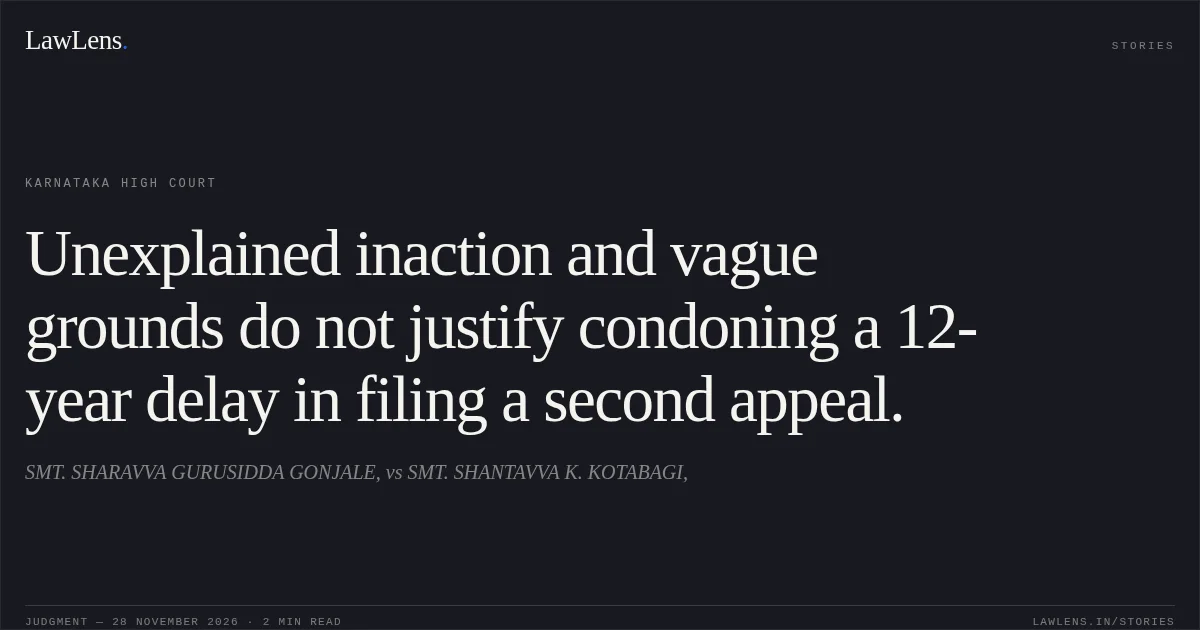
¶ 7The court concluded that the appellants had not offered sufficient cause. The delay of 12 years and 54 days was inordinate and could not be condoned without valid reasons.
¶ 7The statutory test under Section 5 was linked to the facts: the gap between the appellate dismissal (12.12.2012) and the filing (02.05.2025), and the plaintiff's own inaction during her lifetime, were unexplained.
¶ 4, 5, 705Holding
The court answered both issues in the negative. The appellants failed to show sufficient cause for the 4434-day delay, and the late discovery of revenue records was not a valid explanation.
¶ 7I.A. No. 1/2025 under Section 5 of the Limitation Act is dismissed. Consequently, the Regular Second Appeal No. 100380 of 2025 is also dismissed as barred by limitation, and all pending applications stand disposed of.
¶ 8Original Court PDF
SMT. SHARAVVA GURUSIDDA GONJALE,vsSMT. SHANTAVVA K. KOTABAGI,
Click to open original judgment
Original judgment, available to read, download and summarize on LawLens.in



