01Facts
The prosecution alleged that, following a dispute over a pathway, accused Nos. 1–11 formed an unlawful assembly and assaulted Nataraj (PW.1), Ramesha (PW.2) and Vasanthegowda (PW.3) on 12 December 2012.
¶ 6–15Nataraj sustained, among other injuries, a depressed fracture and loss of two teeth.
¶ 6–15The Sessions Court convicted accused Nos. 1–11 under Sections 143, 147, 148, 341, 324 and 326 read with Section 149 IPC, but acquitted them of the charge under Section 307 read with Section 149 IPC; it also acquitted accused No. 12 under Section 212 IPC.
¶ 6–15Nataraj appealed against the acquittal under Section 307 IPC and sought enhanced compensation. Accused Nos. 1–11 appealed their convictions.
¶ 2–402Issues
i.1. Whether the prosecution proved beyond reasonable doubt that accused Nos. 1–11 were members of an unlawful assembly and committed the offences of which the Trial Court convicted them
¶ 44(i)ii.2. Whether the convictions and sentences imposed on accused Nos. 1–11 warranted appellate interference
¶ 44(ii)iii.3. Whether Nataraj established grounds to interfere with the acquittal under Section 307 read with Section 149 IPC or to enhance compensation.
¶ 44(iii)03Law Applied
The Court considered Sections 143, 147, 148, 149, 307, 324 and 326 IPC, and Section 357(1) CrPC.
Liability under Section 149 requires proof of the unlawful assembly and its common object; mere presence at the scene does not suffice.
¶ 76For Section 307 IPC, intention or knowledge is assessed from circumstances including the weapon, the body part targeted and the manner of assault.
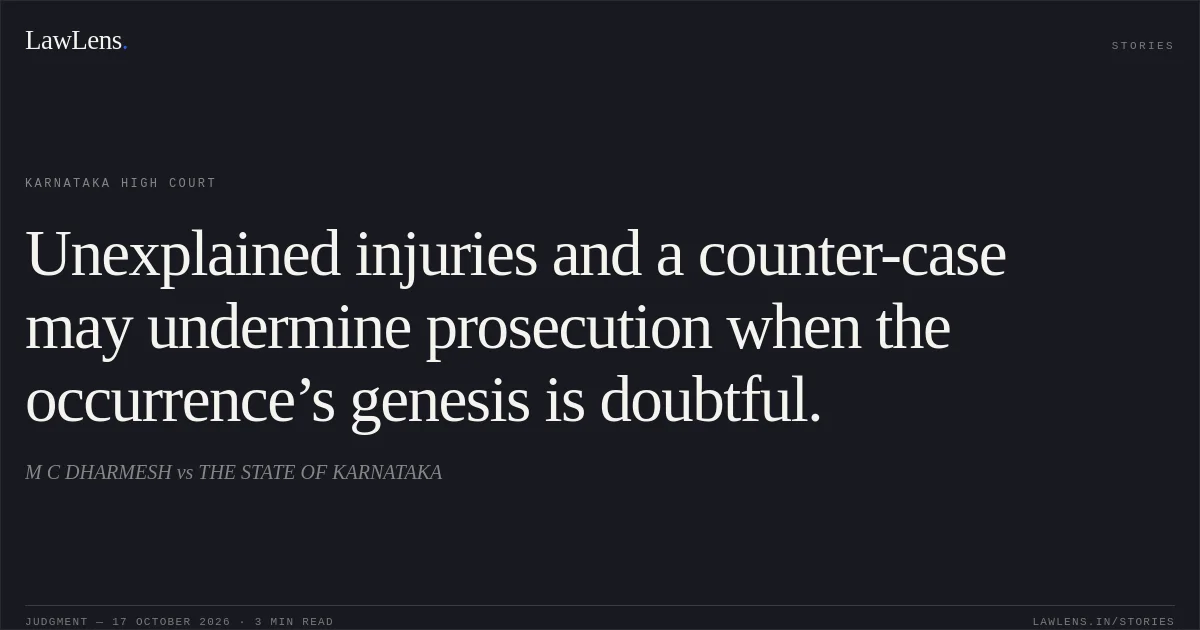
¶ 86Under Lakshmi Singh v. State of Bihar, non-explanation of injuries sustained by accused persons may support an inference that the prosecution has suppressed the genesis of the occurrence, particularly where the witnesses are interested or the defence version is reasonably probable; it is not an automatic ground for rejecting the prosecution case.
¶ 56–59Dashrath Singh v. State of U.P. and Nand Lal v. State of Chhattisgarh likewise treat unexplained injuries as a factor to be assessed with the quality of the evidence and the competing versions.
¶ 62(a)–(b)For case and counter-case, the Court relied on the Karnataka Full Bench decision in State of Karnataka v. Hosakeri Ningappa: ordinarily, both cases should be investigated by the same Investigating Officer and tried by the same Court, with each decided on its own evidence.
¶ 64, 68Provisions in the judgment · 17 · Linked ones open on LawLens
Code of Criminal Procedure, 1973 Section 372Section 374Section 313Section 357
Indian Penal Code, 1860 13 provisions
Section 143Section 147Section 148Section 341Section 504Section 324Section 307Section 427Section 149Section 114Section 212Section 326Section 30204Reasoning
The Court found that accused Nos. 3, 6 and 11 had contemporaneous injuries, that the prosecution did not satisfactorily explain them, and that a counter-complaint and counter-FIR arose from the same occurrence.
¶ 50–61These circumstances were considered together with the separate investigation of the two cases, the dispute between the parties, weaknesses in aspects of the eyewitness evidence, and uncertainty about the genesis of the incident.
¶ 63–83Although the injured witnesses’ presence and injuries were established, that evidence did not remove the reasonable doubt concerning the accused’s participation and shared common object.
¶ 71, 76, 83, 87–88The Court held that grievous injuries to PW.1 did not, by themselves, prove the liability of every accused under Section 149 IPC.
¶ 71, 76, 83, 87–88It therefore found no basis to disturb the acquittal under Section 307 IPC or enhance compensation.
05Holding
The Court dismissed Nataraj’s appeal and allowed the appeals of accused Nos. 1–11.
¶ 89(i)–(v)It set aside their convictions and sentences and acquitted them of the offences under Sections 143, 147, 148, 341, 324 and 326 read with Section 149 IPC.
¶ 89(i)–(v)The acquittal of accused No. 12 under Section 212 IPC was left undisturbed.
¶ 89(viii)Original Court PDF
M C DHARMESHvsTHE STATE OF KARNATAKA
Click to open original judgment
Original judgment, available to read, download and summarize on LawLens.in