Facts
The petitioner, an Assistant Engineer serving as Manager of the STM Division in Bhind, was suspended on 14.10.2011 following allegations of negligence and lack of supervision
Source reference: para. 2A charge sheet was issued on 25.10.2011, leading to a departmental enquiry where the charges were found partly proved in a report dated 17.02.2014
Source reference: para. 3Consequently, the disciplinary authority imposed a punishment of stoppage of one annual grade increment for one year without cumulative effect on 18.09.2014
Source reference: para. 4The petitioner’s departmental appeal was dismissed on 30.03.2015
Source reference: para. 4The petitioner challenged these orders via a writ petition filed on 27.11.2021, asserting that the findings were perverse and the appellate order was non-speaking
Source reference: para. 5, 9The respondents raised a preliminary objection regarding an unexplained delay of approximately six years and eight months
Source reference: para. 6, 9Issues
1. Whether the writ petition is liable to be dismissed on the grounds of delay and laches given the lapse of over six years since the final administrative order
Source reference: para. 92. Whether the findings of the enquiry officer and the subsequent punishment orders were perverse or warranted interference under the limited scope of judicial review in disciplinary matters
Source reference: para. 17Law Applied
The court applied the discretionary nature of Article 226 of the Constitution, noting that extraordinary remedies are not intended for the "tardy and the indolent"
Source reference: para. 10, 13It relied on the doctrine of "Delay and Laches" as established in Karnataka Power Corporation Ltd. v. K. Thangappan (2006) 4 SCC 322 and Chennai Metropolitan Water Supply & Sewerage Board v. T.T. Murali Babu (2014) 4 SCC 108, which hold that inordinate, unexplained delay precludes equitable relief
Source reference: para. 10, 13Regarding the scope of judicial review, the court followed Union of India v. P. Gunasekaran (2015) 2 SCC 610, which prohibits High Courts from reappreciating evidence or interfering with enquiry conclusions unless there is a violation of law or gross disproportionality
Source reference: para. 17Reasoning
The court first scrutinized the petitioner's justification for the six-year delay, which cited "excessive work pressure" and the COVID-19 pandemic
Source reference: para. 9The court rejected this explanation as "wholly unsatisfactory," noting that work pressure does not justify a six-year inaction and the petitioner failed to show any change in circumstances that eventually allowed him to file the petition
Source reference: para. 15The court observed that laches were "writ large"
Source reference: para. 16On the merits, the court held that it could not act as an appellate authority to reappreciate evidence
Source reference: para. 17Since the petitioner held a supervisory role (Assistant Engineer), he was vicariously responsible for the irregularities at the sub-center under his control
Source reference: para. 18Finding no malafide intentions or procedural defects in the enquiry, the court determined that the minor punishment did not result in irreparable injury or shock the conscience of the court
Source reference: para. 18Holding
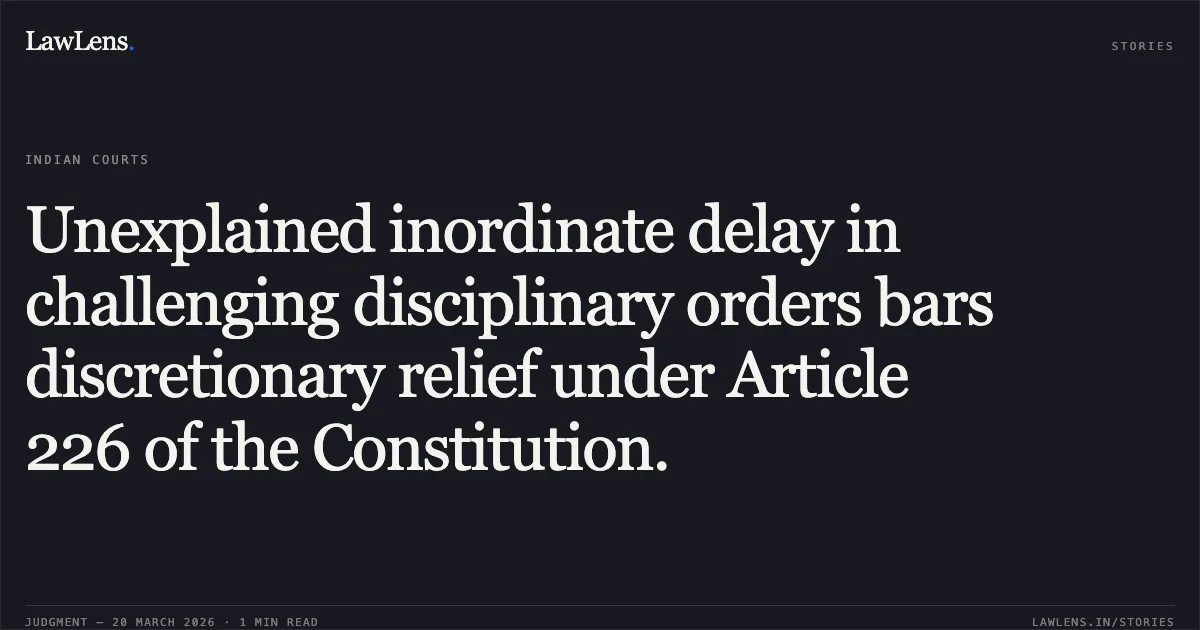
The High Court dismissed the writ petition, holding that the delay of over six years was not cogently explained and that the concurrent factual findings of the disciplinary and appellate authorities did not warrant interference
The court upheld the punishment of stoppage of one annual grade increment for one year without cumulative effect
Source reference: para. 19Original Court PDF
Arvind Kumar BanwasivsM.P. Madhya Kshetra Vidhyut Vitaran Co. Ltd. Thr.
Click to open original judgment
Original judgment, available to read, download and summarize on LawLens.in