Facts
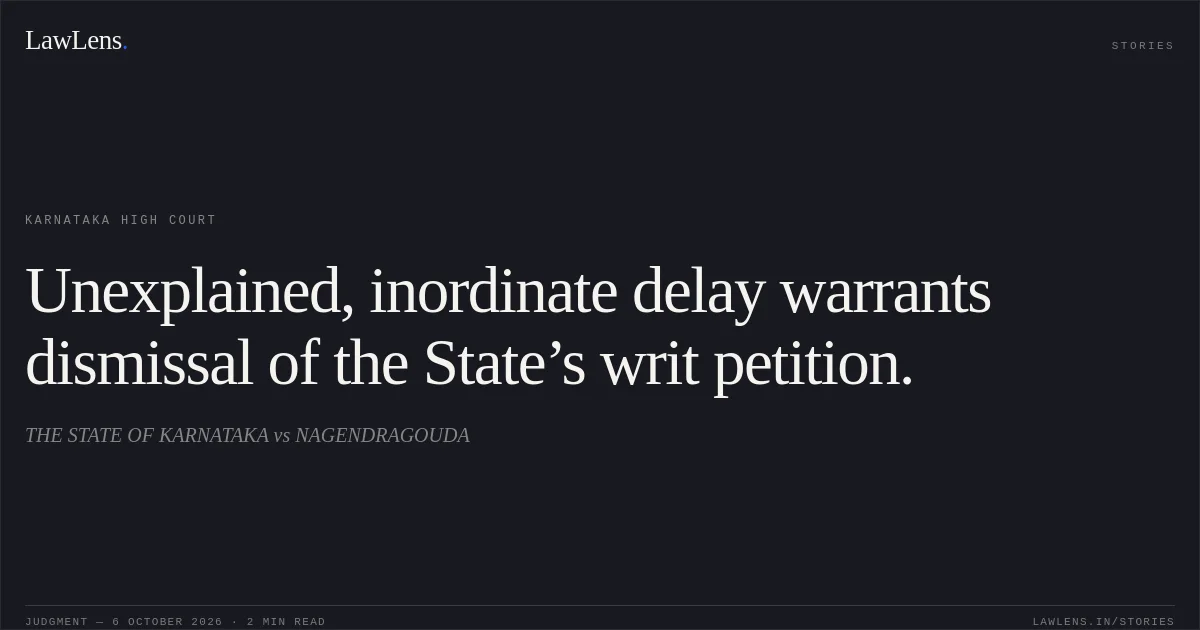
The State of Karnataka and its officials filed a writ petition under Articles 226 and 227 challenging the Karnataka State Administrative Tribunal’s order dated 24 March 2022. The petition was filed on 27 August 2026, more than four years after the Tribunal’s order. The petition contained no explanation for the delay; the record indicated that it was filed after the respondent initiated contempt proceedings.
Source reference: p. 2–4The respondent, a retired Assistant Horticulture Officer, was over 67 years old when the High Court considered the petition.
Source reference: p. 4Issues
1. Whether the writ petition should be entertained despite the State’s unexplained delay of more than four years in challenging the Tribunal’s order
Source reference: p. 3–42. Whether an asserted basis on the merits for challenging the Tribunal’s order could justify entertaining the petition despite that delay
Source reference: p. 4Law Applied
The High Court applied the principle that, although no fixed limitation period governs a petition under Article 226, the writ jurisdiction must be invoked within a reasonable time; unexplained delay and laches may justify refusing relief.
Source reference: p. 4–8Relying on Mrinmoy Maity v. Chhanda Koley, 2024 SCC OnLine SC 551, the Court noted that delay is a relevant factor in the discretionary exercise of writ jurisdiction and that a stale claim should not be revived without a satisfactory explanation.
Source reference: p. 5–11It also relied on Shivamma v. Karnataka Housing Board, 2025 SCC OnLine SC 1969, for the principle that the State is not entitled to preferential treatment and must establish a bona fide, sufficient, and cogent cause for delay; administrative lethargy or procedural inefficiency alone is insufficient.
Source reference: p. 11–16Reasoning
The State filed its petition more than four years after the Tribunal’s order and offered no explanation for the delay in the petition.
Source reference: p. 3–4The Court held that the State’s submission that the underlying issue was covered by a coordinate Bench decision did not cure that omission or provide a sufficient cause for the late filing.
Source reference: p. 4Given the unexplained delay and the prejudice and hardship potentially caused to the respondent by reopening the matter, the Court declined to exercise its discretionary writ jurisdiction.
Source reference: p. 4–5Holding
The Court dismissed the writ petition on the ground of delay, without deciding the merits of the challenge to the Tribunal’s order.
It also directed the State to conduct an enquiry into the four-year delay, initiate disciplinary proceedings against the officials responsible, and file an action-taken report within six months of the order being uploaded on the High Court website.
Source reference: p. 16Acts & Sections Cited
2 provisions across 2 statutes referred to in this judgment. Each provision opens on LawLens.
Limitation Act, 19631
Code of Civil Procedure, 19081
Original Court PDF
THE STATE OF KARNATAKAvsNAGENDRAGOUDA
Click to open original judgment
Original judgment, available to read, download and summarize on LawLens.in