Facts
The assessee filed its return for Assessment Year 2018–19 declaring nil income.
Source reference: no citationThe case was selected for scrutiny through the Computer-Assisted Scrutiny Selection system for verification of investments, loans, advances and related transactions.
Source reference: p.4The Assessing Officer identified credits of ₹1,69,69,098 and ₹1,68,47,661 in the assessee’s bank accounts and treated ₹3,88,16,759 as unexplained money under Section 69 of the Income-tax Act, 1961.
Source reference: p.4He also treated investments in unlisted shares amounting to ₹6,74,64,000 and short-term loans and advances amounting to ₹12,46,36,329, aggregating to ₹19,21,00,329, as unexplained investments under Section 69 read with Section 115BBE.
Source reference: p.4The Commissioner of Income Tax (Appeals) upheld the assessment order.
Source reference: p.4On further appeal, the Income Tax Appellate Tribunal examined the assessee’s IDBI and UBI bank statements and audited balance sheets for the relevant and preceding years, found that the investments and advances were disclosed in the books and carried forward from the preceding year, and directed deletion of the addition.
Source reference: pp.5–6The Revenue appealed to the High Court under Section 260A of the Act, raising several purported substantial questions of law concerning the Tribunal’s factual findings and alleged procedural deficiencies.
Source reference: pp.1–3Issues
Whether the Tribunal’s deletion of the addition of ₹19,21,00,329 under Section 69 read with Section 115BBE involved any substantial question of law, particularly when the investments and advances were claimed to have been carried forward from the preceding year?
Source reference: pp.1–3Whether the Tribunal’s findings, based on the assessee’s bank statements, audited balance sheets and books of account, were perverse or legally unsustainable?
Source reference: pp.1–3, 5–8Whether the Tribunal ought to have remanded the matter to the Assessing Officer for further verification on account of alleged non-cooperation, incomplete documentation and the CASS scrutiny parameters?
Source reference: pp.2–3Law Applied
The Court applied Section 69 of the Income-tax Act, 1961, under which an investment may be deemed to be the assessee’s income only where the investment is not recorded in the books of account and the assessee either offers no explanation regarding its nature and source or offers an explanation that the Assessing Officer considers unsatisfactory.
Source reference: p.6Section 115BBE prescribes the special rate of taxation for income referred to, inter alia, in Section 69, but becomes relevant only where the underlying income is properly characterised as unexplained under Section 69.
Source reference: pp.6–7The Court also applied the settled principle that the Income Tax Appellate Tribunal is the final fact-finding authority and that the High Court, in an appeal involving substantial questions of law, does not ordinarily interfere with factual findings unless they are perverse or vitiated by illegality.
Source reference: pp.7–8Reasoning
The Court held that the Tribunal had not granted relief without evidence. It had examined the assessee’s IDBI and UBI bank accounts, audited balance sheets and relevant financial records, and found that the investments and loans and advances were duly reflected in the books and had come forward from the preceding assessment year.
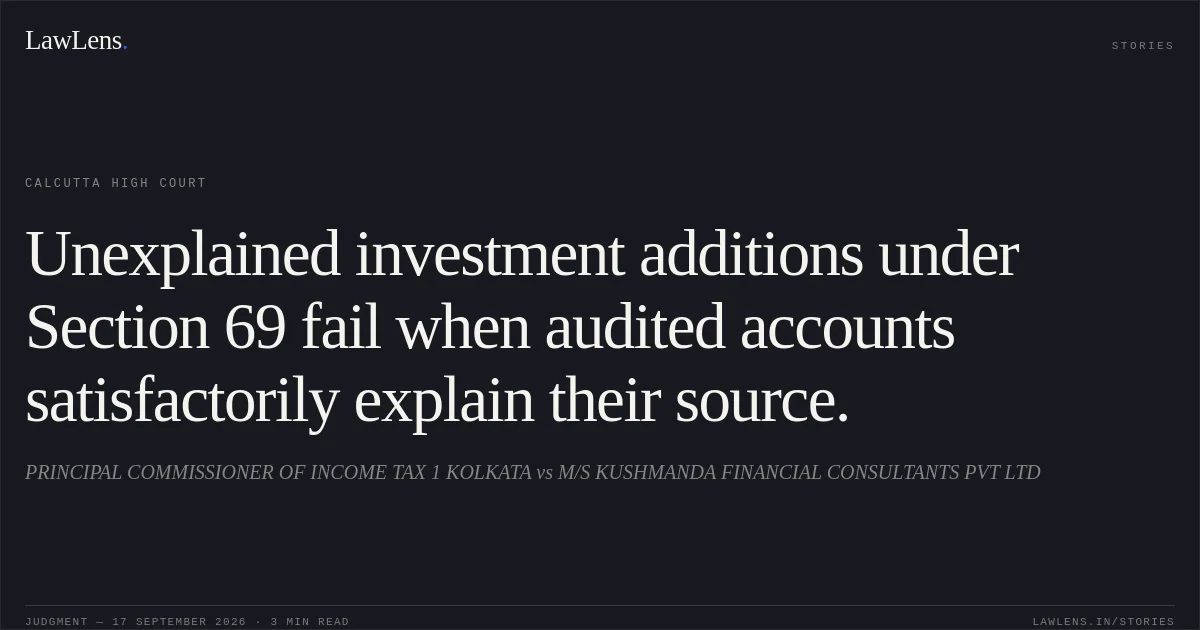
Source reference: pp.5–6Since the transactions were recorded and satisfactorily explained through the financial statements and bank records, the foundational condition for invoking Section 69—an unexplained investment not recorded in the books—was absent.
Source reference: pp.6–7The Revenue’s objections regarding the assessee’s alleged non-filing of documents, non-filer status for the preceding year, CASS selection and the need for further verification essentially challenged the Tribunal’s appreciation of evidence and factual conclusions.
Source reference: pp.7–8The Court found no perversity, illegality or failure of due process in the Tribunal’s approach, particularly because the Tribunal had itself considered the relevant documentary material.
Source reference: pp.7–8Holding
The High Court held that the Revenue’s proposed questions were questions of fact and did not give rise to any substantial question of law.
The Tribunal’s finding that the investments and loans and advances were properly explained was neither perverse nor illegal.
Source reference: pp.7–8Accordingly, the appeal was dismissed, and the connected stay application was also dismissed.
Source reference: p.8There was no order as to costs.
Source reference: p.8Acts & Sections Cited
10 provisions across 1 statute referred to in this judgment. Linked provisions open on LawLens.
Income Tax Act, 1961
Original Court PDF
PRINCIPAL COMMISSIONER OF INCOME TAX 1 KOLKATAvsM/S KUSHMANDA FINANCIAL CONSULTANTS PVT LTD
Click to open original judgment
Original judgment, available to read, download and summarize on LawLens.in