Facts
On May 8, 2008, PW1 (Atul), PW2 (Ashish), and their grandmother (Vimla Devi) were traveling to court regarding the 2005 murder of Atul's father
Source reference: p. 10According to the prompt FIR, five named individuals (Gyan Singh, Punjab Singh, Dilshad, Irshad, and Susheel) intercepted them on two motorcycles and opened fire, killing Vimla Devi and injuring Atul
Source reference: p. 4However, the investigation took a "sudden turn" when PW1 later claimed the assailants were unknown individuals
Source reference: p. 4-5Subsequently, Praveen Balmiki was arrested on May 18, 2008, leading to the implication of Narendra, Amit, and Pappu Gujjar based on alleged confessions and recoveries of firearms
Source reference: p. 5-6The trial court convicted Narendra, Pappu, and Praveen for murder, attempt to murder, and conspiracy in Sessions Trial No. 335 of 2008, while Praveen was additionally convicted under the Arms Act
Source reference: p. 2-3Susheel was acquitted in a separate trial (Sessions Trial No. 335A of 2008)
Source reference: p. 3-4Issues
1. Whether the testimonies of eyewitnesses PW1 and PW2 were reliable given the significant contradictions between the FIR and their court depositions
Source reference: p. 14-162. Whether the conviction under Section 25 of the Arms Act was sustainable in the absence of a proved sanction under Section 39 of the same Act
Source reference: p. 183. Whether the prosecution established a criminal conspiracy under Section 120B IPC against the accused through corroborated evidence
Source reference: p. 18-19Law Applied
The court applied Sections 302 (murder), 307 (attempt to murder), 120B (criminal conspiracy), and 504 (intentional insult) of the Indian Penal Code, 1860
Source reference: p. 2It also examined Section 25 (possession of prohibited arms) and Section 39 (requirement of previous sanction for prosecution) of the Arms Act, 1959
Source reference: p. 3, 18The court relied on the evidentiary principle that a confession made to a police officer is inadmissible and that the prosecution must prove its case beyond a reasonable doubt, particularly regarding the identity of the accused in cases of shifting testimony
Source reference: p. 17-18Reasoning
The court found the prosecution's case fundamentally flawed due to the "wavering statements" of the primary witnesses
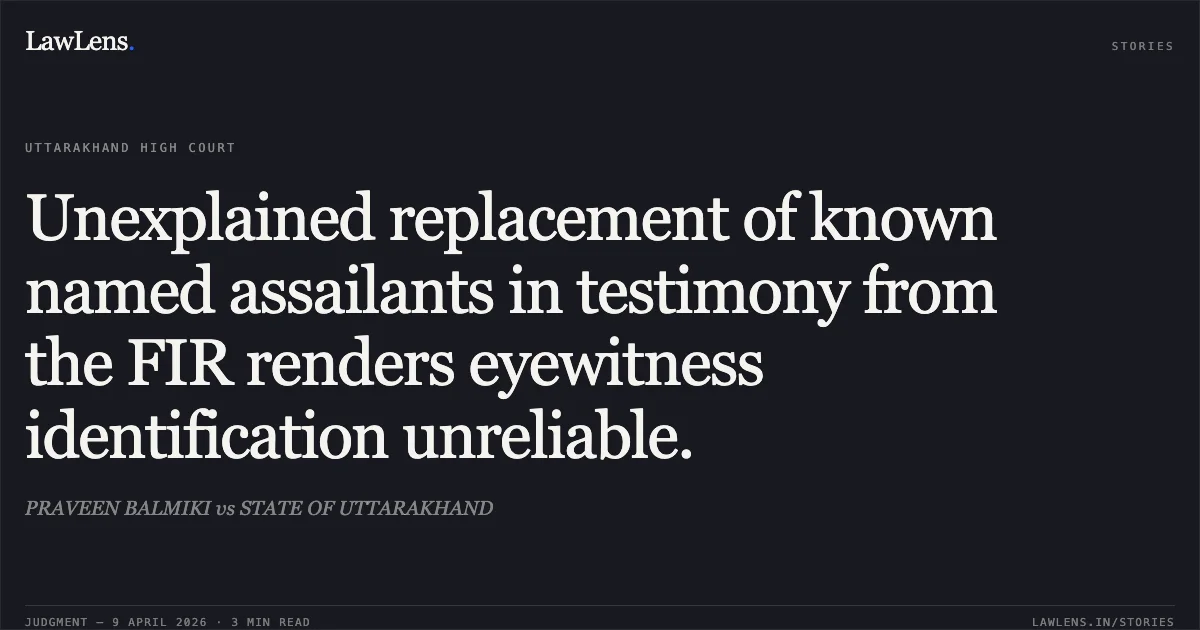
Source reference: p. 14While the FIR named four specific individuals known to the witnesses as their father’s killers, the witnesses later substituted them with the appellants, which the court deemed fatal to the prosecution's credibility
Source reference: p. 14-15The court noted that PW1 admitted the police introduced him to the appellants at the station rather than through a Test Identification Parade (TIP), which violated standard criminal procedure for identifying unknown assailants
Source reference: p. 15-16Furthermore, physical contradictions existed: the FIR cited five assailants on two motorcycles, while the trial testimony cited three assailants on one motorcycle
Source reference: p. 17Regarding the Arms Act, the court held the conviction of Praveen Balmiki legally untenable because the mandatory sanction under Section 39 was never proved
Source reference: p. 18Finally, the conspiracy charge under Section 120B failed as the prosecution produced no electronic evidence or call records to corroborate the alleged telephonic contact between the accused
Source reference: p. 18-19Holding
The High Court allowed Criminal Appeals No. 24, 25, 43, and 44 of 2015, setting aside the convictions of Narendra, Pappu Gujjar, and Praveen Balmiki, and ordering their acquittal on all charges, including the Arms Act violation
The court dismissed Government Appeal No. 53 of 2019, affirming the acquittal of Susheel due to a total lack of evidence
Source reference: p. 19-20The court ordered the immediate release of Praveen Balmiki and discharged the bail bonds of the other appellants
Source reference: p. 20Acts & Sections Cited
12 provisions across 3 statutes referred to in this judgment. Each provision opens on LawLens.
Indian Penal Code, 18608
Arms Act, 19592
Code of Criminal Procedure, 19732
Original Court PDF
PRAVEEN BALMIKIvsSTATE OF UTTARAKHAND
Click to open original judgment
Original judgment, available to read, download and summarize on LawLens.in