Facts
The petitioner, an employee of Punjab State Power Corporation Limited, was posted as Additional Superintending Engineer and was also given additional charge of Additional Superintending Engineer/North Technical.
Source reference: paras. 1–2; pp. 1–3During this period, a complaint was made that Tirath Ram, Junior Engineer, had accepted a bribe of ₹45,000 for providing a commercial electricity connection.
Source reference: paras. 1–2; pp. 1–3During the departmental proceedings, the petitioner was implicated in the matter.
Source reference: paras. 1–2; pp. 1–3A charge-sheet was issued on 3 November 2014, and the disciplinary authority imposed the punishment of demotion to the post of Assistant Executive Engineer for one year by order dated 15 September 2017.
Source reference: paras. 1–2; pp. 1–3The petitioner filed an appeal, which was allowed partly on 19 August 2019 by modifying the punishment to stoppage of one annual grade increment with future effect.
Source reference: paras. 1–2; pp. 1–3His earlier writ petition challenging the charge-sheet and original punishment became infructuous and was dismissed on 19 January 2023, with liberty to challenge the appellate order separately.
Source reference: para. 2; p. 3The petitioner filed the present writ petition on 29 July 2026, after receiving the appellate order on 24 September 2019 and after retiring on 30 September 2025.
Source reference: paras. 3–4, 12–13; pp. 3–4, 14–15Issues
Whether the writ petition challenging the appellate punishment order dated 19 August 2019 was liable to be dismissed on the ground of inordinate and unexplained delay and laches?
Source reference: paras. 4, 7, 12–14; pp. 4–6, 14–15Whether the petitioner’s failure to challenge the appellate order during the pendency of his earlier writ petition, or within a reasonable period after receiving liberty to do so, disentitled him from discretionary relief under Articles 226/227 of the Constitution?
Source reference: para. 13; p. 15Whether the petitioner was entitled to quashing of the disciplinary punishment and consequential service and retiral benefits?
Source reference: paras. 1, 3, 14; pp. 1–4, 15Law Applied
The Court applied the equitable and discretionary nature of writ jurisdiction under Article 226 of the Constitution, under which an unexplained and inordinate delay may disentitle a petitioner to relief where the claim has become stale or intervention would cause prejudice.
Source reference: para. 8; pp. 5–7Relying on Yunus (Baboobhai) A. Hamid Padvekar v. State of Maharashtra, 2009 (2) SCT 24, the Court held that delay and laches are relevant considerations even where a constitutional right is asserted.
Source reference: para. 8; pp. 5–7It further relied on Ram Kumar v. State of Haryana, 2022 (3) SCT 346; New Delhi Municipal Council v. Pan Singh, (2007) 9 SCC 278; Jagdish Lal v. State of Haryana, (1997) 6 SCC 538; Chairman, U.P. Jal Nigam v. Jaswant Singh, (2006) 11 SCC 464; Prem Nath v. State of Punjab, 2018 (2) SCT 687; Tarsem Pal v. Punjab State Power Corporation Limited, 2013 (3) SLR 314; and Senior Divisional Manager, LIC of India v. Shree Lal Meena, (2019) 4 SCC 479, which establish that courts ordinarily do not assist litigants who sleep over their rights, particularly when they approach the court after retirement or after an unexplained prolonged delay.
Source reference: paras. 9–11; pp. 7–14A subsequent judgment or liberty granted in earlier proceedings does not revive a stale claim or excuse failure to approach the court within a reasonable time.
Source reference: paras. 9–10, 13; pp. 7–15Reasoning
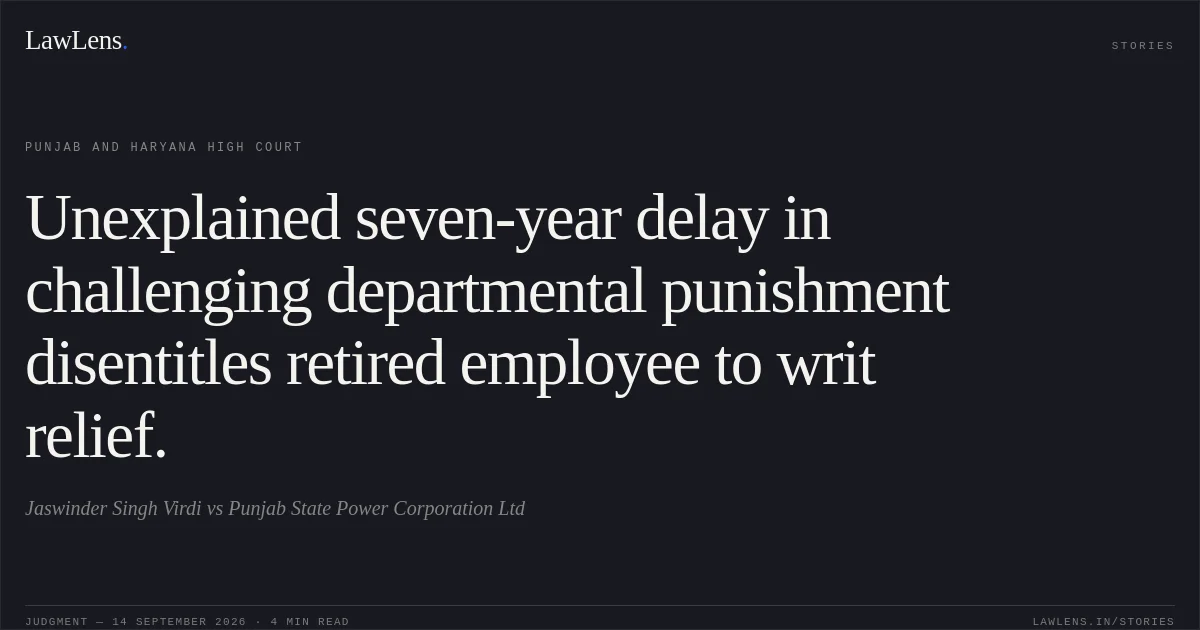
The Court found that the petitioner had received the appellate order on 24 September 2019 but waited nearly seven years to challenge it, without providing a satisfactory explanation.
Source reference: paras. 4, 12; pp. 4, 14The delay was aggravated by the fact that he had already invoked the Court’s jurisdiction in the earlier writ petition and could have amended that petition to challenge the appellate order.
Source reference: para. 13; p. 15Even after the earlier petition was dismissed as infructuous on 19 January 2023 with liberty to file a fresh challenge, he remained inactive for more than three years.
Source reference: para. 13; p. 15Since the petitioner approached the Court only after retirement and sought to reopen a disciplinary matter that had attained finality years earlier, the Court held that the claim was stale and that discretionary writ relief was unavailable.
Source reference: paras. 12–14; pp. 14–15In view of this conclusion, the Court did not find it necessary to examine the merits of the disciplinary findings.
Source reference: paras. 12–14; pp. 14–15Holding
The Court answered the issues against the petitioner and dismissed the writ petition on the ground of inordinate and unexplained delay and laches.
The challenge to the appellate order dated 19 August 2019, and consequently to the modified punishment of stoppage of one annual grade increment with future effect, was rejected.
Source reference: paras. 12–14; pp. 14–15The petitioner was directed to deposit costs of ₹25,000 with the High Court Lawyers Welfare Fund within two months; failing such deposit, the Deputy Commissioner, Hoshiarpur, was directed to recover the amount as arrears of land revenue.
Source reference: para. 14; p. 15Original Court PDF
Jaswinder Singh VirdivsPunjab State Power Corporation Ltd
Click to open original judgment
Original judgment, available to read, download and summarize on LawLens.in
![Similarly situated Laboratory Attendants are entitled to equivalent pay-scale and ACP benefits, subject to eligibility.. Chaman Lall vs Education. CAT - ['Kolkata']. LawLens](/stories/thumbnails/similarly-situated-laboratory-attendants-are-entitled-to-equivalent-pay-scale-and-acp-bene-888ed0be7a204600a029e484ddf5176a.webp)