Facts
Following a search under Section 132 of the Income-tax Act, 1961, the Revenue seized documents and electronic Tally data from the Purushottam Lal Soni Group’s premises.
Source reference: p.5The Assessing Officer relied on that material to add amounts for unexplained cash payments, cash receipts, unsecured loans and commission, and assessed the respondent’s income at approximately Rs.206.95 crore.
Source reference: p.6The CIT(A) confirmed the additions.
Source reference: p.7The ITAT accepted that the additions were based on seized electronic data but directed that the relevant amounts be assessed at a lump-sum rate of 8%, with telescopic benefit to avoid double addition.
Source reference: pp.8–9The Revenue appealed under Section 260A, challenging the 8% estimate and the grant of telescopic benefit.
Source reference: pp.4, 9–10Issues
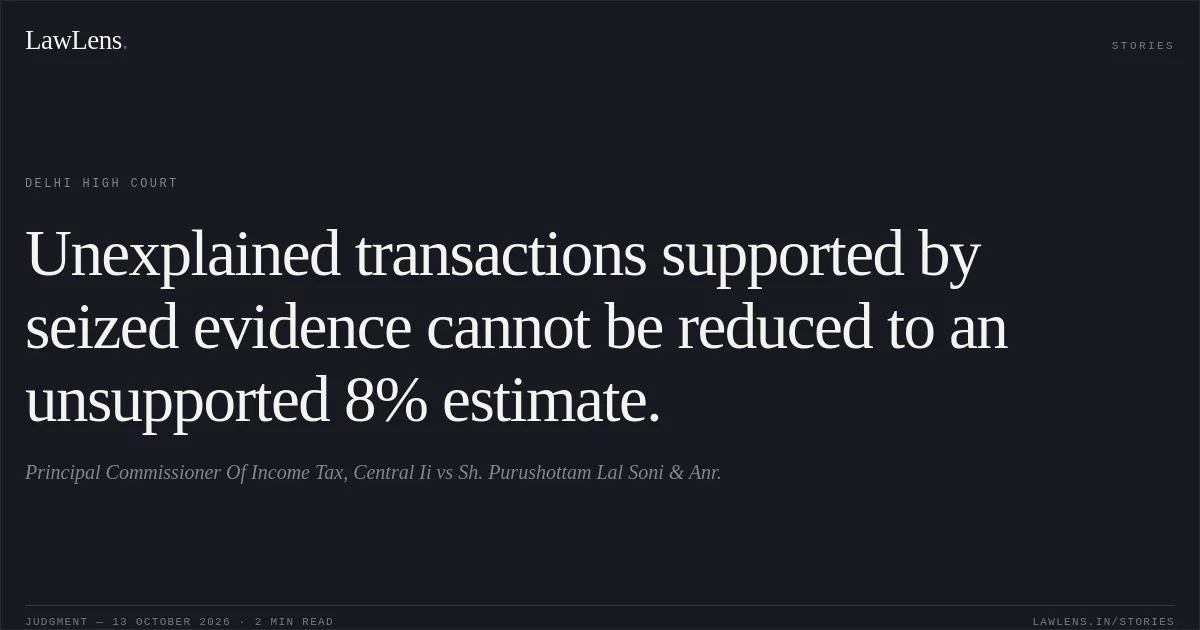
Whether the ITAT was justified in restricting the additions for unexplained cash payments, receipts and credits to a lump-sum rate of 8%, despite upholding that they were based on specific seized material.
Source reference: p.10, para. 5(A)Whether the ITAT could treat the amounts as turnover from an accommodation-entry business and tax only an estimated commission component, notwithstanding the provisions governing unexplained income and credits.
Source reference: p.10, para. 5(B)Whether the ITAT’s 8% estimate was justified in the absence of supporting evidence, comparable instances or other material on record.
Source reference: p.11, para. 5(C)Law Applied
Section 260A of the Income-tax Act provides for appeals to the High Court on substantial questions of law; Section 132 concerns search and seizure; and Section 68 governs unexplained credits.
Source reference: pp.10–12, paras. 5–6The Court’s reasoning was that an ad hoc estimate limiting additions established from seized material requires a legal or evidentiary basis. The judgment cited no precedent or statutory provision authorising the 8% restriction.
Source reference: pp.10–12, paras. 5–6Reasoning
The ITAT had accepted that the unexplained transactions were supported by electronic data seized during the search and that the assessee had not satisfactorily rebutted that material.
Source reference: p.11, para. 6Its conclusion that the assessee appeared to conduct an accommodation-entry business, and that no specific commission rate or comparable instances were available, did not justify substituting an 8% estimate for the unexplained amounts. Because the Tribunal identified no legal, evidentiary or market-practice basis for that rate, the High Court held the restriction to be perverse.
Source reference: pp.11–12, para. 6Holding
The Court answered the Revenue’s questions in the affirmative and allowed the appeals to the extent of setting aside paragraphs 12 and 13 of the ITAT’s order, which imposed the 8% estimate and directed telescopic benefit.
It clarified that the assessee’s separate appeals would be heard independently: if those appeals are allowed, the ITAT’s order is to be remanded in its entirety; if dismissed, the computation is to be made by the authorities in accordance with law.
Source reference: p.12, para. 8Pending applications were disposed of.
Source reference: p.12, para. 7Acts & Sections Cited
10 provisions across 2 statutes referred to in this judgment. Linked provisions open on LawLens.
Income Tax Act, 1961
Indian Evidence Act, 18721
Original Court PDF
Principal Commissioner Of Income Tax, Central IivsSh. Purushottam Lal Soni & Anr.
Click to open original judgment
Original judgment, available to read, download and summarize on LawLens.in


