Facts
The petitioner was issued a Letter of Intent (LOI) on 29.03.2024 by Reliance BP Mobility Limited for a retail petrol outlet.
Source reference: para. 3.1Despite obtaining NOCs from various departments, the District Magistrate (DM), Fatehpur, failed to issue the requisite NOC for over two years.
Source reference: para. 3.2Even after the State issued a simplified policy via Government Order (G.O.) dated 18.12.2025, the DM took no decision.
Source reference: para. 3.3The petitioner filed this writ seeking a mandamus. During proceedings, the Court compelled the DM’s personal appearance.
Source reference: para. 4After the DM's appearance, the DM finally issued the NOC, albeit with conditions regarding building plan sanctions.
Source reference: para. 6The DM attributed the delay to a police report and penalized a clerk with a "censure entry".
Source reference: para. 10Issues
1. Whether the failure of the District Magistrate to issue the 'No Objection Certificate' without reasonable justification for over two years attracts the "doctrine of malice in law" and violates fundamental rights under the Constitution.
Source reference: para. 11 & 132. Whether administrative inaction and "red tapism" constitute an arbitrary exercise of power hit by Articles 14, 19(1)(g), and 21.
Source reference: para. 8, 21, & 22Law Applied
The Court applied the Doctrine of Malice in Law, which denotes a wrongful act done intentionally without just cause or excuse, as established in Ratnagiri Gas and Power Pvt. Ltd. v. RDS Projects Ltd. and West Bengal State Electricity Board v. Dilip Kumar Ray.
Source reference: para. 18 & 19It invoked the Doctrine of the Golden Triangle, holding that Articles 14, 19, and 21 are interrelated; specifically, Article 14 strikes at arbitrariness as established in E.P. Royappa v. State of Tamil Nadu and Maneka Gandhi v. Union of India.
Source reference: para. 20 & 21Rights under Article 19(1)(g) (trade/business) and Article 21 (dignity/livelihood) are infringed when state action is guided by extraneous considerations or unexplained delay.
Source reference: para. 21-22Reasoning
The Court reasoned that the DM provided no "plausible explanation" for a two-year delay in a process meant to be simplified by G.O.s.
Source reference: para. 11It held that such inaction is not merely a procedural lapse but "malice in law," as the authority acted in disregard of the statutory scheme.
Source reference: para. 14, 16The Court rejected the DM’s attempt to scapegoat a "petty clerk," holding the office of the DM responsible for the "apathetic attitude" and "red tapism".
Source reference: para. 7, 14By failing to act, the State arbitrarily impeded the petitioner’s right to carry on trade under Article 19(1)(g), which consequently affected his right to live with dignity under Article 21.
Source reference: para. 22The Court found that "equality and arbitrariness are sworn enemies," and the DM’s whim-based delay violated the spirit of Article 14.
Source reference: para. 20, 23Holding
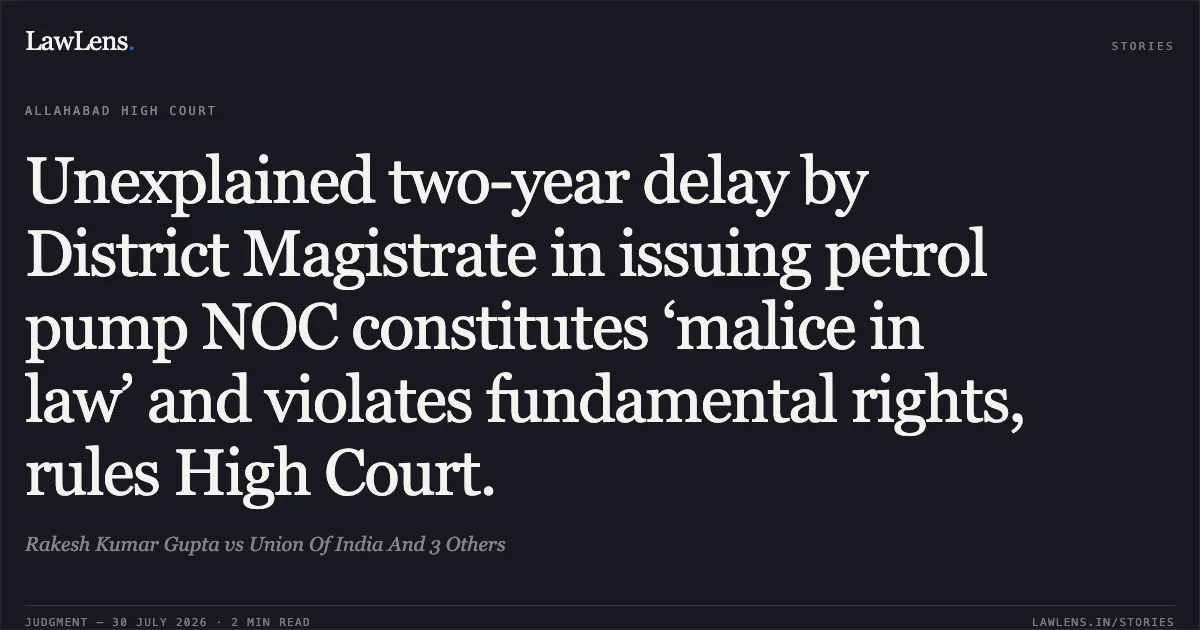
The Court held that the unexplained delay constituted malice in law and arbitrariness.
The Court disposed of the petition with directions to the Oil Company to proceed expeditiously with the LOI dated 29.03.2024 and issued a stern warning to the District Magistrate to act with promptitude in the future.
Source reference: para. 26, 27-28Original Court PDF
Rakesh Kumar GuptavsUnion Of India And 3 Others
Click to open original judgment
Original judgment, available to read, download and summarize on LawLens.in