01Facts
The testator, Akhilesh Kumar Sinha, allegedly executed a Will on December 24, 1987, appointing Sant Agarwal as the executor.
¶ 8-9Following the testator's death, the propounder filed an application for probate, which was contested by the testator's son (the Respondent/Caveator).
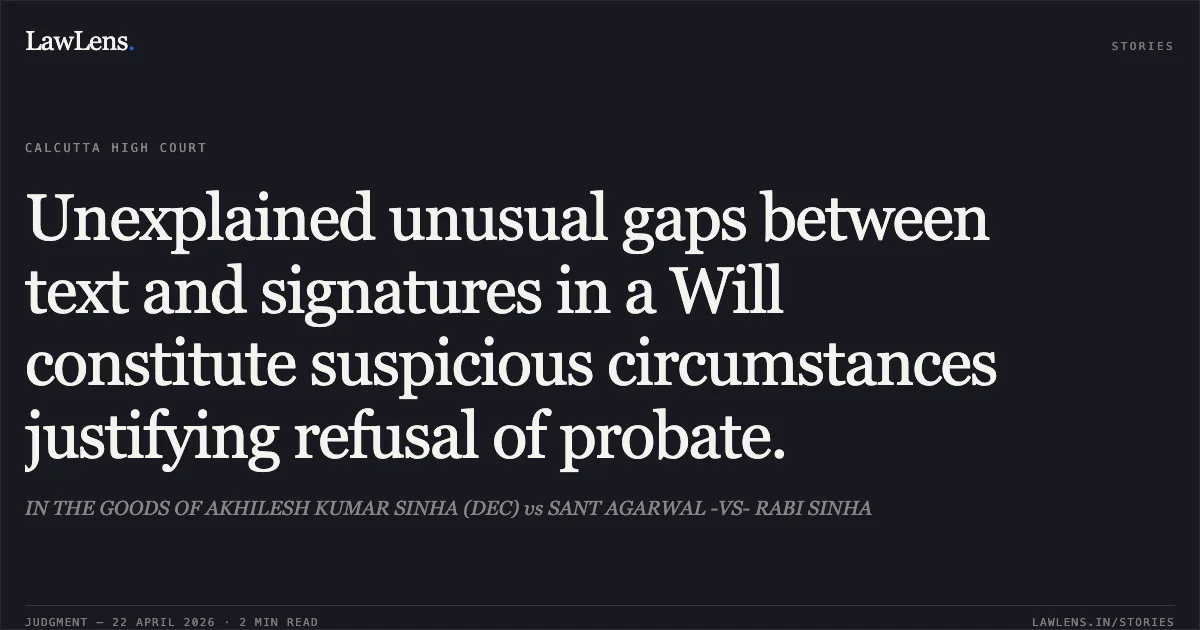
¶ 8-9The Caveator alleged that the Will was fraudulent, as the testator’s signatures were obtained on blank papers and later converted into a Will, evident from the unusual gaps between the text and signatures.
¶ 10On May 18, 2023, the learned Single Judge of the High Court dismissed the probate application on the grounds of unresolved suspicious circumstances.
¶ 1-2The appellant (propounder) challenged this dismissal before the Division Bench, arguing that the Trial Court misapplied Section 63 of the Indian Succession Act, 1925.
¶ 302Issues
i.1. Whether the Will dated December 24, 1987, was validly executed in accordance with the requirements of the Indian Succession Act.
¶ 12, Issue 2ii.2. Whether the signatures of the testator were obtained on blank papers and subsequently converted into a Will under fraudulent circumstances.
¶ 12, Issue 3 & 4iii.3. Whether the propounder successfully discharged the burden of proof to remove the suspicious circumstances surrounding the execution of the Will.
¶ 2, 2103Law Applied
Section 63 of the Indian Succession Act, 1925, which mandates the formal requirements for the execution of unprivileged Wills.
¶ 18Section 63(b) requires that the testator's signature be placed in such a manner as to indicate an intention to give effect to the writing as a Will.
¶ 18, 20The established principle that the burden of proof lies on the propounder to remove all "suspicious circumstances" surrounding the execution of a Will to satisfy the conscience of the Court before probate can be granted.
¶ 2Provisions in the judgment · 1 · Linked ones open on LawLens
Indian Succession Act, 1925 Section 63
04Reasoning
The Court observed several irreconcilable suspicious circumstances that the propounder failed to explain. First, there was an "unusual gap" between the typed text and the testator’s signature on the first page, and the last page contained a signature with no text, supporting the Caveator's claim that signatures were obtained on blank papers.
¶ 14, 20Second, there were material contradictions between the testimony of P.W.1 (attesting witness) and P.W.2 (executor) regarding who typed the Will and who was present during the execution.
¶ 15Third, the court noted conflicting evidence regarding the location of execution; one attesting witness’s affidavit cited 48, Vivekananda Road, while the other witness testified the execution occurred at Salt Lake.
¶ 16The court held that under Section 63(b), the placement of signatures must clearly manifest the testator's intent to validate the specific text; the physical anomalies in this document failed this test.
¶ 20-2105Holding
The Court answered the issues in the negative, holding that the propounder failed to clear the clouds of suspicion surrounding the execution of the Will.
¶ 2, 21The High Court affirmed that the probate was rightly refused because the evidence did not satisfy the court's conscience that the testator intended to give effect to the writings in the document. The appeal (APD/3/2024) was dismissed without costs, and the Trial Court's judgment was upheld.
¶ 21-22, 23Original Court PDF
IN THE GOODS OF AKHILESH KUMAR SINHA (DEC)vsSANT AGARWAL -VS- RABI SINHA
Click to open original judgment
Original judgment, available to read, download and summarize on LawLens.in