Facts
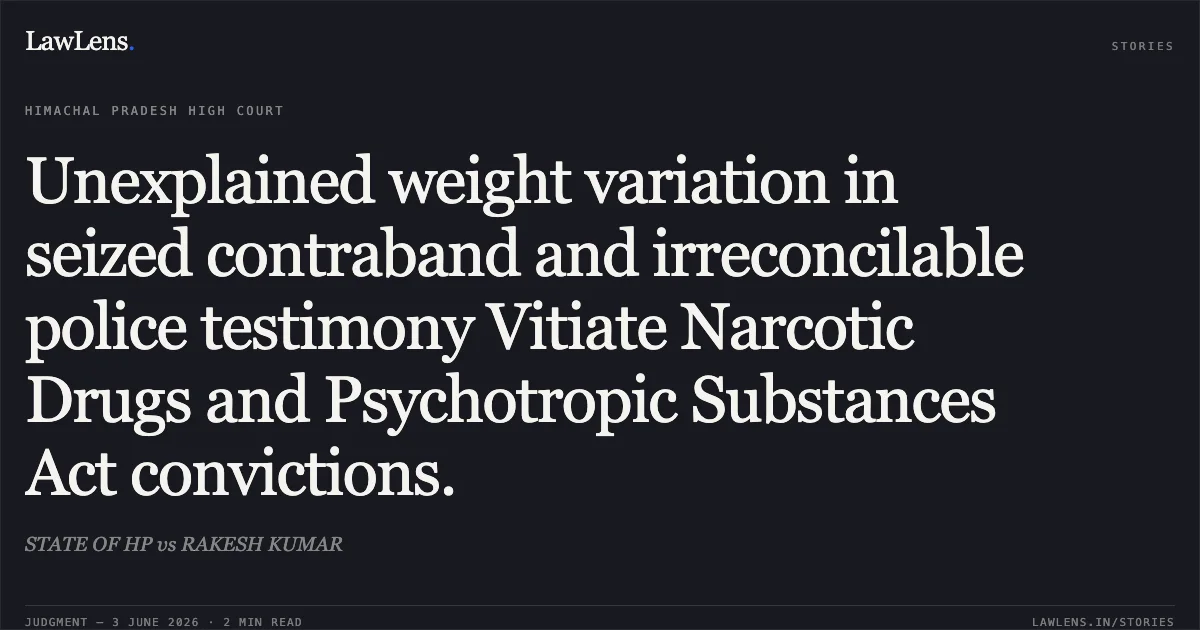
The State appealed against a Trial Court judgment dated 21.12.2013, which acquitted the respondents of charges under Section 20 of the NDPS Act.
Source reference: p. 1The prosecution alleged that on 09.10.2009, acting on information obtained during the interrogation of another accused (Rajesh Kumar), a police party set up a Nakka near Ochhghat.
Source reference: p. 2-3They intercepted a motorcycle, and while the driver (Respondent No. 2) fled, the pillion rider (Respondent No. 1) was apprehended with a bag containing 3.800 kg of Charas.
Source reference: p. 3-4However, the State Forensic Science Laboratory (SFSL) recorded the weight of the contraband as 3.500 kg.
Source reference: p. 5The Trial Court acquitted the accused based on material contradictions in the testimony of official witnesses and the hostility of independent witnesses.
Source reference: p. 6Issues
1. Whether the significant discrepancy in the weight of the recovered contraband (3.800 kg vs. 3.500 kg) creates reasonable doubt regarding the identity of the property sent to the SFSL.
Source reference: p. 5 / para. 152. Whether the irreconcilable contradictions in the testimonies of official witnesses regarding their arrival, the vehicle used, and the topography of the crime scene undermine the prosecution's case.
Source reference: p. 8-12 / para. 21-313. Whether the State provided sufficient evidence to overturn the presumption of innocence reinforced by the Trial Court's acquittal.
Source reference: p. 13 / para. 33-34Law Applied
Section 20 of the Narcotic Drugs and Psychotropic Substances (NDPS) Act, 1985, which penalizes the possession of contraband.
Source reference: p. 1The principle of "proof beyond reasonable doubt" in criminal jurisprudence, particularly emphasizing that in appeals against acquittal, the presumption of innocence is further strengthened.
Source reference: p. 13Section 42(2) of the NDPS Act regarding the transmission of recorded information to superior officers.
Source reference: p. 2Reasoning
The Court found the prosecution's case fundamentally flawed due to "irreconcilable" discrepancies. First, the 300-gram difference between the weight recorded at the time of seizure (3.800 kg) and the weight recorded by the SFSL (3.500 kg) was deemed too significant to ignore, raising doubts about whether the sample analyzed actually belonged to the accused.
Source reference: p. 5, 13The testimonies of PW-3, PW-9, PW-11, and PW-15 were riddled with contradictions regarding how they reached Solan (together by bus vs. alone), the timing of their arrival, and the type of official vehicle used (Maruti 800 vs. Gypsy).
Source reference: p. 7-9The court noted that the two independent witnesses (PW-1 and PW-14) turned hostile, denying that any recovery took place in their presence and claiming their signatures were obtained on pre-written documents at different locations.
Source reference: p. 10-11The varying descriptions of the crime scene—specifically the existence of a petrol pump and shops—further weakened the credibility of the official witnesses.
Source reference: p. 11-12Holding
The High Court held that the State "miserably failed" to prove its case beyond reasonable doubt due to the lack of cogent and reliable evidence.
The High Court dismissed the State's appeal, affirming the Trial Court's judgment of acquittal; the bail and surety bonds of the respondents were discharged, and the record was ordered to be returned.
Source reference: p. 13-14Acts & Sections Cited
4 provisions across 2 statutes referred to in this judgment. Each provision opens on LawLens.
Narcotic Drugs and Psychotropic Substances Act, 19852
Code of Criminal Procedure, 19732
Original Court PDF
STATE OF HPvsRAKESH KUMAR
Click to open original judgment
Original judgment, available to read, download and summarize on LawLens.in


