Facts
The petitioner, a Scheduled Caste candidate, applied pursuant to the advertisement dated 18 December 2015 for recruitment to 15,000 posts of Assistant Teachers in Uttar Pradesh Basic Shiksha Parishad schools.
Source reference: pp.1–3Of the 200 posts allotted to District Firozabad, four posts reserved for Scheduled Tribes remained unfilled due to the non-availability of eligible Scheduled Tribe candidates.
Source reference: pp.1–3The petitioner participated in counselling on 24 June 2016 but was not selected; his quality-point marks were 66.78, whereas the last selected Scheduled Caste candidate had secured 69.58 marks.
Source reference: p.2After obtaining information under the Right to Information Act in February 2019, the petitioner sought consideration against the four unfilled Scheduled Tribe vacancies under Section 3(3) of the Uttar Pradesh Public Services (Reservation for Scheduled Castes, Scheduled Tribes and Other Backward Classes) Act, 1994.
Source reference: pp.2–5Pursuant to an order in an earlier writ petition, the Secretary, U.P. Basic Shiksha Parishad, rejected the petitioner’s claim on 06 December 2019, followed by the District Basic Education Officer’s order dated 07 December 2019.
Source reference: p.5Issues
1. Whether an unfilled vacancy reserved for a Scheduled Tribe candidate could, subject to the statutory conditions, be filled by a suitable Scheduled Caste candidate under Section 3(3) of the 1994 Act.
Source reference: pp.11–132. Whether the petitioner could claim appointment against the four unfilled Scheduled Tribe vacancies after expiry of the one-year validity period of the select list under Rule 17-A(2) of the U.P. Basic Education (Teachers) Service Rules, 1981.
Source reference: pp.12–163. Whether the petitioner was entitled to parity on the basis of appointments allegedly granted to similarly situated Scheduled Caste candidates in another district.
Source reference: p.15Law Applied
The Court applied Section 3(3) of the Uttar Pradesh Public Services (Reservation for Scheduled Castes, Scheduled Tribes and Other Backward Classes) Act, 1994, as amended, which permits an unfilled Scheduled Tribe vacancy to be dealt with through the prescribed statutory mechanism, including consideration of a suitable Scheduled Caste candidate, subject to the applicable conditions, recruitment process and roster.
Source reference: pp.7–12The Court also applied Rule 17-A(2) of the U.P. Basic Education (Teachers) Service Rules, 1981, under which the select list remains valid for only one year from its preparation.
Source reference: pp.7, 13–14It relied on B.N. Tewari v. Union of India, AIR 1965 SC 1430, for recognition of the historical SC–ST interchange principle, while distinguishing it from an automatic right to appointment; and referred to M.R. Balaji v. State of Mysore, T. Devadasan v. Union of India, Indra Sawhney v. Union of India, State of U.P. v. Sangam Nath Pandey, Upendra v. State of U.P., and Ram Chandra v. State of U.P. regarding reservation, carry-forward vacancies, roster operation and backlog vacancies.
Source reference: pp.8–11The governing principle was that statutory interchange does not amount to de-reservation and cannot revive an expired select list or create an indefeasible right to appointment.
Source reference: pp.11–16Reasoning
The Court held that the respondents could not treat an unfilled Scheduled Tribe vacancy as absolutely incapable of being considered for a Scheduled Caste candidate; Section 3(3) required examination of the statutory mechanism, eligibility, suitability and roster requirements.
Source reference: pp.11–13However, that statutory possibility did not confer an automatic or vested right upon the petitioner.
Source reference: pp.13–16Since the petitioner’s claim was raised after the select list had exhausted its statutory one-year life under Rule 17-A(2), the continued existence of the four vacancies could not preserve or revive his entitlement.
Source reference: pp.13–16The Court emphasised that a vacancy does not, by itself, create an enforceable right to appointment, and judicial review cannot be used to extend the validity of a select list contrary to the service rules.
Source reference: p.14The alleged appointments in District Hathras did not establish a legal entitlement because parity requires identical facts and a subsisting legal right; an allegedly erroneous benefit granted to another candidate cannot justify a direction contrary to the governing rules.
Source reference: p.15Holding
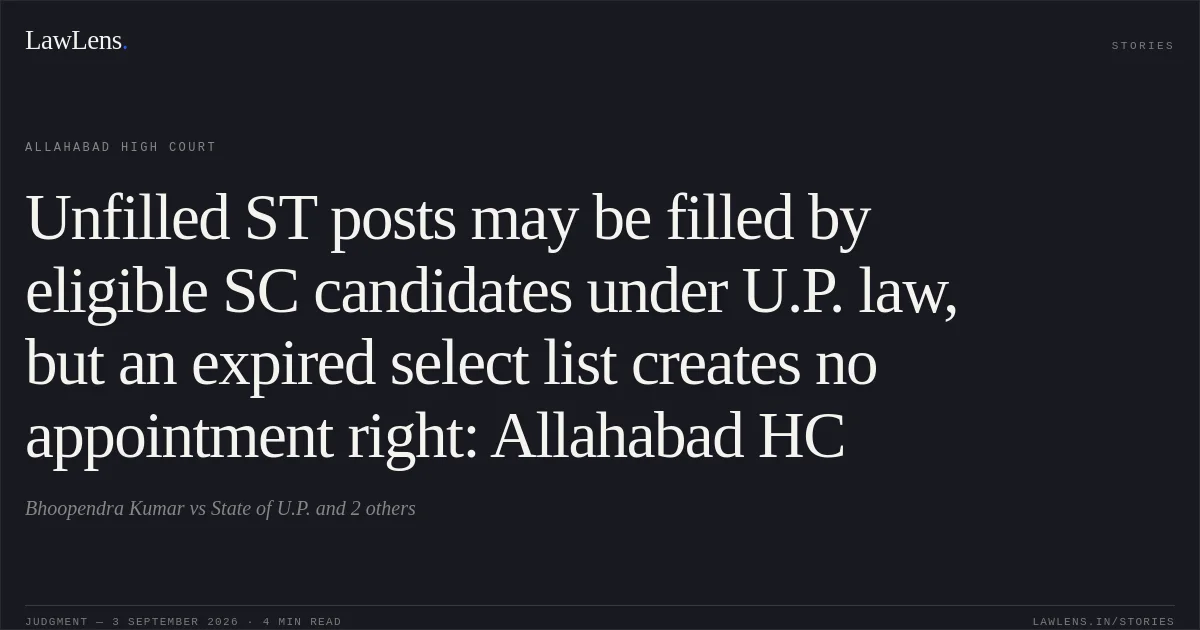
The Court answered the first issue by holding that an unfilled Scheduled Tribe vacancy may, where the statutory conditions are satisfied, be dealt with in favour of a suitable Scheduled Caste candidate under Section 3(3) of the 1994 Act; it is not automatically dereserved or converted into a general vacancy.
Nevertheless, the petitioner had no enforceable right to appointment because the select list arising from the 2015 recruitment had expired under Rule 17-A(2).
Source reference: pp.13–16The challenge to the orders dated 06 December 2019 and 07 December 2019 was therefore rejected, and the writ petition was dismissed.
Source reference: p.16The Court left it open to the competent authority to deal with the unfilled reserved vacancies in accordance with the Reservation Act, applicable roster and recruitment rules governing any subsequent recruitment.
Source reference: p.16Acts & Sections Cited
1 provisions across 1 statute referred to in this judgment. Linked provisions open on LawLens.
U.P. Public Services (Reservation For Scheduled Castes, Scheduled Tribes And Other Backward Classes) Act, 19941
Original Court PDF
Bhoopendra KumarvsState of U.P. and 2 others
Click to open original judgment
Original judgment, available to read, download and summarize on LawLens.in