01Facts
The petitioners, the widow and children of Late K.J. Sivaraman, instituted O.S. No.137 of 2020 before the District Munsif Court, Kumarapalayam, seeking a declaration that the unilateral Deed of Revocation of Settlement dated 10.02.2009, Document No.626 of 2009, was null, void and not binding upon them, along with a permanent injunction concerning the suit property.
¶ 2.1–2.2 · pp. 2–3The property had originally been settled by Sivaraman’s parents in his favour under a registered Settlement Deed dated 28.11.2005. Although the parents later executed a unilateral revocation, Sivaraman allegedly acted upon the original settlement, constructed a building, obtained and discharged a mortgage, and subsequently settled the property in favour of the first petitioner on 20.04.2010.
¶ 2.2–2.3 · pp. 2–3After Sivaraman’s death on 23.08.2017, the first petitioner applied for an Encumbrance Certificate on 20.09.2017 and claimed that she then first discovered the 2009 Revocation Deed.
¶ 2.4 · p. 4The defendants sought rejection of the plaint under Order VII Rule 11 CPC, contending that the suit was barred by limitation because the revocation had been registered in 2009.
¶ 2.5 · p. 5The Trial Court dismissed the application on 28.03.2023. In CRP No.1465 of 2023, the High Court, exercising jurisdiction under Article 227 of the Constitution, allowed the revision and directed rejection of the plaint on 12.02.2024. The present Review Application was filed under Section 114 read with Order XLVII Rule 1 CPC.
¶ 2.6, 3 · pp. 5–602Issues
i.Whether the order allowing the revision under Article 227 and directing rejection of the plaint disclosed an error apparent on the face of the record warranting review under Section 114 read with Order XLVII Rule 1 CPC.
¶ 11–16 · pp. 9–12ii.Whether the revision against the Trial Court’s order refusing rejection of the plaint ought to have been filed under Section 115 CPC rather than under Article 227 of the Constitution.
¶ 14–16 · pp. 10–12iii.Whether the plaint could be rejected at the threshold on the ground of limitation when the pleadings asserted that the plaintiffs first acquired knowledge of the Revocation Deed in 2017 and material factual disputes existed regarding the Release Deed and the parties’ conduct.
¶ 18–25 · pp. 13–16iv.Whether the registered unilateral revocation of the Settlement Deed, in the absence of a contractual power of revocation, could be conclusively treated as valid at the stage of considering an application under Order VII Rule 11 CPC.
¶ 21–22 · pp. 14–1503Law Applied
Section 114 read with Order XLVII Rule 1 CPC permits review for, inter alia, a patent error or error apparent on the face of the record; review is not an appellate rehearing and cannot be used merely to substitute another possible view.
¶ 11–12 · pp. 9–10Section 115 CPC provides the statutory revisional remedy where the challenged interlocutory order, if reversed, would finally dispose of the suit; an order concerning rejection of a plaint therefore falls within the proviso to Section 115(1) CPC.
¶ 15–16 · pp. 10–12Article 58 of the Limitation Act prescribes three years for a declaratory suit from the date when the right to sue first accrues, while Section 3 of the Transfer of Property Act embodies the principle of constructive notice arising in appropriate cases from registration and circumstances discoverable by due diligence.
¶ 8–9, 23–24 · pp. 7–8, 15–16At the Order VII Rule 11 stage, the plaint and documents relied upon by the plaintiff must generally be read as they stand; disputed questions of fact, including knowledge, suppression, the effect of subsequent transactions, and the validity of a revocation, ordinarily require adjudication at trial.
¶ 20–26 · pp. 13–17The Court also referred to State of Telangana v. Mohd. Abdul Qasim, S. Madhusudhan Reddy v. V. Narayana Reddy, Shri Mukund Bhavan Trust v. Shrimant Chhatrapati Udayan Raje Pratapsinh Maharaj Bhonsle, Dahiben v. Arvindbhai Kalyanji Bhanusali and Ramisetty Venkatanna v. Nasyam Jamal Saheb on the limits of review, limitation, and constructive notice.
¶ 7–9 · pp. 7–8Provisions in the judgment · 5 · Linked ones open on LawLens
Code of Civil Procedure, 1908 Section 114Section 115
Limitation Act, 1963 Section 58Section 59
Transfer of Property Act, 1882 Section 3
04Reasoning
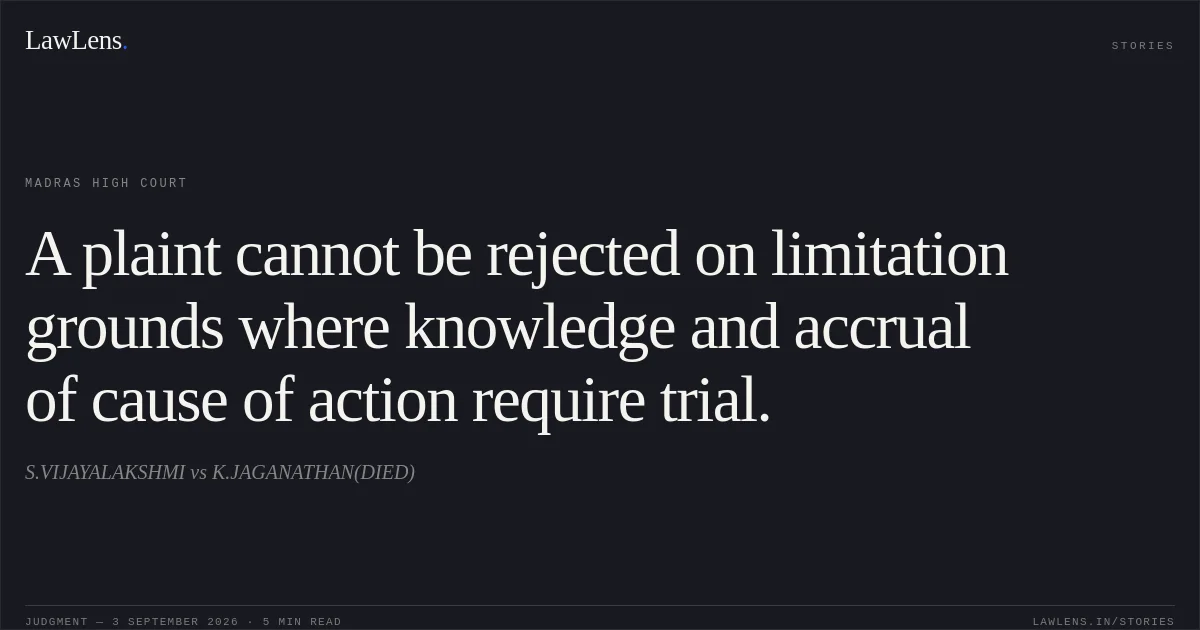
The Court held that the earlier order contained a manifest jurisdictional error because the revision petition challenged an order which, if reversed, would have resulted in final disposal of the suit; consequently, the appropriate remedy was under Section 115 CPC and not Article 227 of the Constitution.
¶ 14–16 · pp. 10–12The Court further found that the earlier decision had improperly relied upon the Release Deed dated 25.01.2010, although that document was not pleaded by the plaintiffs, was introduced by the defendants, and did not specifically identify the suit property.
¶ 18–21 · pp. 13–15Whether the Release Deed covered the suit property, and how Sivaraman could thereafter execute a Settlement Deed in favour of the first petitioner, were factual matters incapable of determination at the plaint-rejection stage.
¶ 18–21 · pp. 13–15Although registration may, in suitable circumstances, constitute constructive notice, the plaint specifically pleaded that the first petitioner discovered the Revocation Deed only upon obtaining the Encumbrance Certificate on 20.09.2017.
¶ 23–25 · pp. 15–16That assertion had to be accepted for the limited purpose of deciding the Order VII Rule 11 application, particularly since the original Settlement Deed had allegedly been acted upon and Sivaraman later executed another registered settlement in favour of the first petitioner.
¶ 23–25 · pp. 15–16The unilateral revocation, moreover, was executed without an express clause reserving a power of cancellation in the original Settlement Deed. Its legal validity and effect therefore raised triable issues and could not justify rejection of the plaint without evidence.
¶ 22 · p. 1505Holding
The Review Application was allowed.
¶ 25, 28 · pp. 16–17The High Court held that the order dated 12.02.2024 in CRP No.1465 of 2023 suffered from a manifest error, both in the exercise of Article 227 jurisdiction and in rejecting the plaint by deciding disputed factual and limitation issues at the threshold.
¶ 25, 28 · pp. 16–17The order allowing the Civil Revision Petition was set aside, and the Trial Court’s order dated 28.03.2023 dismissing the application for rejection of the plaint in I.A. No.1 of 2021 in O.S. No.137 of 2020 was restored. No costs were awarded.
¶ 28 · p. 17Original Court PDF
S.VIJAYALAKSHMIvsK.JAGANATHAN(DIED)
Click to open original judgment
Original judgment, available to read, download and summarize on LawLens.in