01Facts
The workmen of Hotel Sofitel Surya, represented by the Hotel Mazdoor Union, submitted a Charter of Demands on 26.03.1992 seeking revision of pay scales, allowances and service benefits on the ground that their conditions were inferior to those prevailing in comparable five-star hotels in Delhi.
¶ 2–4 · pp. 2–3Upon failure of conciliation, the dispute was referred to Industrial Tribunal-III, Delhi, under the Industrial Disputes Act, 1947, on 08.01.1993.
¶ 4 · p. 3The Tribunal framed issues concerning espousal, maintainability in view of any settlement, and the workmen’s entitlement under the reference.
¶ 24–25 · pp. 10–11The workmen relied principally on settlements entered into with other hotels, while the Management relied on its audited financial statements, existing wage revisions and benefits, and evidence concerning its financial condition.
¶ 6 · p. 3By Award dated 01.08.2002, the Tribunal held that the dispute had been validly espoused and directed revision of wages, allowances and service benefits by reference to those prevailing in the “nearest Five Star Hotel”; certain benefits were made operative from the date of the Award and salary and allowances were directed to be paid from 01.01.2003.
¶ 7, 28 · pp. 4, 11–12The workmen challenged the prospective effective date, while the Management challenged the substantive entitlement and the ambiguity of the Award.
¶ 8 · p. 402Issues
i.Whether the Tribunal’s finding that the industrial dispute had been validly espoused warranted interference under Articles 226 and 227 of the Constitution?
¶ 19, 26 · pp. 7–8, 10–11ii.Whether the workmen had established a continuing disparity in wages, allowances and service conditions, after accounting for revisions already granted by the Management, by comparison with a properly comparable hotel?
¶ 29–32 · pp. 12–14iii.Whether the Tribunal could direct payment of wages and benefits prevailing in the “nearest Five Star Hotel” without identifying the comparator, corresponding categories and applicable wage and service conditions?
¶ 38–40 · pp. 17–19iv.Whether the Tribunal had adequately assessed the Management’s financial capacity and the additional burden imposed by the Award?
¶ 42 · pp. 19–20v.Whether the workmen were entitled to retrospective operation of the Award from 26.03.1992, or alternatively from 08.01.1993, instead of 01.01.2003?
¶ 9–13, 48 · pp. 5–6, 2203Law Applied
The Court applied the supervisory jurisdiction under Articles 226 and 227 of the Constitution, holding that a writ court does not ordinarily re-appreciate evidence or substitute its factual conclusions for those of an Industrial Tribunal, but may interfere where material evidence is ignored, the relevant inquiry is not undertaken, an erroneous legal principle is applied, or relief lacks an evidentiary foundation.
¶ 21–23 · pp. 8–10Under the industry-cum-region principle stated in Kamani Metals & Alloys Ltd. v. Their Workmen, (1967) 2 SCR 463, wage fixation requires comparison with workers of similar grade and skill in comparable establishments in the region, together with consideration of the employer’s capacity to pay; dissimilar establishments cannot be treated as comparators without accounting for relevant differences.
¶ 34 · p. 14The Court also relied on Syed Yakoob v. K.S. Radhakrishnan, AIR 1964 SC 477, and Indian Overseas Bank v. I.O.B. Staff Canteen Workers’ Union, (2000) 4 SCC 245, for the limited scope of certiorari and supervisory review.
¶ 22–23 · pp. 9–10The governing rule was that a claim for comparative wage revision must be supported by evidence identifying a proper comparator, establishing the corresponding wages and benefits, demonstrating the residual disparity after considering existing revisions, and specifying the relief justified under each head.
¶ 31–39 · pp. 13–18Provisions in the judgment · 1
Industrial Disputes Act, 1947 Section 36A
04Reasoning
The Court upheld the Tribunal’s finding on espousal because it was based on evidence and disclosed no jurisdictional or legal infirmity warranting supervisory interference.
¶ 26 · pp. 10–11However, the substantive Award could not be sustained. The workmen had accepted successive wage revisions granted in 1992, 1994 and 1995, and one witness admitted that the scale demanded was lower than the scale actually being received; therefore, the relevant inquiry had to concern any continuing disparity after those revisions.
¶ 30–31 · pp. 13–14The settlements concerning other hotels merely proved the terms agreed in those establishments and did not establish entitlement at Sofitel Surya. The workmen failed to provide reliable particulars of corresponding categories, pay, D.A., H.R.A. and other benefits, or to establish any particular hotel as a proper comparator.
¶ 33–36 · pp. 14–16The direction to follow the benefits of the “nearest Five Star Hotel” was also legally deficient because geographical proximity did not establish comparability, and the Award did not identify the hotel, categories, wage components or applicable conditions.
¶ 38–40 · pp. 17–19Determining those matters at the implementation stage would require a fresh adjudication of entitlement rather than a ministerial calculation.
¶ 40, 44 · p. 19, 21Further, the Tribunal granted relief under several heads without recording corresponding factual findings or explaining the extent of entitlement under each head.
¶ 41 · p. 19Its finding that the Management had sufficient financial capacity was not reconciled with admitted losses during the relevant period and did not assess the additional burden created by the Award.
¶ 42 · pp. 19–20Since the substantive entitlement itself had not been established, the challenge to the effective date became academic.
¶ 48 · p. 2205Holding
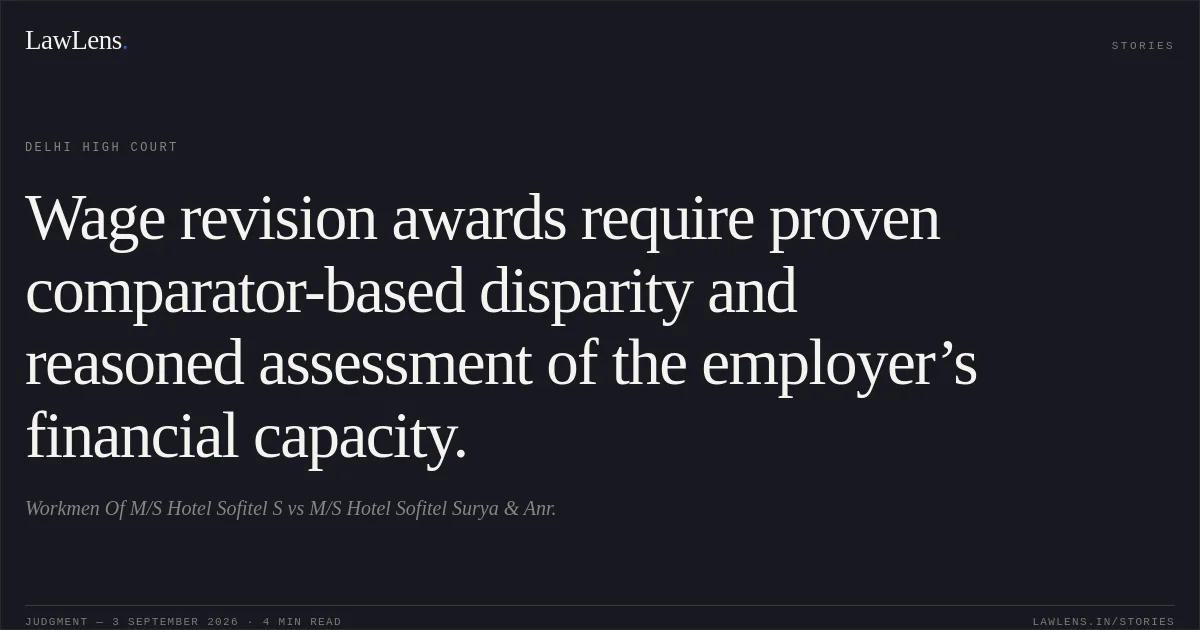
The High Court set aside the Award dated 01.08.2002 because the Tribunal had granted further wage revisions and service benefits without sufficient comparative evidence, without identifying a proper comparator, without determining any residual disparity after existing revisions, and without adequately assessing the Management’s financial capacity.
¶ 43–46 · pp. 20–22The finding of valid espousal was affirmed, but the workmen’s substantive claims were not upheld.
¶ 45 · p. 21W.P.(C) No. 3734/2003 filed by the Management was allowed, while W.P.(C) No. 200/2003 filed by the workmen was disposed of as the issue of the effective date no longer survived.
¶ 46–48 · p. 22Existing wage revisions or benefits independently granted by the Management were left unaffected; the interim order stood disposed of and there was no order as to costs.
¶ 49–51 · pp. 22–23Original Court PDF
Workmen Of M/S Hotel Sofitel SvsM/S Hotel Sofitel Surya & Anr.
Click to open original judgment
Original judgment, available to read, download and summarize on LawLens.in